
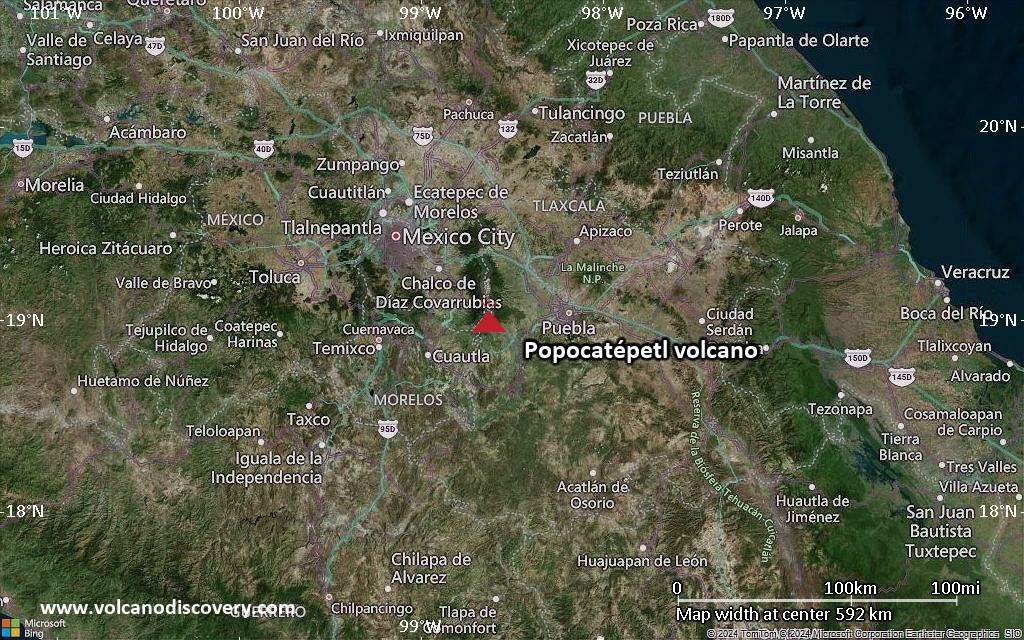
Popocatépetl volcano in central Mexico continues to exhibit explosive activity, prompting ongoing volcanic ash advisories issued throughout Sunday, February 22, 2026. The Washington Volcanic Ash Advisory Center (VAAC) reported ash plumes reaching altitudes of up to 22,000 feet (6,700 meters) as of this afternoon, according to VolcanoDiscovery.com.
Earlier in the day, the VAAC issued multiple advisories detailing continued explosive activity and ash plumes rising to 20,000 feet (6,100 meters). The ash is drifting northeast and southeast, posing a potential hazard to aviation. The alerts, categorized as “CONT VA EMS PSBL” and “ONGOING VA EMS,” indicate a continuing, potentially significant volcanic ash event.
Seismic monitoring data, as reported by Mexico’s Centro Nacional de Prevención de Desastres (CENAPRED) during the period of January 21-28, 2026, shows 12 to 37 long-period events recorded daily, accompanied by consistent steam and gas emissions. Tremor activity was also detected, with 15 to 36 minutes recorded daily between January 22 and 24. These seismic signals are indicative of ongoing magma movement within the volcano.
Popocatépetl, whose name means “Smoking Mountain” in the Aztec language, is the second-highest volcano in North America, located 70 kilometers (approximately 43 miles) southeast of Mexico City. The stratovolcano contains a steep-walled crater measuring 400 by 600 meters. The volcano’s eruptive history dates back to at least the 14th century, with at least 41 confirmed eruptions in the past 10,000 years, according to VolcanoDiscovery.com.
CENAPRED has maintained the Alert Level at Yellow, Phase Two – the middle level of a three-color scale – and continues to advise the public to stay at least 12 kilometers (approximately 7.5 miles) away from the crater. The current eruption period began in January 2005 and has been characterized by episodes of lava dome growth and destruction within the summit crater.
