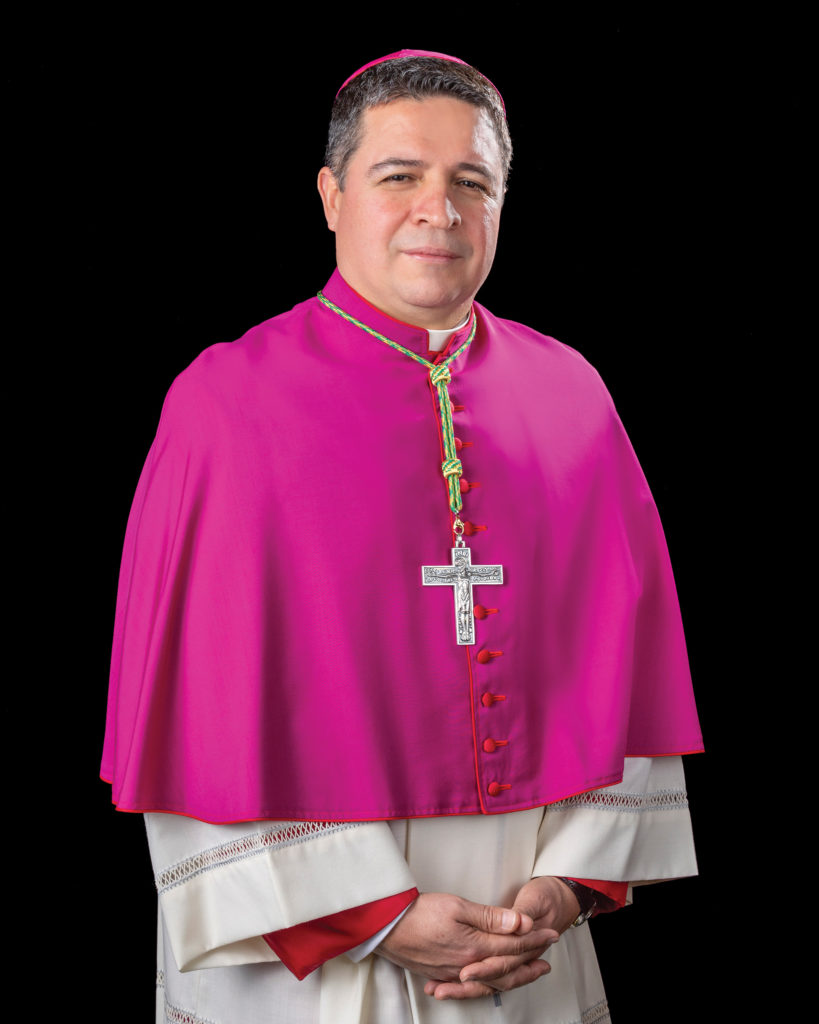
Pope Leo XIV appoints Bishop Evelio Menjivar-Ayala to lead West Virginia Catholics
Bishop Evelio Menjivar-Ayala’s path to his current position involved years of manual labor, a crossing of the American desert, and a progression through the roles of the Catholic Church. On Friday, the man who once navigated the U.S. as an undocumented migrant accepted the appointment to lead the Diocese of Wheeling-Charleston according to The Guardian.
Menjivar-Ayala, 55, replaces the 79-year-old Most Rev. Mark Brennan, who has served as West Virginia’s bishop since 2019. This transition takes place in a region with demographics that differ from the bishop’s own origins. While the archdiocese of Washington, where Menjivar-Ayala previously served as an auxiliary bishop, sees more than 40% of its parishioners identifying as Latino, West Virginia is one of the least racially diverse states in the country. U.S. Census data shows that 92.6% of the state’s 1.77 million residents identify as white, while only 2.4% are Latino.
Survival and the Long Road North
Menjivar-Ayala’s early life was impacted by the Salvadorian civil war. Born on August 14, 1970, in Chalatenango, El Salvador, his early years were marked by instability. He previously told the Catholic Standard that he and his family narrowly survived being fired upon by soldiers while fleeing their home.
His attempts to reach the United States were not immediate successes. He faced two failed attempts, hindered by a guide who deserted his migrant group and a subsequent deportation. It was on his third attempt that he succeeded, though the journey remained grueling. It involved a brief imprisonment in Mexico and a difficult crossing of the desert.
“a backpack with only one change of clothes, but it was full of dreams, of illusions that sometimes we do not understand. That dream is a light that guides you and, although you don’t understand the plan, you launch yourself with confidence in God.” Bishop Evelio Menjivar-Ayala
Upon arriving in the U.S. in 1990, the transition was not instantaneous. PBS reporting indicates that Menjivar-Ayala gained humanitarian protection within a couple of weeks
of his arrival. He later received a visa as a religious worker and became a U.S. citizen two decades ago.
The Path Through Manual Labor
Before the vestments and the mitre, Menjivar-Ayala’s American experience was defined by the struggle for basic stability. He prioritized his education, learning English and earning a GED. His early working years were spent in the margins of the economy, taking on janitorial and construction jobs to survive.
This period of manual labor preceded his entry into the priesthood. He eventually answered a religious calling at a local parish in Silver Spring, Maryland, which served as the starting point for his theological studies. His experience as a laborer provides a personal background that he draws upon when discussing the current state of migration in the United States.
Even after rising to become the first Salvadorian bishop in the country in 2023, Menjivar-Ayala maintained a connection to those still facing the risks he once did. Reflecting on federal law enforcement surges and raids in Washington in 2025, he told the Associated Press, that could have been me,
noting his continued closeness to immigrants caught in such actions.
A Symbolic Mandate in West Virginia
The appointment of a former undocumented immigrant to a state with the demographic profile of West Virginia occurs alongside the bishop’s history of public advocacy. Menjivar-Ayala has a history of public advocacy against aggressive immigrant policies, specifically those championed by Donald Trump. The Guardian reports that he has urged Catholics to oppose such policies, aligning himself with the views of Pope Leo XIV.
Pope Leo has been vocal in his criticism of the Trump administration’s handling of migrants. When questioned about U.S. immigration policies, the pope suggested that foreigners in the U.S. were being treated in an extremely disrespectful way
.
“How did you receive the foreigner, did you receive him and welcome him, or not? I think there is a deep reflection that needs to be made about what is happening,” Pope Leo XIV
This alignment has not been without friction. In a Truth Social post last month, Donald Trump described Pope Leo as WEAK on Crime, and terrible for Foreign Policy
.
Despite these political tensions, Menjivar-Ayala’s rhetoric during his acceptance news conference in Wheeling focused less on policy and more on listening. He spoke in both English and Spanish, emphasizing his desire to be welcomed by the people of West Virginia. He expressed gratitude toward the first American pope
for the appointment and outlined a priority for the poor, workers, and the youth.
Outgoing Bishop Mark Brennan supported the appointment during the shared news conference, reminding the local community that many Americans come from elsewhere. Brennan assured the laity that Menjivar-Ayala loves all the people here
and would serve as a bishop for everyone in the diocese, not just a specific group.
“I have much to learn, but my heart is ready and wide-open. Above all, I want to listen to the poor. Those in the margins of the church and society. To workers, to the immigrants, because as Matthew 25 says, the way we treat the least is the way we treat Jesus.