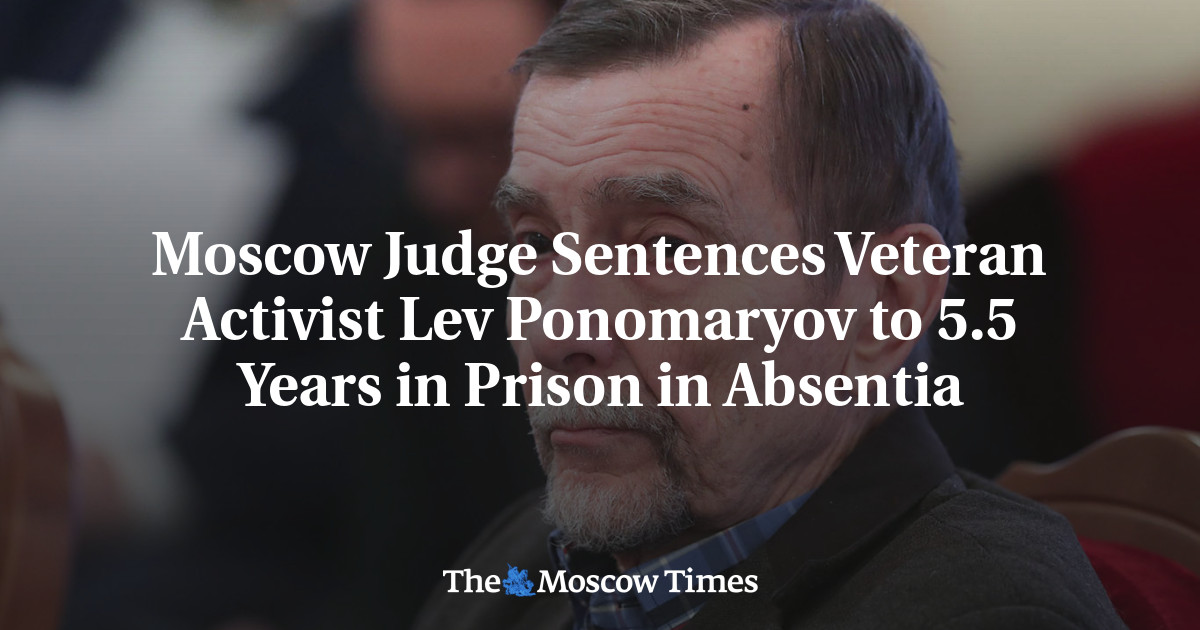
Ponomaryov Convicted of Foreign Agent and Undesirable Organization Violations
A Moscow court sentenced veteran human rights activist Lev Ponomaryov to five and a half years in prison on July 9, 2026. Convicted in absentia, Ponomaryov faced charges related to the evasion of “foreign agent” registration requirements and participation in an “undesirable” organization, marking a significant escalation in the state’s campaign against independent civil society figures.
The Legal Framework of the Conviction
The sentence delivered against Ponomaryov rests on two pillars of Russian legislation that have become primary tools for suppressing dissent. The “foreign agent” law, which requires individuals and organizations receiving international funding or perceived to be under foreign influence to register with the Ministry of Justice, has been used to systematically isolate activists from public life. According to the U.S. Department of Justice, such designations often serve as a precursor to more severe criminal charges.
The second charge—participation in an “undesirable” organization—carries even steeper consequences. Under the law, any entity labeled as “undesirable” is effectively banned, and its members or affiliates face immediate criminal liability for continued association. This dual-charge strategy ensures that activists like Ponomaryov are not merely fined, but are subjected to lengthy incarceration terms.
For those currently operating within high-risk jurisdictions, the complexity of these regulations is absolute. Ensuring compliance with local statutes while maintaining humanitarian operations requires the assistance of specialized legal counsel. Without rigorous oversight, the risk of retrospective criminalization remains a constant threat to non-governmental workers.
Historical Precedent and the Shrinking Civil Space
Lev Ponomaryov, a long-time fixture in the Russian human rights movement, has faced decades of state scrutiny. His career spans the Soviet era to the present, during which he has consistently advocated for prisoner rights and democratic reform. This latest sentencing in absentia reflects an ongoing shift where the state no longer requires the physical presence of the accused to finalize a conviction.
Legal observers note that this approach simplifies the prosecution process while signaling to other activists that exile provides no immunity from domestic sentencing. As the Office of the United Nations High Commissioner for Human Rights has observed, the systematic dismantling of civil society organizations in Russia has left a vacuum in legal defense and advocacy.
Dr. Elena Volkov, a regional analyst specializing in Eastern European legal systems, stated: `The sentencing of figures like Ponomaryov is designed to signal the end of the era of permitted activism. It is a calculated move to force a choice between total silence and permanent departure.`
Operational Challenges for NGOs and Independent Media
The practical impact of this verdict extends beyond the individual. It places a chill on the remaining network of independent researchers, journalists, and aid workers. When the state characterizes standard advocacy work as “undesirable,” it effectively criminalizes the act of documenting state activity.

For organizations maintaining operations in such environments, the risk profile has shifted from administrative fines to long-term imprisonment. This necessitates a robust approach to data security and asset protection. Many entities are now turning to security and risk management firms to audit their internal communications and funding structures, attempting to insulate their staff from the reach of these laws.
Beyond the legal risks, the administrative burden of managing “foreign agent” compliance is overwhelming. Organizations are forced to dedicate significant portions of their budgets to legal reporting and administrative overhead. For those who need to navigate these requirements, connecting with regulatory compliance specialists is no longer optional—it is a survival necessity.
The Future of Dissent in Russia
The sentencing of Ponomaryov serves as a definitive marker in the 2026 political landscape. With the legal system increasingly aligned with state security objectives, the capacity for traditional human rights work within the country has been severely curtailed.
The broader implications are clear: the state is moving toward a totalizing control of public discourse. By targeting the most visible and experienced figures, the authorities effectively discourage a new generation of activists from taking up the mantle. As the legal environment continues to tighten, the ability to source independent, verified information about the state of human rights within the region will become increasingly difficult.
History suggests that when legal avenues for redress are closed, the focus of the international community must shift toward documentation and the preservation of records for future accountability. As the legal pressures mount, those caught in the crosshairs must rely on established networks of support to manage their exit, protect their assets, and maintain their advocacy from safer jurisdictions. The cost of standing for human rights in an environment that views such work as a criminal offense is, as of today, five and a half years of one’s life.