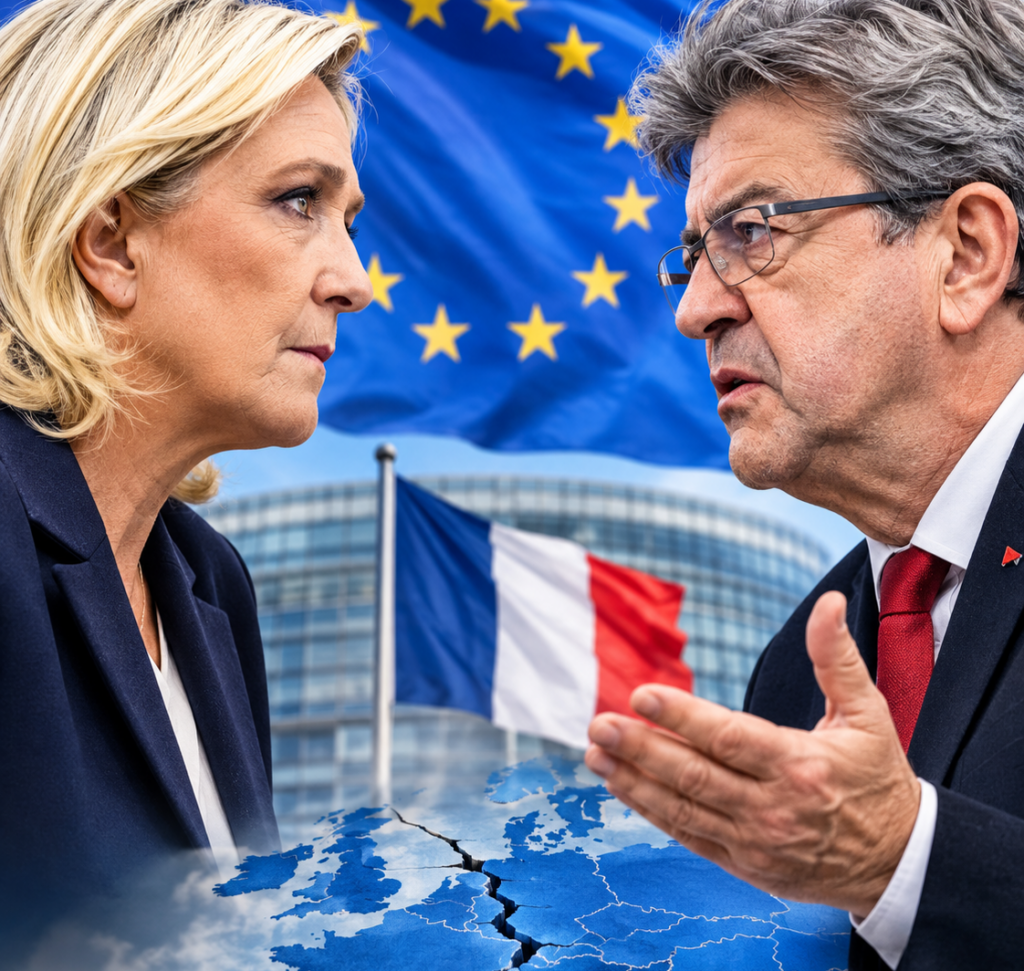
Poll Shows Le Pen Leading Mélenchon For Runoff
Recent polling indicates a potential presidential runoff between Marine Le Pen and Jean-Luc Mélenchon, a scenario that has sparked significant concern regarding the future of the European Union.
Surveys conducted by Ipsos BVA for Le Parisien on October 21 and 22 show Marine Le Pen leading with 32% to 33.5% of the vote, while Jean-Luc Mélenchon has risen to 17%, according to causeur.fr. In the four hypotheses tested, Le Pen arrives widely ahead with 32 to 33.5% of voting intentions. The poll was conducted among 1,500 people registered on electoral lists.
This shift places the former prime minister Édouard Philippe, previously considered a favorite, at 15% in scenarios where he represents the central bloc, causeur.fr reported. The emergence of a Le Pen-Mélenchon duel challenges the traditional “front républicain,” as both candidates face significant opposition from moderate voters, causeur.fr noted. A duel Le Pen-Mélenchon would place the country in a political situation entirely different from the second rounds of 2017 and 2022. The reflex of the “front républicain” would become much more uncertain. A part of the right and the centre would probably refuse to vote for Mélenchon; a part of the moderate left could just as difficultly support Marine Le Pen. Vote transfers would become the central issue of a campaign where each of the two finalists would provoke massive rejection in the opposing camp.
Six months before the presidential election, the latest Ipsos BVA survey for Le Parisien installs the leader of La France Insoumise in the second round for the first time in all configurations tested. The scenario long presented as a bogeyman becomes a very serious hypothesis, but it is still too early to speak of the inevitable. For months, Édouard Philippe was presented as the most probable adversary of Marine Le Pen in the second round.
The former prime minister seemed to enjoy a simple advantage: a weakened central bloc but still sufficiently wide to allow him to overtake a fragmented left. The latest Ipsos BVA-CESI poll for Le Parisien upsets this scenario. When Édouard Philippe is the candidate of the central bloc, he obtains only 15%, against 17% for the leader of La France Insoumise. Raphaël Glucksmann follows at 14%.

Philippe loses status as centre favourite
Comparison with September is severe for the former prime minister. A few weeks ago, a previous Ipsos BVA poll placed him at 19% when he alone represented the central bloc, behind Marine Le Pen but ahead of Mélenchon. He falls today to 15%. Gabriel Attal also slips back in the scenarios where he is tested. This slippage poses a broader question than that of personalities. After ten years in power, the central bloc pays for the wear of Emmanuel Macron, the budgetary situation, social tensions and the absence of an undisputed successor. Philippe retains an image of a presidential candidate, but this image no longer automatically guarantees his qualification. Mélenchon benefits from a very consolidated base. His 17% represents a progression of two points compared to September in the Ipsos survey.
This level remains very far from that of Marine Le Pen, but with the vote split among many candidates, it can suffice to reach the second round. The paradox is known. Mélenchon remains one of the most polarising political personalities in the country, but this polarisation also guarantees him a disciplined electoral base.
When the centre, the traditional right and the non-Mélenchon left share their voters between several candidacies, a bloc of 17 or 18% can become decisive. The violence of October 17 did not make Marine Le Pen progress in this survey, contrary to what a mechanical reading might have suggested.
They did not weaken Mélenchon either. The most visible result is rather the erosion of the centre candidates, while the two most structured poles retain or reinforce their positions.
Political stakes for European integration
Justice Minister Gérald Darmanin, who supports Philippe, argued during a forum in Barcelona on November 2 that both candidates would effectively end the European project as it currently exists, franceinfo.fr reported.

“It is undeniable that if Mr. Mélenchon or if Ms. Le Pen is elected, there will no longer be a Europe as we know it today,” said Darmanin, as quoted by france24.com. He added that while European countries would continue to communicate, the current European Community would cease to function under their leadership.
“There will always be a European continent and countries that will speak to each other, but there will not be a European Community,” the minister continued, estimating that “the projects of the two candidates are extremely clear and are built on the end of this Europe.”
The Keeper of the Seals further called for “someone very pro-European” to win the presidential election, whose first round is scheduled for April 18, “to make Europe change,” considering that the stake for the next French head of state will be “to transform Europe into a power Europe and not into a talking Europe.”
Gérald Darmanin, who was a member of all governments since 2017, with the exception of the brief Barnier team, also deplored that “Europe is falling behind in the world” and that “France tends to fall behind in Europe.”
“In France, debates are often debates of old people — that is to say debates on pensions, on health insurance, on how we will end our lives — while the world speaks of quantum physics, artificial intelligence, climate and green industry,” Darmanin further observed, according to France24. “We must stop debates of old people to project ourselves towards debates of the future,” he exhorted.
Concerns over nationalist and populist platforms
Critics of the potential matchup argue that a Rassemblement National victory would weaken European institutions and jeopardize the rule of law, according to sauvonsleurope.eu. The organization further said that Mélenchon’s platform, characterized by a personalized conception of democracy and an economic strategy based on confrontation with European rules, would isolate France rather than foster cooperation. An RN power would weaken European institutions, contest the primacy of European law, weaken solidarity between member states and compromise the common policies on which our future depends. It would weigh a threat on the rights of minorities and the rule of law. It would risk above all dividing Europeans at the hour when they should gather. For we are entering a world dominated by empires and relations of force: the Russia of Putin, the China of Xi Jinping and the United States of Trump, although weakened by the heavy defeat of the Republicans in the Midterms, according to Sauvonsleurope. Faced with these powers, no European country, not even France, can claim to weigh alone.
Our security, our strategic independence and our capacity to defend our values depend on our unity. Yet the RN, by its nationalism and its mistrust of European integration, would contribute to politically disarming Europe. In the context of the Russian threat, weakening European cooperation in matters of defence and support for Ukraine would be a historic fault. Mélenchon’s geopolitical alignment with Russian and Chinese interests should, on its own, delegitimize his candidacy.
His economic programme rests on a confrontation with European rules, a logic of disobedience and a form of national withdrawal that would isolate France rather than transform Europe with its partners.
Finally, his political strategy, founded on the radicalisation of debate and the rejection of a large part of voters and democratic forces, would make impossible the gathering necessary for the second round. It would even offer Marine Le Pen a boulevard to the Elysée, which the polls confirm with gaps such that they do not seem able to be bridged.
Her party’s historical stance fuels EU anxieties: as president of the National Rally from 2011 to 2021, Le Pen led a “de-demonisation” effort that softened the party’s image but retained its core opposition to the primacy of European law and advocacy for national sovereignty over EU integration.
Critics argue an RN victory would weaken European institutions and contest the rule of law, while Mélenchon’s confrontational platform would isolate France, creating a runoff where either outcome jeopardizes the bloc’s future.
| Candidate | Polling Range/Result |
|---|---|
| Marine Le Pen | 32% – 33.5% |
| Jean-Luc Mélenchon | 17% |
| Édouard Philippe | 15% |
The first round of the presidential election is scheduled for April 18, 2027. It remains unclear whether any coalition of democratic and pro-European forces can successfully mobilize to alter the current polling trajectory before that date.