Police Identify Moroccan Agents Passive During Ceuta Migration
Witnesses Identify Moroccan Officials in Ceuta Border Crossing
During the mass migration event into Ceuta on July 30, 2026, Moroccan authorities displayed “absolute passivity and permisivity,” according to three council members of the Ceuta government who testified before National Court María Tardón, EL PAÍS reported. Three consejeros of the Government of Ceuta assured the judge on Tuesday that when the massive entry of migrants to the autonomous city from the neighboring country began on July 30, the Moroccan authorities did not act. The investigation focuses on whether the events constituted an attack on Spain’s territorial integrity and independence.
Three Moroccan nationals who swam into Ceuta and were housed in the Temporary Reception Center for Foreigners testified by videoconference before the central investigative court, having crossed to swim and been custodied in the CATE to formally identify political high charges and police commanders of Morocco deployed on the border line during the hours of greatest influx. Central Instruction Court Number 3 of the National Court judge María Tardón interrogated by videoconference three Moroccan citizens whose testimonies open a key path in the cause investigating last summer’s massive jump to Ceuta. Among the testimonies stands out that of an ancient sergeant chief of the Royal Gendarmerie of Morocco, assigned to the Marrakech airport until last spring, who decided to cross upon seeing the deployment on social networks. A former sergeant chief of the Moroccan Royal Gendarmerie identified Youssef Haji, known as the bacha of Castillejos/Fnideq, standing at a roundabout near the border at 10 a.m. giving orders, located at a roundabout next to the Senator Hotel at few meters from the dividing line at around ten in the morning on that July 30, identified without any doubt during the photographic recognition. The witness also identified the Wali Al-Amn of Tetouan, the zone’s top police authority, having an authority equivalent to the Superior Chief of Police of Tetouan according to the witness. On October 21 itself, at the Temporary Reception Center for Foreigners (CATE), the police interrogated Mohamed Amtiou, who declared that on the 30th he was in Tetouan when he discovered on social networks what was happening in Ceuta, took his motorcycle, arrived at the area, went to the beach, and reached the Spanish city toward 17h. The third witness cited this Wednesday is Ziyad al Yazid, who arrived swimming to Ceuta on the 30th quite early, between 9h and 9.30h, realizing that many people were going toward the frontier and taking advantage that his boss left him the motorcycle to go to Castillejos and throw himself into the water, knowing the man well because he tried to cross the border a dozen times, and in the four times they intercepted him that man beat him.
Police Review Images of Border Agents
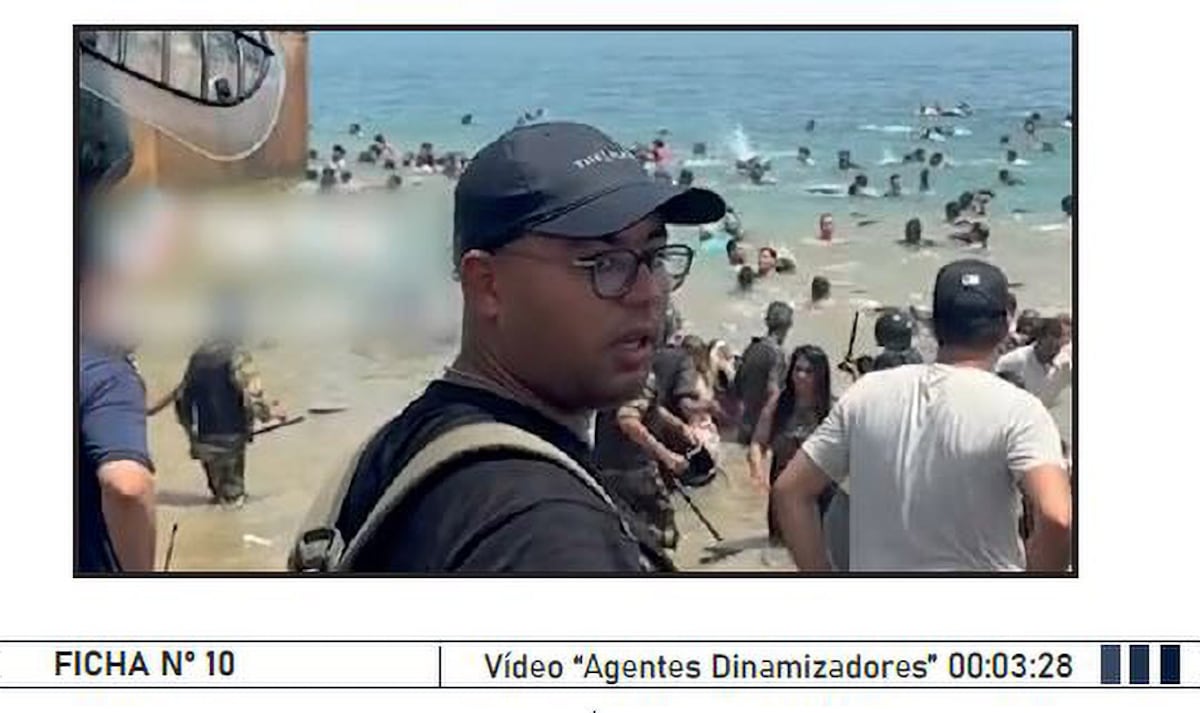
Police investigators reviewed images of individuals described in a report by the National Center for Immigration and Frontiers as “dynamizing agents” on the Moroccan side of the border. On October 21, investigators took his declaration and showed images of those described in the Cenif report that launched the National Court investigation as dynamizing agents of the migratory wave on the Moroccan side of the border, where the ex-gendarme Hicham el Bouazzaouy explained to police that on July 30 he observed that agents of the auxiliary forces of Rabat, agents of the Moroccan National Police, and agents of the royal gendarmerie were present in the border area, and before the photographs shown he identified without any doubt the Bacha of Castillejos/Fnideq, second-in-command of the Wali Alas, seen at a roundabout located below the Senator Hotel near the border at approximately 10h or 10.30h, stating that he was giving orders at that moment while twenty or thirty other agents were in the area. A second witness, who traveled to Castillejos by motorcycle after viewing social media calls on Instagram, TikTok, and Facebook under the pretext of the Throne Festival device, identified Younes Tazi, governor of the Tangier-Tetuán-Alhucemas region, and Mohamed el Oualidi, chief of police in Tetouan, recognizing the governor as Younes Tazi and the chief of police of Tetouan as Mohamed el Oualid, while a third witness pointed out local informers from the Castillejos town hall, specifically mkadam or informers of the border town hall tasked with reporting irregularities to the mayor’s office, and a lieutenant of the auxiliary forces assigned to the Tarajal pass whom the witness with prior military instruction denounced for having been brutally beaten by that commander on up to four previous occasions during failed crossing attempts before being deported by bus toward the interior of Morocco.
National Police reports submitted to the court include video footage showing uniformed Moroccan agents standing impassibly as crowds descended toward the border fences to swim around the Tarajal breakwater. In one of the videos delivered to the magistrate of the National Court, CENIF identifies several uniformed agents who remain impassible before the passage of people and observe with evident passivity the mass descent through the thorn fence in order to skirt swimming around the Tarajal breakwater, with explanatory arrows on the location of Ceuta and the direction of the immigrants, pointing out the presence of uniformed agents in the maritime zone of Castillejos near the border indicating the direction to take and observing passively their passage to the other side of the border without acting while the crowd advances through the police cordon. Ceuta government council members Nabila Banian, Alberto Ramón, and Alejandro Ramírez told the court that Guardia Civil agents directed migrants toward the Tarajal beach during the height of the crisis.
Supreme Court Rejects Ceuta Precautionary Measures
The Supreme Court recently rejected urgent precautionary measures requested by the Autonomous City of Ceuta in its appeal concerning the central administration’s handling of the July 30 and 31 arrivals. The court gave the Ministry of the Presidency, Justice and Relations with Parliament a 20-day window to submit the administrative file.

Legal challenges of this scale require specialized support. When local governance and regional jurisdictions face complex jurisdictional disputes, affected municipalities often consult experienced administrative law firms to evaluate state compliance and jurisdictional boundaries.
The National Court continues to examine the role of Moroccan officials and local security forces as the judicial inquiry moves forward. María Tardón has in her power dozens of images and videos on the massive entry in Ceuta, and the National Police has forwarded to court various reports and files identifying Moroccan agents in Castillejos observing passively the flow of immigrants toward Ceuta according to police investigators, with files accessing the cause as annexes showing Moroccan agents in passive attitude during the massive flow of July 30 and 31 alongside persons dressed in civilian clothes who could also be police and administrative staff members of the locality bordering Ceuta.