
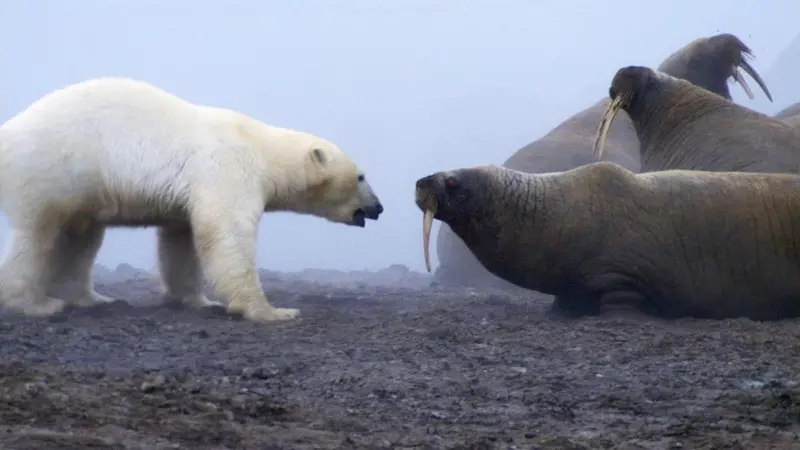
Polar Bear vs. Walrus: A Dramatic Arctic Battle for Survival
A lone male polar bear’s desperate attack on a herd of walruses, captured on film in 2004, continues to resonate as a stark illustration of the challenges facing Arctic wildlife amid a rapidly changing climate. The dramatic sequence, featured in the BBC’s “Planet Earth” documentary series, depicts the bear attempting to prey on the walruses, a struggle that ultimately left the predator injured and unsuccessful.
Filmed for the “Worlds of Ice” episode, the footage shows the polar bear strategically approaching a walrus colony under the cover of fog. According to the BBC, the bear attempted to penetrate the walruses’ thick layer of blubber – up to fifteen centimeters thick – in a bid for sustenance. Adult walruses worked collectively, pushing their young towards the center of the group, forming a protective barrier. The bear initially attempted to reach the calves by jumping onto the backs of adult walruses.
The attack escalated as the bear focused on a female walrus, repeatedly biting at her neck. However, the walrus fiercely defended her calf, her thick skin proving impervious to the bear’s attacks. As the walrus herd began to retreat towards the sea, the increasingly desperate bear continued to fight, but his opportunity for a meal dwindled. Despite briefly securing a grip on an adult walrus, the animal’s immense strength allowed it to break free.
The footage, captured by award-winning underwater filmmaker Adam Ravetch, shows the bear ultimately limping away, defeated and wounded by the walrus’s tusks. Ravetch spent two years in the Arctic filming for “Planet Earth,” a landmark natural history series narrated by David Attenborough. He recounted that the bear had been swimming for a considerable distance before attempting the attack, drawn by the scent emanating from the island.
Ravetch described the encounter as extraordinarily dangerous, noting that polar bear attacks on humans are rare but often fatal. However, he recognized the significance of witnessing the walruses’ defensive behavior, something rarely documented. “I thought the bear […] would catch a walrus calf within minutes, but it was completely new behavior to notice the walrus defend itself and win,” Ravetch said, as reported by BBC Mundo.
The incident is not simply a dramatic wildlife encounter, but a symptom of the adaptations polar bears are making to survive in increasingly challenging conditions. The documentary highlights how the loss of sea ice, due to climate change, is forcing polar bears to adopt riskier hunting strategies. The bears are being compelled to swim longer distances, increasing the risk of drowning or starvation.
Vanessa Berlowitz, the producer and director of the “Worlds of Ice” episode, explained that the scene perfectly encapsulated the polar bear’s plight. “You admired the polar bear for being forced to confront this enormous adversary, and then you realized it was a real battle of titans,” she said. “You felt empathy for the walruses when they were attacked, you felt empathy for the polar bear… It was a incredibly balanced scene. Nobody wins here. Everyone is fighting.”
Although polar bears have demonstrated adaptability in their foraging behavior, including consuming beluga whales, reindeer, and even berries, experts caution that these alternative food sources are insufficient to sustain the entire polar bear population, estimated at around 30,000. Research indicates that declining sea ice is negatively impacting the survival rates of polar bears, particularly pregnant females who rely on the ice for hunting seals and building up fat reserves before entering their dens for the winter.
The footage from “Planet Earth” served to raise public awareness about the impact of climate change on Arctic wildlife. As Attenborough narrates in the episode, “Unable to feed, this bear will not survive. If global temperatures continue to warm and Arctic ice continues to melt each year faster, We see certain that more bears will suffer the same fate.” The long-term fate of the bear filmed by Ravetch remains unknown.