
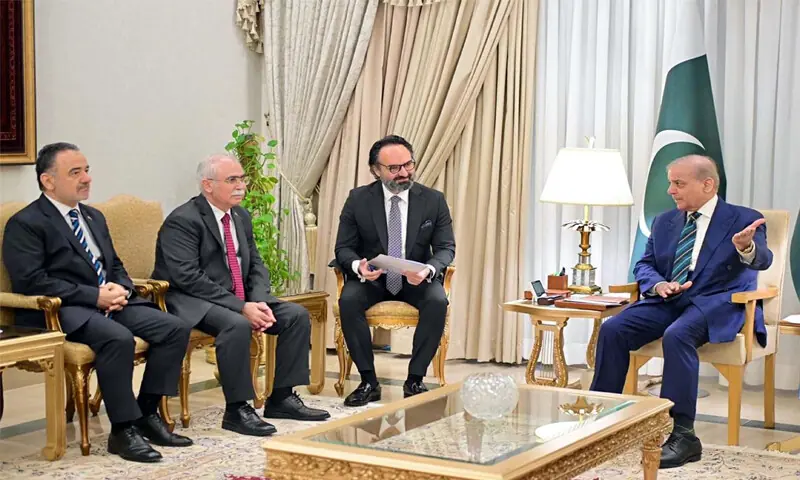
PM Shehbaz Sharif Pushes for Renewable Energy and Gulf Export Growth
Prime Minister Shehbaz Sharif confirmed on April 8, 2026, that Pakistan has averted a power crisis and maintained export stability despite Gulf war-driven oil supply disruptions. By leveraging a 55% renewable energy mix and strategic maritime pivots via the PNSC, Islamabad is insulating its macroeconomy from regional volatility.
The narrative coming out of Islamabad is one of resilience, but the underlying fiscal reality is a race against time. While the Prime Minister paints a picture of stability, the real story lies in the aggressive pivot toward energy independence to hedge against the extreme volatility of the Brent crude spot market. For the C-suite, this isn’t just about “keeping the lights on”—it is a fundamental restructuring of the national balance sheet to reduce reliance on foreign currency expenditures for fuel imports.
This shift creates a massive opening for institutional capital. As Pakistan targets a 90% renewable energy share within a decade, the demand for high-capacity infrastructure will outstrip local supply. Companies are now scrambling to secure industrial engineering firms capable of scaling Battery Energy Storage Systems (BESS) to stabilize a grid that remains prone to frequency fluctuations.
The Energy Arbitrage: Transitioning from Fossil Fuels to BESS
The current energy mix—55% renewables and 45% fossil fuels—is a precarious equilibrium. In a standard geopolitical shock, the “fuel-cost pass-through” typically crushes industrial margins. However, by prompt-tracking the Battery Energy Storage System (BESS) project, Pakistan is attempting to solve the intermittency problem inherent in solar and wind. Without storage, renewable peaks lead to curtailment; with it, they create a strategic reserve that lowers the Levelized Cost of Energy (LCOE).

Looking at the broader regional trend, the International Energy Agency (IEA) has consistently highlighted that emerging markets must decouple their GDP growth from carbon-heavy imports to avoid “balance of payments” crises. For Pakistan, the fiscal problem is clear: every barrel of oil imported during a Gulf conflict is a drain on dwindling foreign exchange reserves.
“The transition to a 90% renewable grid is not an environmental choice for Pakistan; it is a national security imperative. The ability to decouple industrial productivity from the volatility of the Strait of Hormuz is the only way to ensure long-term sovereign credit stability.” — Marcus Thorne, Chief Strategist at Global Macro Insights.
To execute this, the government will demand more than just policy willpower. They will require sophisticated project finance consultants to structure Public-Private Partnerships (PPPs) that attract foreign direct investment (FDI) without bloating the national debt profile.
Export Resilience and the Maritime Pivot
The claim that exports to the Gulf remain intact despite regional tensions suggests a successful diversification of logistics. The directive to the Pakistan National Shipping Corporation (PNSC) to secure more maritime routes is a move to bypass traditional chokepoints. In the world of global trade, “just-in-time” delivery has been replaced by “just-in-case” redundancy.
Agricultural exports are the hidden winner here. As Gulf nations seek to diversify their food security sources away from conflict zones, Pakistani produce is filling the void. Here’s a classic case of market opportunistic growth. However, scaling these exports requires a rigorous upgrade in cold-chain logistics and compliance with international phytosanitary standards.
This surge in trade volume increases the complexity of cross-border transactions. As trade flows increase, the risk of contractual disputes and regulatory friction grows, driving a surge in demand for international trade law firms to draft airtight bilateral agreements and manage customs litigation.
The Macro Explainer: Three Pillars of the Latest Economic Strategy
- Energy Decoupling: By targeting a 10% fossil fuel ceiling, Pakistan is attempting to flatten its vulnerability to oil price spikes. This reduces the “imported inflation” that typically triggers aggressive interest rate hikes from the State Bank of Pakistan to defend the currency.
- Logistical Sovereignty: Moving from reliance on third-party carriers to an expanded PNSC fleet allows the state to control the “last mile” of its export strategy, ensuring that agricultural yields reach Gulf markets regardless of regional naval tensions.
- Judicial Digitalization: The collaboration with Turkiye’s Kadir Ozkaya on digital justice isn’t just about courts; it’s about the “Ease of Doing Business.” A digitalized judiciary reduces the time to resolve commercial disputes, which is a key metric for institutional investors looking at the World Bank’s investment climate indicators.
The financial implications are stark. If Pakistan can successfully migrate 35% more of its power generation to renewables over the next decade, the resulting savings in foreign exchange could potentially improve the current account deficit by several billion dollars annually.
But the road to 90% is paved with capital expenditure. The “BESS” project is the linchpin. Without massive storage capacity, the grid cannot handle the volatility of solar inputs. This is where the private sector must step in. The gap between government ambition and technical execution is where the most lucrative B2B opportunities currently reside.
According to recent data from the IMF’s country reports on Pakistan, the stability of the energy sector is the primary determinant for the country’s ability to maintain a sustainable debt-to-GDP ratio. Any failure in the renewable transition will lead to a renewed reliance on expensive emergency oil imports, erasing the gains made in the current quarter.
The current trajectory suggests a move toward a “Fortress Economy” model—one that is internally powered and externally diversified. For the global investor, the play is no longer in the volatility of the currency, but in the infrastructure of the transition. As the state pivots, the firms that provide the hardware for the energy shift and the legal framework for the trade shift will capture the most value.
Navigating these shifts requires a vetted network of partners who understand the intersection of geopolitical risk and industrial scaling. Whether you are looking for the engineering prowess to build a national grid or the legal expertise to navigate Gulf trade corridors, the World Today News Directory remains the definitive source for connecting with the B2B entities driving this global transformation.