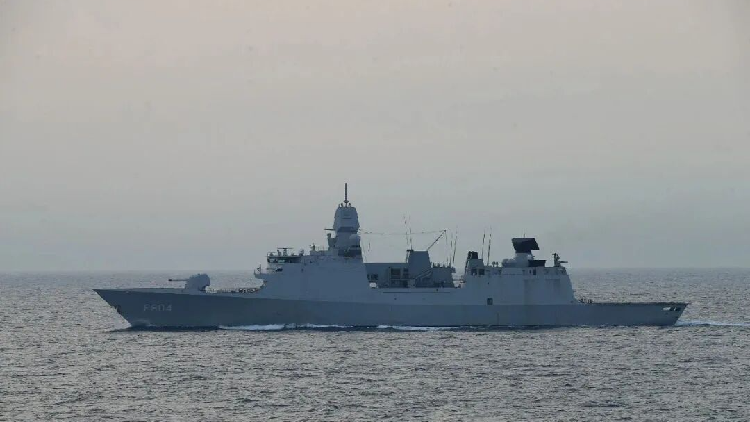
PLA Responds to Dutch Frigate Transit in Taiwan Strait
The Chinese People’s Liberation Army (PLA) Eastern Theater Command dispatched naval and air assets to monitor the Dutch frigate HNLMS De Ruyter during its transit through the Taiwan Strait on June 5, 2026. Beijing asserts the move was a necessary measure to safeguard sovereignty, while the Netherlands maintains the transit complied with international law.
A Strategic Corridor Under Constant Surveillance
The Taiwan Strait serves as one of the world’s most critical maritime arteries. For global commerce, it is not merely a body of water; it is a high-stakes geopolitical theater where the presence of foreign naval vessels consistently triggers friction between Beijing and Western powers. The recent tracking of the HNLMS De Ruyter underscores a hardening stance from the PLA, which views the strait as its own territorial waters—a claim that stands in direct opposition to the international community’s designation of the passage as an area of international navigation.
This incident follows a previous reported encounter in the Paracel Islands, where Beijing accused the same Dutch vessel of an “illegal intrusion.” The repetition of these encounters suggests a new normal in the region: a persistent cycle of naval posturing that forces shipping companies and regional stakeholders to recalculate their risk profiles. When military tensions rise, the stability of supply chains becomes the primary casualty.
The Ripple Effect on Global Logistics
For businesses operating in the Asia-Pacific region, the proximity of kinetic naval activity to commercial shipping lanes is a significant operational hazard. The “effective handling” of such vessels, as described by regional commands, often involves electronic warfare protocols and close-approach maneuvers that can disrupt satellite communications and maritime navigation systems.

Companies reliant on the stability of these waters are now finding that standard insurance policies may no longer cover the full scope of risks associated with “gray zone” military incidents. As these tensions escalate, maritime logistics providers are increasingly turning to maritime risk assessment specialists to audit their transit routes and ensure compliance with evolving international maritime security directives.
The frequency of these close-encounter incidents in the Taiwan Strait is creating a predictable pattern of friction that disrupts the perceived safety of commercial corridors. It is no longer a matter of ‘if’ a transit will be contested, but ‘how’ the escalation will be managed in real-time.
Legal Ambiguity and the Sovereignty Dispute
The core of this conflict remains the divergent interpretations of international maritime law. The Netherlands, alongside several other nations, anchors its position in the principles of freedom of navigation. Conversely, the PLA Eastern Theater Command has signaled its intent to remain on “high alert,” framing their actions as a resolute defense of national security. This legal stalemate creates a vacuum where diplomatic norms are frequently superseded by military muscle.
For corporations caught in the middle, the legal landscape is precarious. Navigating the intersection of local Chinese regulations and international maritime law requires expert oversight. Many multinational firms are now engaging maritime legal counsel to shield their assets and clarify their liabilities should a transit be deemed an “illegal intrusion” by local authorities.
Managing the Operational Fallout
Beyond the immediate military headlines, the economic impact is felt in the boardrooms of firms that rely on the prompt delivery of goods through the strait. The potential for sudden exclusion zones or electronic signal interference poses a direct threat to just-in-time manufacturing models.
- Navigation Security: Increased monitoring leads to deviations in standard shipping routes, increasing fuel consumption and delivery times.
- Communication Integrity: Electronic warfare exercises can degrade GPS and AIS signals, requiring ships to maintain secondary, manual navigation capabilities.
- Regulatory Compliance: Companies must now track the specific claims of coastal states to ensure their vessels are not inadvertently violating contested zones.
To mitigate these risks, industry leaders are prioritizing the acquisition of advanced tracking and communication redundancy systems. Organizations looking to harden their infrastructure against these geopolitical shocks are advised to consult with logistics security consultants who specialize in navigating contested maritime environments.
Looking Toward a Volatile Horizon
As of June 6, 2026, the situation in the Taiwan Strait remains fluid. The PLA’s stated commitment to maintaining high alert suggests that future transits by European and North American naval vessels will likely be met with similar displays of force. This represents not merely a military standoff; it is a long-term geopolitical shift that forces every participant in the global economy to pick a side—or at least, to pick a strategy for survival.

The history of international shipping shows that when maritime corridors become political bargaining chips, the cost is ultimately borne by the consumer and the shareholder. The stability of the 21st-century global order relies on the predictability of these waters. As that predictability wanes, the burden of protection shifts from states to the private entities themselves.
In this era of uncertainty, being reactive is a recipe for failure. Whether you are a shipping line, a manufacturing conglomerate, or an international trade organization, the need for proactive security and legal foresight has never been more urgent. The experts in our global directory are equipped to provide the risk analysis, legal shielding, and logistical support necessary to navigate these increasingly turbulent waters. Do not wait for the next incident to re-evaluate your exposure; the time to secure your interests is now.