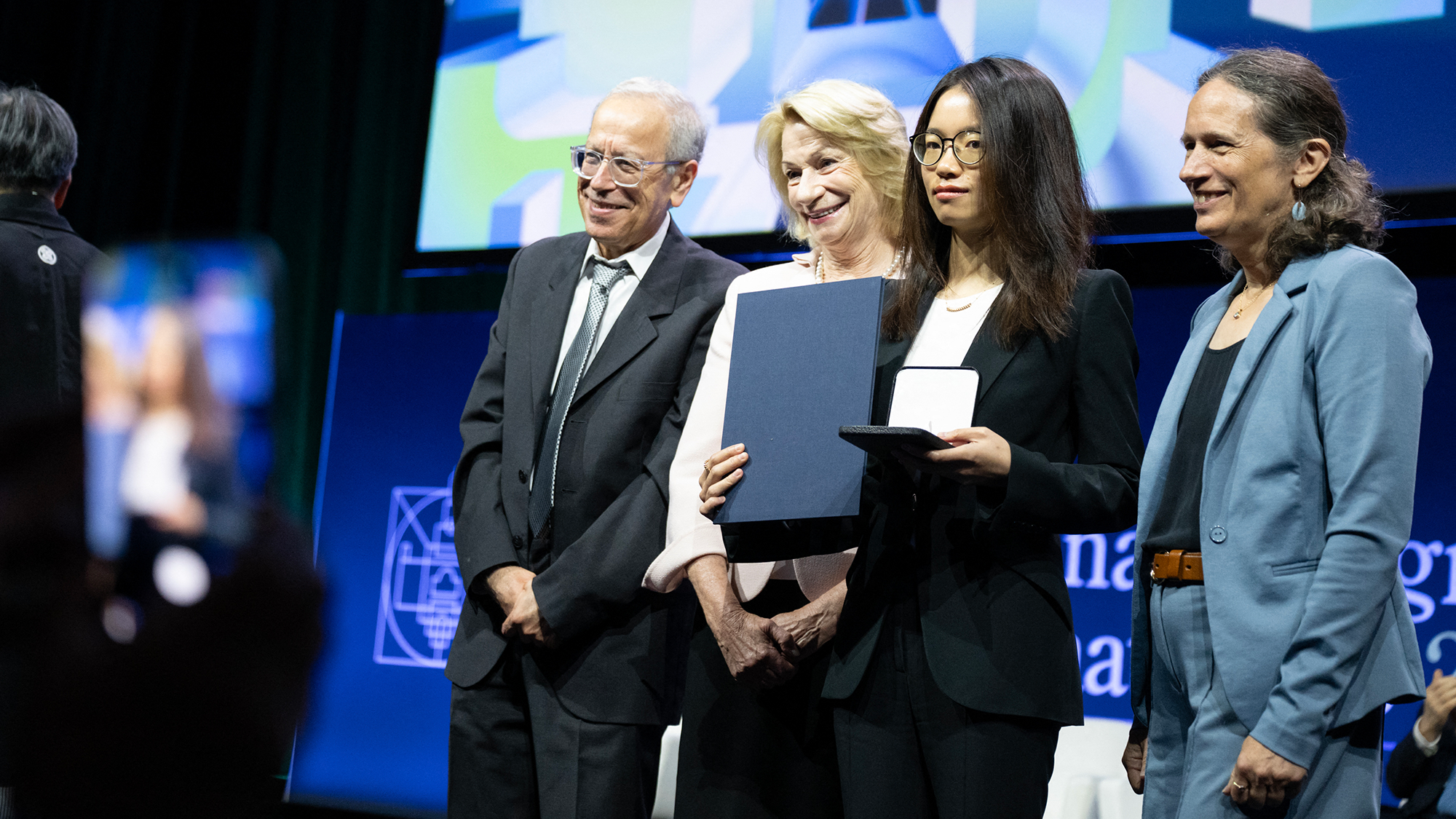
Pioneering Young Mathematician Wins Prestigious Fields Medal
The 2026 Fields Medal, widely recognized as one of the highest honors in mathematics, has been awarded to four researchers, including NYU professor Hong Wang. Announced on Thursday, July 23, 2026, by the International Mathematical Union during the International Congress of Mathematicians in Philadelphia, the prize marks a historic milestone as Wang becomes only the third woman to win the award in its 90-year history.
Key Clinical Takeaways:
- Mathematician Hong Wang received the 2026 Fields Medal at the International Congress of Mathematicians in Philadelphia, becoming the third woman to win the prize since its inception in 1936.
- Wang was recognized for her collaborative work on the decades-old Kakeya conjecture regarding how needles move in three-dimensional space.
- The other 2026 recipients include Yu Deng of the University of Chicago, John Pardon of Stony Brook University, and Jacob Tsimerman of the University of Toronto.
Historical Context of the Fields Medal
Established in 1936, the Fields Medal is presented every four years to mathematicians under the age of 40 to recognize outstanding discoveries and future promise in the field. Across nine decades, the award has predominantly honored male researchers, with 65 men receiving the medal prior to the 2026 announcements. Wang’s achievement follows a sparse historical precedent for women in the discipline. Iranian mathematician Maryam Mirzakhani became the first female recipient in 2014, followed by Ukrainian mathematician Maryna Viazovska in 2022. No woman received the prize during the nearly 80-year span between the award’s creation and Mirzakhani’s breakthrough.
Resolving the Kakeya Conjecture
According to announcements from the International Mathematical Union, Wang earned the 2026 medal for her work on the Kakeya conjecture, a long-standing geometric puzzle that asks how little space is needed to rotate a needle so that it points in every possible direction in three dimensions. Mathematicians pursued a solution to this problem for approximately 50 years.
Working alongside collaborator Joshua Zahl, Wang demonstrated that tracking every potential direction of the needle as a bundle of thin tubes reveals a precise trade-off between the thinness of those tubes and the total space they must occupy. Solving this complex puzzle required sophisticated tools from harmonic analysis, a branch of mathematics examining how complex shapes and signals can be separated into simpler components. Quanta Magazine described the resulting 127-page proof as a once-in-a-century result, though the months spent vetting the document beforehand left Wang anxious about the clarity of their argument before publication.
The 2026 Cohort of Laureates
The International Mathematical Union honored three additional researchers alongside Wang at the Philadelphia congress. Yu Deng of the University of Chicago received recognition for connecting microscopic and macroscopic descriptions of gases. John Pardon of Stony Brook University was awarded for solving major problems in topology and geometry. Jacob Tsimerman of the University of Toronto was honored for developing advanced techniques in algebraic geometry that accelerate progress on enduring mathematical puzzles.