
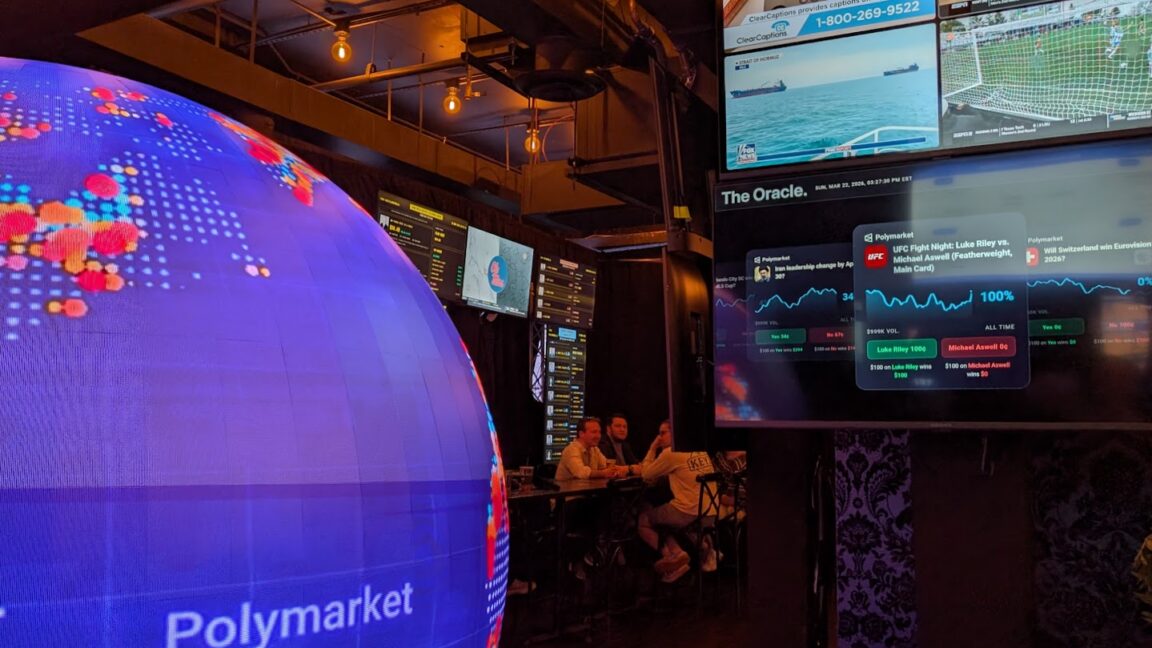
Pints meet prop bets: Polymarket’s “Situation Room” pop-up bar in DC
Beyond the Pint Glass: The Security Debt Behind Polymarket’s DC Activation
The “Situation Room” pop-up bar in DC served pale ale and political prop bets, but the real volatility isn’t in the cocktail menu—it’s in the smart contract architecture underpinning the wagers. While marketing teams celebrate the activation as a bridge between IRL culture and decentralized finance, security engineers spot a different topology. We are looking at a high-frequency prediction market running on Polygon, relying on UMA oracles for settlement, amidst active regulatory scrutiny from state Attorney Generals. The coasters might be collectible, but the latency between event occurrence and oracle resolution creates a exploitable window for insider trading that no amount of brand activation can patch.
- The Tech TL;DR:
- Oracle Latency Risk: Discrepancies between real-world event completion and UMA oracle reporting create arbitrage windows vulnerable to insider exploitation.
- Compliance Gap: Arizona AG charges against competitors highlight the lack of KYC/AML enforcement on anonymity-optimized layers.
- Infrastructure Demand: Major financial players like Visa and Microsoft are aggressively hiring AI Security Directors to mitigate similar systemic risks in automated trading.
Treating this pop-up as merely a marketing stunt ignores the blast radius of the underlying protocol. Prediction markets function as information aggregation engines, but when those engines rely on decentralized oracles to settle bets on geopolitical conflicts or election outcomes, the attack surface expands. The core vulnerability isn’t SQL injection; it’s data integrity. If an actor possesses non-public information—say, the exact timing of a missile strike or a legislative vote—they can execute trades before the oracle updates the state. What we have is the classic insider trading vector, now automated and immutable on-chain.
Oracle Manipulation and Settlement Latency
The technical backbone of these platforms typically involves a dispute resolution mechanism where stakeholders bond tokens to assert the truth of an outcome. In the time between the real-world event and the finalization of the oracle report, the market is technically vulnerable. While Polymarket employs safeguards, the fundamental architecture relies on economic incentives rather than cryptographic certainty for off-chain data. This is where the security posture often fails to meet enterprise-grade standards expected in traditional finance.
“The intersection of artificial intelligence and cybersecurity is defined by rapid technical evolution. When automated betting markets scale, the need for national reference provider networks covering security becomes critical to prevent systemic manipulation.”
Industry analysis from the AI Cyber Authority suggests that as these platforms integrate more AI-driven trading bots, the risk of coordinated manipulation increases. The latency issue is compounded by the anonymity of the wallet addresses. Third-party research indicates that only a compact minority of users realize profits, suggesting that the house edge or structural disadvantages are significant, but for security architects, the concern is whether those losses are due to market variance or exploit.
Enterprise IT departments observing this space should recognize the parallel to high-frequency trading (HFT) risks. Just as traditional exchanges require co-location and strict audit logs, decentralized prediction markets need rigorous cybersecurity auditors and penetration testers to validate oracle integrity. The current reliance on community dispute resolution is insufficient for institutional adoption.
Regulatory Friction and Identity Verification
The legal landscape is tightening. The Arizona Attorney General’s recent indictment of competitor Kalshi for running an illegal gambling operation signals a shift from regulatory tolerance to enforcement. This creates a compliance bottleneck for platforms operating in the US. The technical challenge lies in implementing Know Your Customer (KYC) protocols without destroying the permissionless nature of the blockchain interface.
Financial giants are already preparing for this convergence. Job listings for roles like Director of Security | Microsoft AI and Visa Sr. Director, AI Security indicate that major payment processors and tech firms are building internal capabilities to monitor and secure AI-driven financial transactions. They are not waiting for the regulations to settle; they are building the infrastructure to enforce them.
For platforms like Polymarket, the path forward requires integrating identity layers that satisfy regulators while maintaining user privacy. This is a complex cryptographic problem often requiring zero-knowledge proofs. Organizations struggling to navigate this compliance maze should engage with specialized cybersecurity risk assessment and management services to audit their exposure before regulatory enforcement actions occur.
Implementation: Verifying Market Integrity
Developers looking to build secure prediction markets or audit existing ones must prioritize oracle verification. Below is a simplified example of how a smart contract might query an oracle for event resolution, highlighting the point where external data enters the trusted execution environment.
// SPDX-License-Identifier: MIT pragma solidity ^0.8.0; interface IOracle { function getRequestStatus(bytes32 requestId) external view returns (bool fulfilled, bool exists); function getResponse(bytes32 requestId) external view returns (string memory); } contract PredictionMarket { Ipublic oracle; mapping(bytes32 => bool) public resolvedMarkets; function resolveMarket(bytes32 requestId, string memory outcome) external { require(!resolvedMarkets[requestId], "Market already resolved"); // Critical Security Check: Verify oracle authenticity before state change (bool fulfilled, bool exists) = oracle.getRequestStatus(requestId); require(fulfilled && exists, "Invalid Oracle Response"); resolvedMarkets[requestId] = true; // Execute payout logic here } } This snippet illustrates the dependency on external data sources. If the oracle contract is compromised or the data feed is delayed, the `resolveMarket` function becomes a vector for exploitation. Security teams must monitor these interfaces continuously.
The Market Landscape and Future Mitigation
The broader security ecosystem is responding. The AI Security Category Launch Map identifies over 96 vendors now targeting the intersection of AI and security, with combined funding exceeding $8.5 billion. This capital influx suggests that the market recognizes the severity of the threat landscape surrounding automated decision systems and financial contracts.
As prediction markets evolve, the distinction between gambling platforms and information utilities will blur. The companies that survive will be those that treat security not as a feature, but as the foundational layer of their architecture. For CTOs and investors, the due diligence process must extend beyond user growth metrics to include smart contract audit reports and oracle decentralization scores.
The “Situation Room” bar may close, but the security challenges it represents are permanent. Organizations betting on this technology should ensure they have partnered with verified tech compliance auditors to navigate the impending regulatory crackdown. The cost of mitigation is far lower than the cost of an enforcement action or a protocol exploit.
Disclaimer: The technical analyses and security protocols detailed in this article are for informational purposes only. Always consult with certified IT and cybersecurity professionals before altering enterprise networks or handling sensitive data.