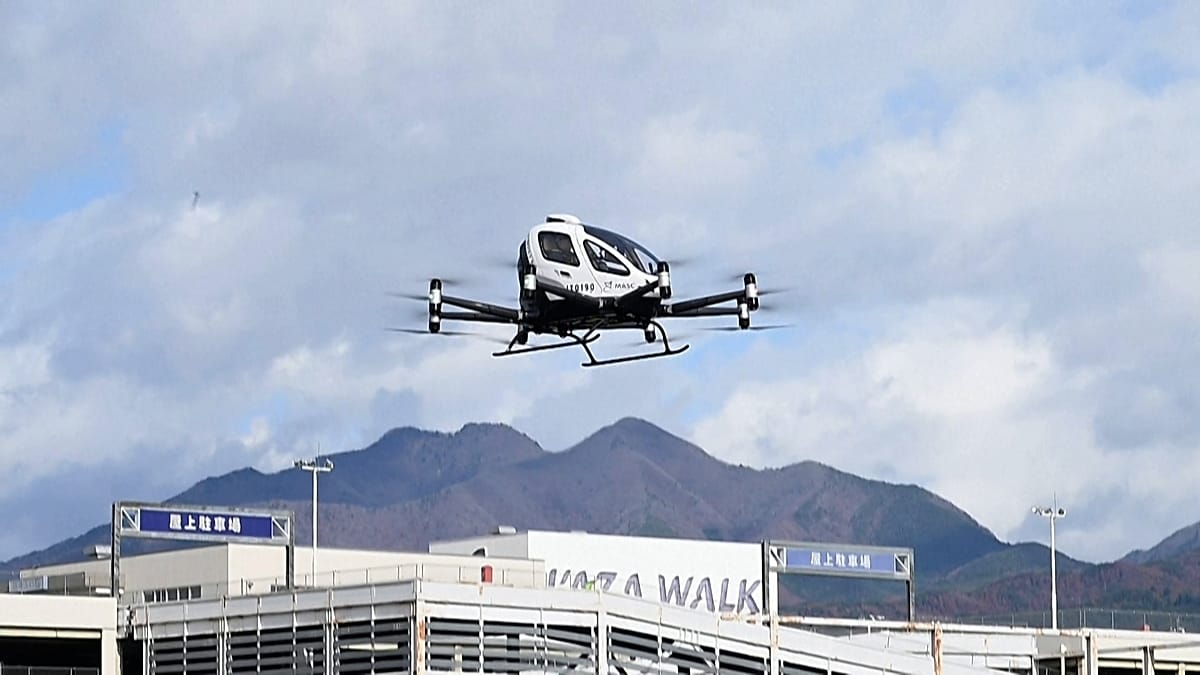
Pilotless Air Taxi Carries Passenger in Japan Demo Flight
An electric, pilotless air taxi completed a passenger-carrying demonstration flight on Friday in the Yamanashi Prefecture of Japan, according to Euronews.
The flight, which featured the EH216-S aircraft developed by Chinese manufacturer EHang, suggested a potential shift in urban air mobility as the vehicle followed a pre-set route without human intervention.
The aircraft, powered by 16 rotating rotors, ascended vertically in front of spectators and journalists. According to reporting by gr.euronews.com, the demonstration took place against the backdrop of Mount Fuji, where the two-seater vessel completed a 380-meter flight path along an academy runway. A second, uncrewed flight later covered a distance of 1,800 meters over the Kamanashi River.
The EHang EH216-S is designed to bypass conventional airport infrastructure, reaching top speeds of 120 kilometers per hour. The craft is capable of traveling approximately 30 kilometers on a single battery charge, a specification that proponents suggest could offer a viable alternative to congested urban road networks.
While the demonstration highlighted the technical capabilities of autonomous vertical take-off and landing (VTOL) technology, the path to widespread commercial adoption remains complex. Industry observers note that despite the successful flight, significant hurdles regarding regulatory frameworks, safety protocols, and the development of necessary ground infrastructure continue to hinder large-scale implementation across Japan.
The event served as an introduction to urban air mobility for the local public, testing the feasibility of short-distance “jumps” between transit hubs.
As companies look to move beyond demonstration phases, the focus shifts toward securing the social and regulatory license to operate in densely populated regions. The ability to manage public perception and handle the intersection of innovative hardware and local municipal codes will be a deciding factor for manufacturers entering the Japanese market.
Headquartered in Guangzhou, China, EHang develops autonomous aerial vehicles for missions ranging from aerial cinematography to emergency response. The company gained global attention in 2016 at the Consumer Electronics Show with the introduction of the EHang 184, which was promoted as the world’s first passenger-carrying autonomous aerial vehicle. By 2019, the organization reached a significant milestone by listing on the NASDAQ.
The company has a history of rigorous testing, having conducted over 1,000 test flights with its earlier models by July 2018 under various conditions, including storm-force winds and low visibility. Following years of development and international partnerships, the EH216-S model achieved approval for commercial flights in 2023.
Disclaimer: The views and cultural analyses presented in this article are for informational and entertainment purposes only. Information regarding legal disputes or financial data is based on available public records.