Physicists Discover Hidden Gluon Structure That Explains Proton Stability
New RHIC Data Reveals Y-Shaped Gluon Junctions Inside Protons
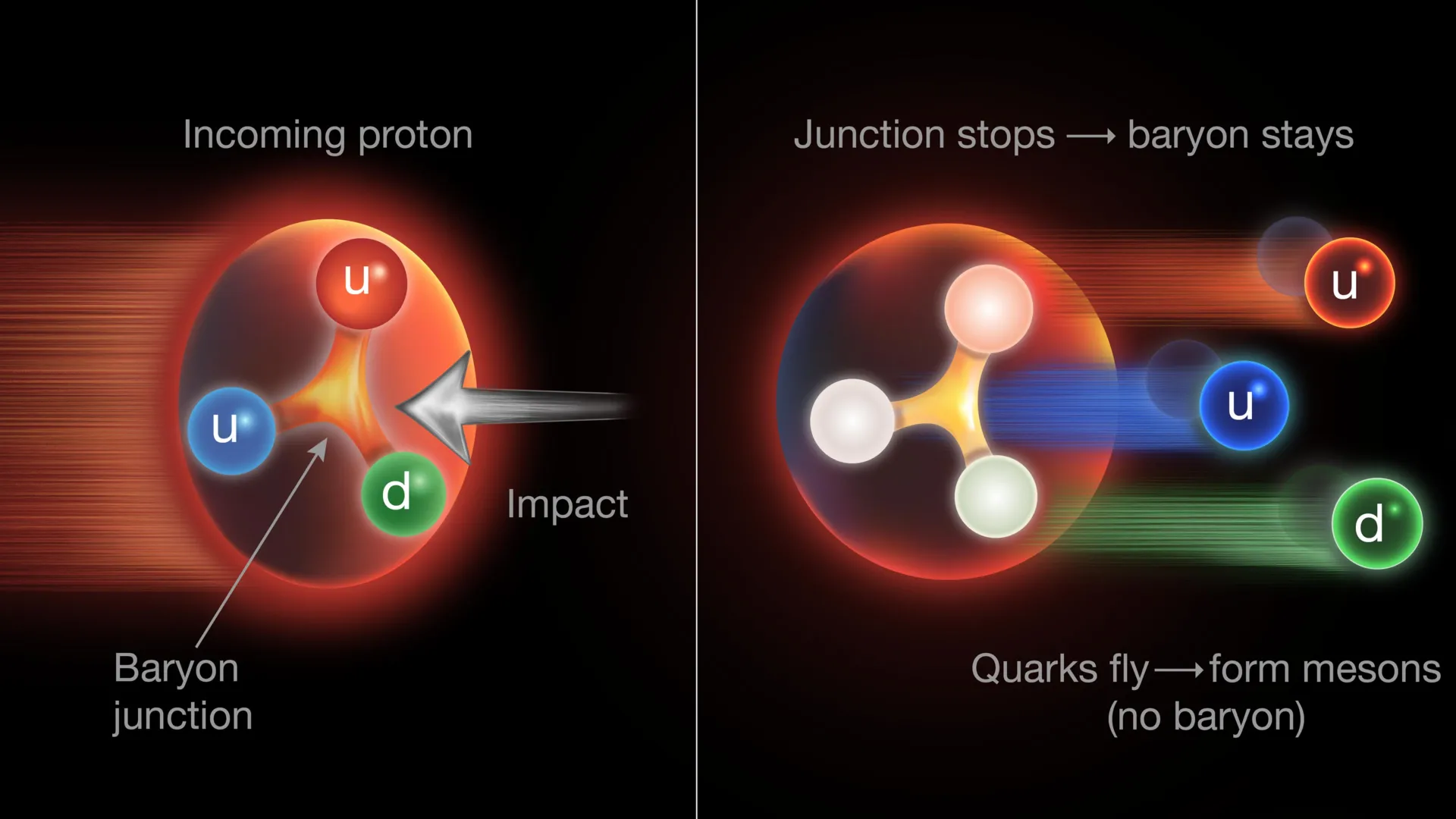
Physicists analyzing collision data from the Relativistic Heavy Ion Collider (RHIC) have identified evidence of a Y-shaped gluon structure within the proton, a finding that challenges the traditional textbook model of baryon number distribution. According to research published in Science, the baryon number—a quantum property essential to matter’s stability—may be carried by these gluon junctions rather than solely by the valence quarks. This discovery, derived from high-energy particle collisions at the U.S. Department of Energy’s Brookhaven National Laboratory, provides a potential explanation for the extraordinary stability of protons, which remain intact over timescales exceeding the current age of the universe.
The Tech TL;DR:
- Fundamental Shift: Baryon number, previously attributed to valence quarks, is now linked to gluon junctions, forcing a revision of standard nuclear physics models.
- Stability Mechanics: This structural configuration helps explain why protons do not decay, a prerequisite for the existence of stable atomic nuclei and matter.
- Data Validation: The STAR collaboration at RHIC utilized complex collision datasets to verify the existence of these junctions, moving beyond the “naïve quark model”.
Architectural Limitations of the Naïve Quark Model
For decades, the standard pedagogical model posited that a proton’s baryon number of plus one was divided equally among its three valence quarks. However, this model fails to account for the dynamic, high-energy environment of subatomic interactions. As noted by Zhangbu Xu of Kent State University and Brookhaven Lab, the “naïve quark model” treats protons as static three-quark systems, ignoring the complex gluon fields that dominate the internal energy landscape. The discovery of the Y-shaped junction suggests that gluons—the force-carriers of the strong interaction—are not mere connective tissue but are structurally central to fundamental properties.
Data Extraction and Computational Verification
The STAR detector collaboration verified these findings by analyzing different types of particle collisions to isolate the junction’s influence.
# Simplified conceptual model for tracking baryon number transport
def calculate_baryon_transport(junction_node, valence_quarks):
    # Mapping the baryon number (B) to the junction vs quarks
    # Based on the STAR collaboration's findings
    if junction_node.is_active:
        return junction_node.baryon_contribution
    else:
        return sum(q.baryon_contribution for q in valence_quarks)
Enterprise IT Triage and Infrastructure Implications
The implications of this discovery extend to our understanding of why matter dominates antimatter in the observable universe. If the baryon number is indeed bound to the gluon junction, it suggests that the stability of the proton is a function of this specific topological configuration.

Future Trajectories in Nuclear Research
The move away from the three-quark-only model marks a significant step toward a more granular understanding of matter. As the STAR collaboration continues to refine its datasets, the goal remains to integrate these findings into a unified model of the proton. As we move into the next phase of nuclear physics, the intersection of experimental data and computational theory will continue to drive the evolution of our fundamental understanding of the physical world.