Physicist James T. Russell, Pioneer of Digital Optical Recording, Dies at 95
James T. Russell, the American physicist who pioneered the system for digital optical recording that served as a precursor to the Compact Disc, has died at age 95.
Born on February 23, 1931, in Bremerton, Washington, Russell began his technical career as an apprentice to an electrician at his father’s dairy plant, earning 7 cents an hour. He went on to earn a degree in physics from Reed College in 1953.
His professional career included work at General Electric, where he designed experimental instrumentation and contributed to electron beam welding technology. In 1965, he joined a laboratory managed by the Battelle Memorial Institute, now known as the Pacific Northwest National Laboratory, according to Macitynet.
Russell’s invention was born from his frustration with the scratching and hissing sounds of vinyl records, which were caused by the physical contact between the needle and the surface of the disc.
To eliminate this, he sought a way to record music digitally and read it without mechanical contact using a light beam. His initial experiments were funded by Battelle, leading to U.S. Patent 3,501,586, which was filed on September 1, 1966, and granted on March 17, 1970. A second patent regarding recording synchronization was filed in 1969.
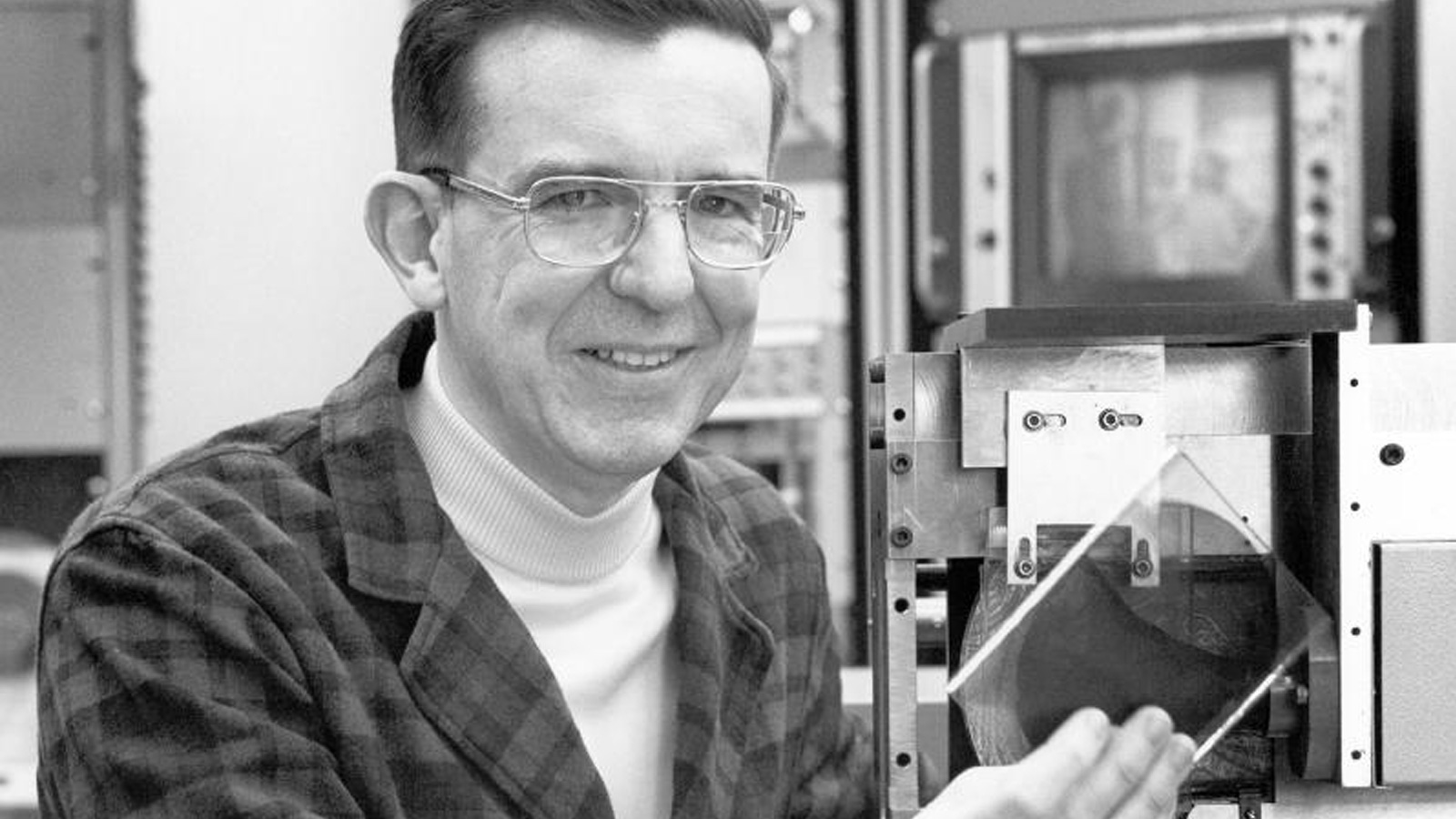
By 1973, Russell had produced a working prototype. Unlike the later commercial CD, this system utilized transparent, rectangular glass plates roughly the size of a paperback book. Between 1973 and 1975, approximately 100 companies—including Sony and Philips—were introduced to the invention through over 1,500 descriptive brochures. Russell recalled that both Sony and Philips sent technicians to Richland to examine his system, though neither company purchased a license at that time.
While Sony and Philips were developing their own optical solutions, they eventually established a common standard in 1980. This collaboration led to the launch of the CDP-101 in Japan in October 1982, the first commercial CD player. Although Russell’s patents were ultimately licensed by major corporations, he never received royalty payments for his foundational contribution to the digital age.