Physicist Expands Black Saturn Model with Dual Rotation in Five Dimensions
Rotation in two independent planes at once changes a strange higher-dimensional black hole solution, according to a preprint uploaded to arXiv by University of Amsterdam theoretical physicist Jay Armas.
The Tech TL;DR:
- A new mathematical solution expands the 2007 Black Saturn model by allowing both the central spherical black hole and the encircling donut-shaped ring to rotate in two independent spatial planes simultaneously in a five-dimensional spacetime.
- The updated calculations demonstrate that both black holes can reach an extremal state—where Hawking temperature drops to absolute zero and no Hawking radiation is emitted—at the same time while preserving their distinct event horizons.
- Because the work remains a theoretical preprint posted publicly without peer review, it serves as a mathematical tool for exploring general relativity and higher-dimensional gravity rather than an observed physical phenomenon.
Previous uniplanar limit and new dual rotation
The geometry of a standard black hole involves a spherical region defined by light’s inability to escape its boundary. Einstein’s theory of general relativity, however, permits stranger configurations when space possesses extra dimensions.
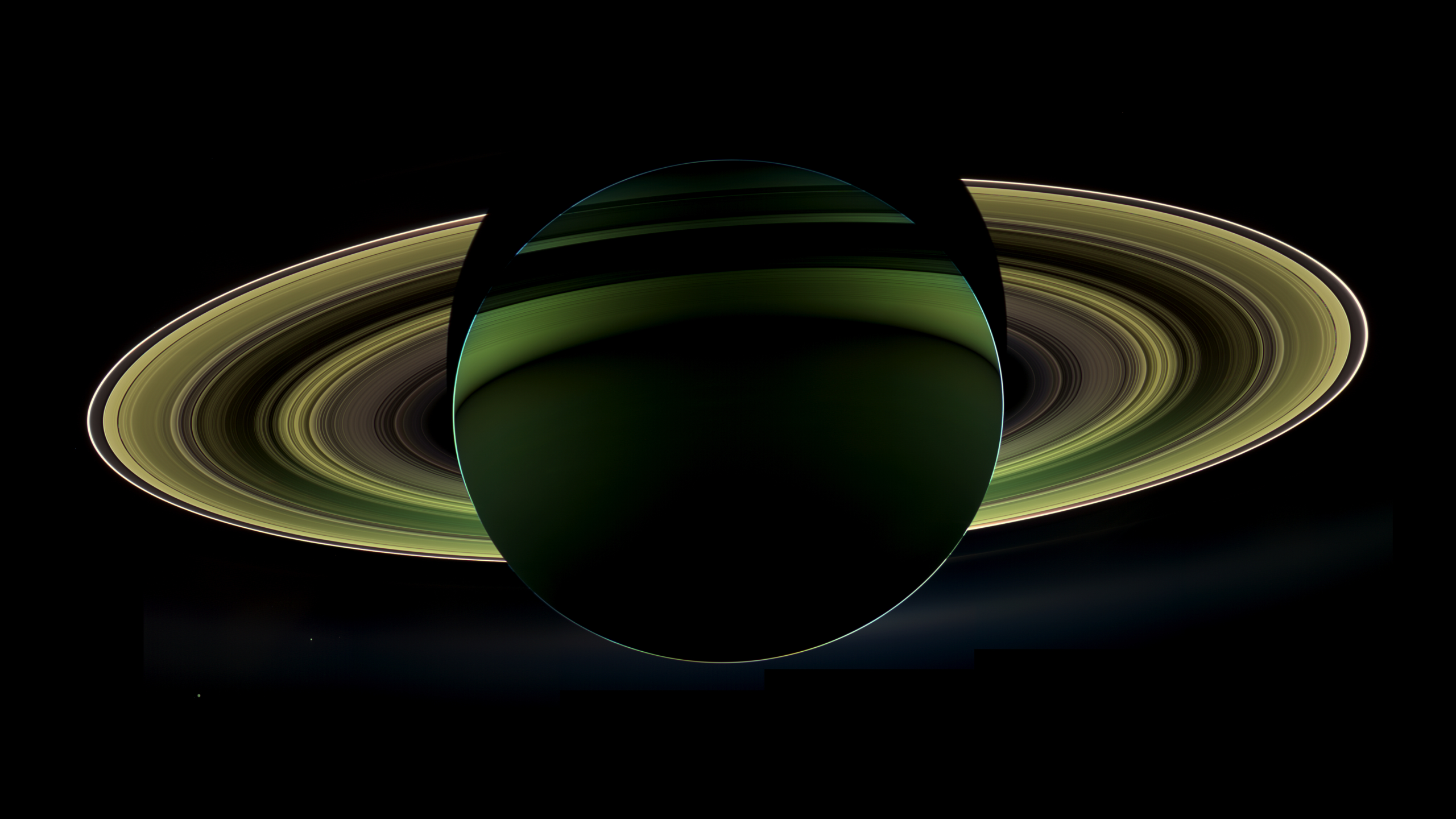
In a five-dimensional spacetime, the equations allow a black hole with a ring-shaped event horizon, forming a torus with a hole in the middle. Placing a second, spherical black hole inside that ring creates a configuration known as a Black Saturn, where each object maintains its own event horizon.
The first mathematical description of this configuration was published in 2007, carrying a distinct limitation: the two black holes could rotate only in one plane. In five-dimensional space, objects can rotate in two independent planes simultaneously, though accounting for both rotations increases mathematical complexity.
Armas addressed that constraint by developing a solution that permits both black holes to rotate in both planes. “The space of black holes in higher-dimensional vacuum gravity is richer than its four-dimensional counterpart,” he writes in the preprint reported by ScienceAlert.
Extremal states and frame dragging effects
The new mathematics shows that both black holes in a Black Saturn can reach a state of extremality together. When a black hole hits the limit of angular momentum relative to its mass, it becomes extremal, dropping its Hawking temperature to absolute zero and halting the emission of Hawking radiation.
In five dimensions, a black hole must spin in both independent planes to reach this state without losing its event horizon entirely, a result earlier uniplanar models could not capture.
Full equilibrium remains out of reach for the pair, because matching their rotations in both planes is not possible while maintaining a regular Black Saturn shape, as aroundprague.cz reported on its news site.
Furthermore, the rotating objects influence one another through frame dragging, a phenomenon where spinning masses drag surrounding spacetime along with them. This effect allows the ring to force the central black hole’s horizon to rotate in a plane where that central body possesses no intrinsic angular momentum.
Verification status and theoretical value
There is no evidence that Black Saturns exist or that the universe contains the extra spatial dimension required to house them. The work described in the arXiv preprint remains unconfirmed by peer review.
The University of Amsterdam, where Armas holds his position, traces its origins to the Athenaeum Illustre founded by municipal authorities in 1632, making it the fourth-oldest academic institution in the Netherlands still operating. It became a municipal university in 1877 and a national university in 1961; today it is the largest in the country by enrollment with more than 44,000 students and counts six Nobel Laureates among its alumni.
The result functions as a theoretical tool rather than an empirical observation. Physicists use solutions of this type to test prior predictions and study how gravity behaves under extreme conditions far removed from everyday observations.