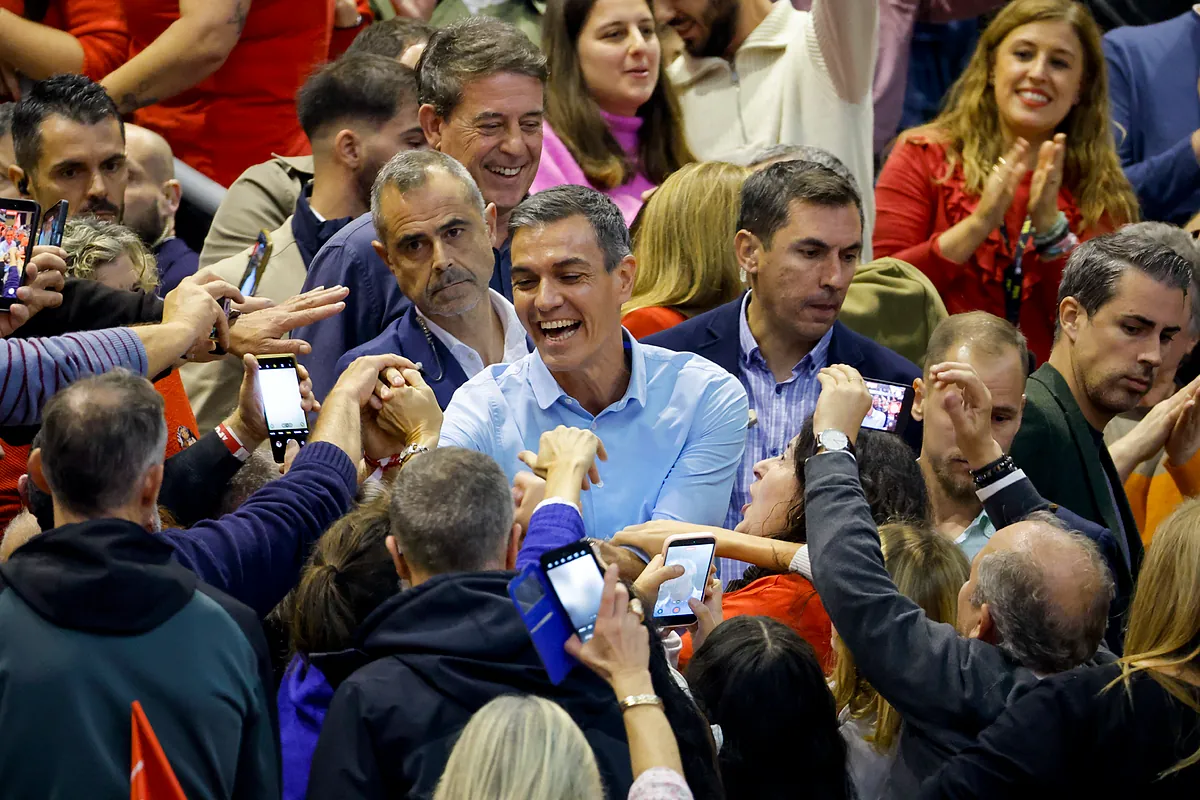
Pedro Sánchez Addressed a Crowd of 10,000 Supporters in Santiago de Compostela
Pedro Sánchez addressed a crowd of 10,000 supporters in Santiago de Compostela on Friday where he challenged Alberto Núñez Feijóo’s political record and criticized his performance in their recent televised debate.
Santiago Rally Attendance Totals
The PSOE rally at the Multiusos Fontes do Sar venue drew 10,000 attendees, according to party figures reported by El Mundo. This turnout serves as a direct response to a challenge issued by the Partido Popular, which claimed an attendance of 8,000 people at the same venue the previous Saturday, according to La Vanguardia.
The PSOE rally was scheduled to coincide with the 51st anniversary of the death of Francisco Franco, a date the party used to frame the upcoming election as a choice between progress and regression.
Socialist officials joked about the turnout, with some remarking, “What do you want us to equal you? We sweep you!” and “Now I know how the Rolling Stones’ opening acts must have felt,” according to El Mundo. The event carried extra weight because the PSOE has ranked as the third political force in Galician regional elections since 2020, behind the BNG.

Sánchez Defends Debate Approach as Exposing Opponent
Sánchez characterized his approach to the recent face-to-face debate with Feijóo as a deliberate choice to prioritize “good education” over conflict. “The great advantage of letting a person speak who has nothing to offer but insults and hoaxes is that they end up portraying themselves,” Sánchez said.
El Debate said that the Prime Minister rejected the suggestion that he was defeated in the debate, framing his performance instead as a demonstration of “good politics” meant to expose his opponent’s tactics.
During the rally, Sánchez argued that voters face a clear choice on November 29: “For those who want to vote for insults and hoaxes, there is the one from Feijóo and Abascal. And there is only one ballot for those who want to claim and win good politics, which is the PSOE’s,” as reported by RTVE.

Regional Context in Galicia
The choice of Santiago de Compostela carries specific political weight, as the region has historically provided the Partido Popular with consistent electoral success. José Ramón Gómez Besteiro, the secretary general of the PSOE in Galicia, addressed the crowd entirely in Galician, stating that “the best thing Feijóo did for Galicia was to leave,” as reported by RTVE, according to Rtve.
Besteiro further claimed that “the worst thing he can do for Spain is to stay,” according to La Vanguardia. Besteiro also accused Feijóo of being a “lazy person” for not learning English during his time as the party’s national leader and criticized his tenure at the Xunta for tripling public debt.
The event featured several prominent figures, including Vigo Mayor Abel Caballero, A Coruña Mayor Inés Rey, former Xunta presidents Emilio Pérez Touriño and Fernando González Laxe, and former minister José Blanco, according to El Mundo.
Sánchez arrived at the venue to the song ‘Superestrella’ by Aitana and wore a shirt with the slogan ‘A forza das mulleres’ (The strength of women), continuing his campaign strategy of wearing shirts in different official state languages, according to RTVE.

Sánchez Pledges to Defend Euthanasia Law at Rally
Sánchez utilized the rally to warn against the potential repeal of the euthanasia law, appearing on stage with Ramona Maneiro, a figure associated with the case of Ramón Sampedro. Maneiro presented Sánchez with the book Querido Ramón. Un testimonio de amor.
“We are not going to allow the euthanasia law to be repealed in our country,” Sánchez told the audience, as reported by La Vanguardia. He urged voters to focus on two specific targets: achieving a 75% turnout to secure 176 seats in the national parliament, the threshold required for an absolute majority, according to El Debate. The Prime Minister said that he ignores polling data currently placing his party at 120 seats.
Sánchez, born in Madrid in 1972, first joined the PSOE in 1993 after Felipe González’s election victory. He entered parliament in 2009 and became party leader in 2014, only to resign in 2016 after clashing with the party executive.
He won back the leadership eight months later, then ousted Mariano Rajoy through a vote of no confidence in June 2018 to become prime minister. In November 2019 he formed Spain’s first national coalition government since the return to democracy, and secured a third term in November 2023 despite his party finishing second in the popular vote.
The Prime Minister’s campaign now moves toward the final weekend of the electoral period, with scheduled stops in Tenerife and Gran Canaria on Saturday, followed by a rally in Murcia on Sunday.
Whether the PSOE’s mobilization efforts can overcome the current polling trends—which, according to a Sigma Dos tracking poll for El Mundo, place the Partido Popular at 31.2%—remains the central question for the final week of the campaign.