Pediatric Hospital Transfers and Regional Care Inequities in Greece
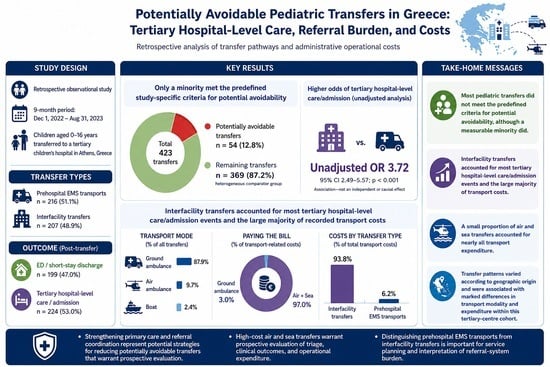
A retrospective analysis of 423 pediatric transfers conducted between 2022 and 2023 at a tertiary children’s hospital in Athens, Greece, reveals that 53.0% of cases required tertiary-level care or hospital admission, while only 12.8% met strict criteria for potential avoidability. Published on Preprints.org in June 2026 by Filippos Filippatos and colleagues, the data underscores significant cost concentrations in specialized transport modalities.
Transport Expenditure Disparities and Modality Costs
The financial burden of regional pediatric transfers is heavily skewed toward specialized transport types, according to the Preprints.org study. Ground ambulances accounted for the majority of total transfer volume in the dataset. Yet, air and sea transport represented just 12.1% of all movements while consuming 97.0% of total transport-related expenditures. Furthermore, interfacility transfers generated 93.8% of the aggregate transport costs, highlighting a stark economic divergence between primary prehospital dispatches and secondary facility-to-facility movements.
Clinical Utilization and Referral Pathway Efficiency
Out of the 423 children aged zero to sixteen evaluated in the research, 216 were prehospital emergency medical service transports and 207 arrived via interfacility transfers. Post-transfer outcomes tracked a binary endpoint dividing emergency department or short-stay discharges from formal tertiary hospital-level admissions. Interfacility transfers proved nearly four times more likely to require intensive tertiary care compared to prehospital EMS dispatches, yielding an odds ratio of 3.72 with a 95% confidence interval ranging from 2.49 to 5.57.
Only 54 out of the 199 emergency department and short-stay discharge cases met conservative resource-utilization thresholds for potential avoidability. This subset represents just 12.8% of the total cohort analyzed by Filippatos, Vasiliki-Maria Kymioni, and co-authors. The findings suggest that the vast majority of current transfer pathways successfully channel clinically appropriate patients toward specialized resources, minimizing systemic waste.
Optimizing Regional Networks and Economic Impact
Managing the fiscal friction of specialized pediatric referral systems requires robust administrative frameworks. Strengthening regional pediatric capacity remains the primary operational objective for mitigating transport cost concentrations across southeastern Europe’s healthcare grid.