
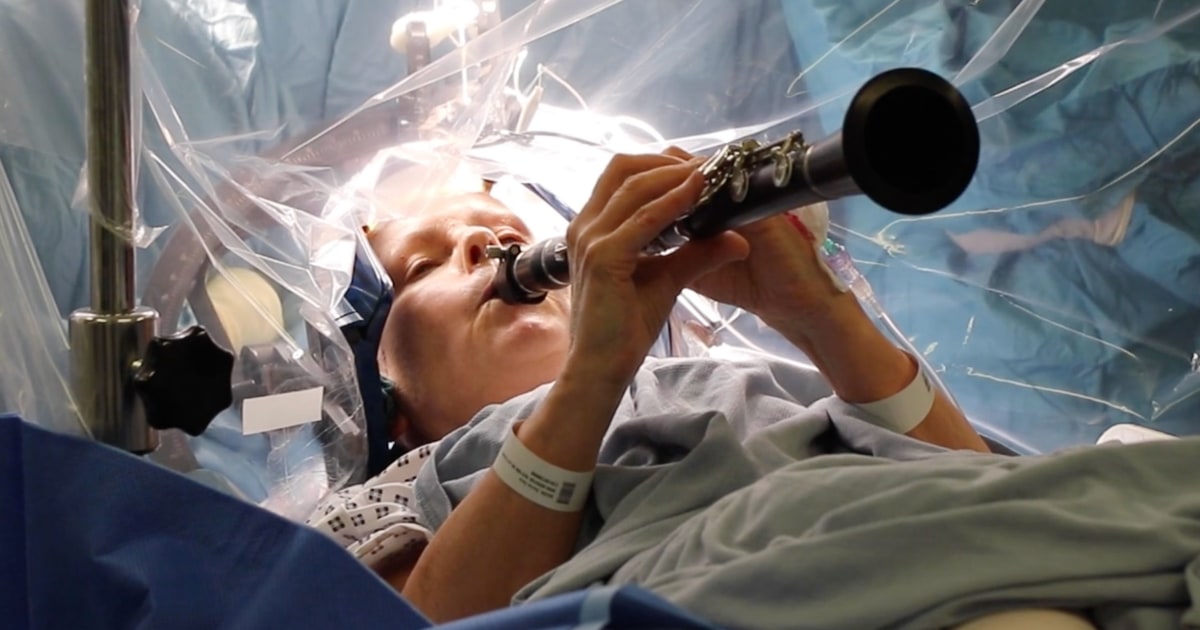
Clarinetist Plays On: Woman Undergoes Brain Surgery for Parkinson’s While Performing Music
LONDON – In a remarkable intersection of music and medicine, a retired speech and language therapist with Parkinson’s disease played the clarinet during her own deep brain stimulation (DBS) surgery at London’s King’s college Hospital, doctors announced Tuesday. The procedure, lasting several hours, allowed surgeons to monitor the impact of the surgery on her motor skills in real-time.
Denise Bacon, diagnosed with Parkinson’s in 2014, had experienced increasing difficulty with movement, impacting her ability to walk, swim, dance, and play her beloved clarinet – a passion she’d enjoyed as a member of the East Grinstead Concert Band until five years ago.
Professor Keyoumars Ashkan, a neurosurgeon at King’s College Hospital, performed the DBS procedure, implanting electrodes into Bacon’s brain. “Stimulating electrodes are placed into the deep structures of the brain,” ashkan explained in a hospital news release, noting that DBS is “a long-established procedure to improve motor symptoms in patients with movement disorders.”
while the brain itself lacks pain receptors, Bacon received local anesthetic to numb her scalp and skull as surgeons made small openings to insert the electrodes. A pulse generator,functioning similarly to a pacemaker,was then connected to deliver targeted electrical signals.
Recognizing the importance of music to Bacon, the surgical team suggested she bring her clarinet to the operating theater. “As a keen clarinetist, it was suggested Denise bring her clarinet into the operating theatre to see whether the procedure would improve her ability to play, wich was one of Denise’s main goals for the surgery,” Ashkan said.
During the surgery, Bacon immediately noticed a positive change. “I remember my right hand being able to move with much more ease once the stimulation was applied, and this in turn improved my ability to play the clarinet, which I was delighted with,” Bacon stated in the release.
The practice of keeping patients awake during certain brain surgeries allows doctors to safeguard vital brain functions. This isn’t the first time Professor Ashkan has utilized this technique at King’s College Hospital; in 2020, a violinist played jazz while surgeons removed a brain tumor.
Bacon is already experiencing improvements in her walking and anticipates a return to swimming and dancing. The chest-implanted pulse generator will continue to deliver electrical impulses for the next 20 years, offering her the possibility to fully re-engage with the activities she loves.
