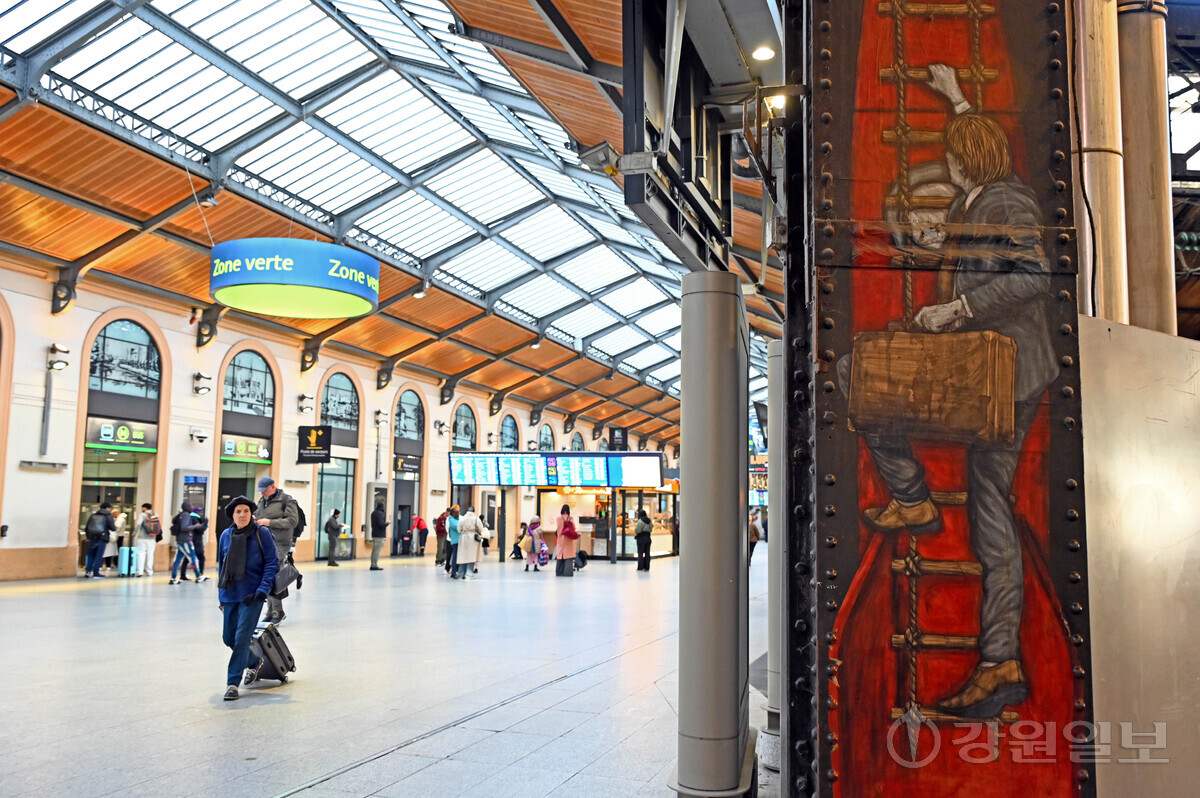
Paris Gare Saint-Lazare Model Links Transit, Art and Urban Culture
Paris’s Gare Saint-Lazare serves as both a transportation hub and a model for integrating urban art into daily transit, offering a template for regions seeking to revitalize railway stations.
Opened in 1837 as the city’s first railway station, the site has evolved from a historic transit point into a complex featuring 80 shops and restaurants following a 2012 renovation, 강원일보 reported.
The station’s cultural identity is rooted in its history as a subject for Impressionist painters. Claude Monet produced a series of 12 works in 1877 depicting the station’s steam engines and light filtering through its iron roof. Today, the facility continues this tradition by hosting contemporary installations, such as the works of French artist Levalet. These include “Complaints Department,” located above a yellow mailbox on the second floor, and “Obtaining a Perspective,” situated on a metal pillar opposite platforms 20 and 21.
Beyond the station’s interior, the surrounding area encourages visitors to explore local cultural resources. The streets north of the station house numerous music shops, instrument repair stores, and galleries. The Pernod Ricard Foundation, a hub for contemporary art, is located within a one-to-two-minute walk from the station exit.
“It is important to look at both the artistic resources formed around the station and the historical nature of the station itself,” said Camille Lemonnier, an artist and musician who works in Paris. Lemonnier said that while famous works draw attention, stations offer a unique opportunity to provide exposure for emerging artists by using high foot traffic.
The transformation of railway infrastructure extends to other Parisian landmarks, most notably the Musée d’Orsay.
Originally built as the Gare d’Orsay for the 1900 World’s Fair, the building was repurposed into a museum in 1986 after it ceased operations as a train station, according to 강원일보. The museum retains its original iron structure and large clock, preserving the site’s industrial heritage while serving as a cultural space.
“Train stations are exchange spaces where people and culture come and go,” Lemonnier told 강원일보.