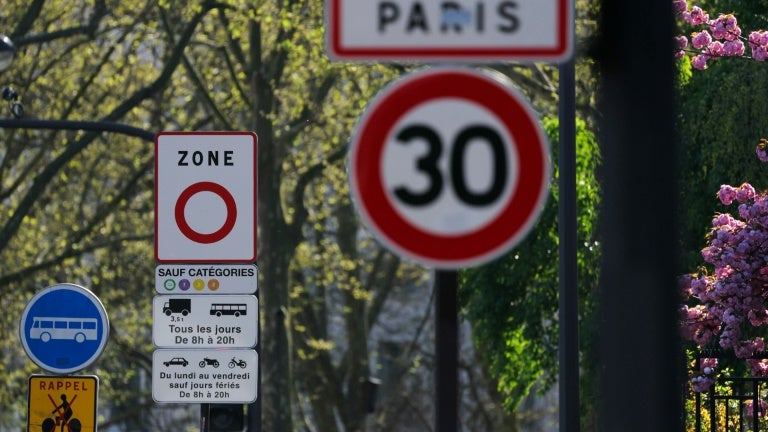
Paris City Hall to Remove 2,000 Traffic Signs Deemed Obsolete in GPS Era
Paris city hall will remove nearly 2,000 of the capital’s 80,000 traffic signs, declaring them obsolete in the GPS era.
The panels, deemed redundant or degraded, clutter public space and no longer reflect a city where bicycles now outnumber cars, officials said.
Deputy Mayor Pierre Lombard said the initiative targets direction, monument and public building signs. “In the 1980s when the signs were installed in Paris, we still drove R5s,” Lombard said in a video released by the municipality.
“Today in 2026, there are more bicycles than cars circulating in Paris and to find our way we use a GPS.” The plan extends beyond Paris; in Thiécourt, Oise, the mayor has already removed nearly 40 signs, about one in five, judging them outdated or unnecessary, according to RMC.
Critics argue the removal deepens a digital divide. “Signage is a public service and there are still people who don’t have a GPS,” lawyer Yaël Mellul said Monday on RMC’s “Estelle Midi” program. “This will accentuate the digital divide that already exists, especially for the elderly.”
Host Estelle Denis cited a recent Orange network outage to support the concern. “Sometimes the GPS isn’t always well made,” she told RMC Story. “Recently, there was a major Orange outage and I had a rental car without GPS and nothing worked anymore while I was in a city I didn’t know.”
Bookseller Jean-Philippe Doux said he relies on street signs. “I have no sense of direction and I love to wander, I need the signs and the street names,” he said on RMC. “Whereas the only accident I’ve had on a two-wheeler was while changing an address on my phone. We must not have the phone in the car, that’s not the solution.”
Listener Romuald, a frequent driver, supported removing some panels. “But information kills information,” he told RMC. “Indeed people without GPS or those on bikes, they will be able to find their way and it’s logical but sometimes there are too many, there’s a lot of information I don’t know where to look.”
Commentator Daniel Riolo accused the administration of ignoring outer arrondissements. “The deputy mayor implies that everyone is on a bike,” Riolo said on RMC. “This city hall has been privatized by friends of the 1st, 2nd, 3rd, 4th arrondissement. Their voters are among themselves, the elderly they don’t give a damn about, tourists the same, visibly they don’t want them anymore.”
Deputy Mayor Pierre Lombard, elected Conseiller de Paris on 22 March 2026 and appointed adjoint au Maire on 29 March 2026 with responsibility for cleanliness, sanitation, waste reduction and the circular economy, announced the plan to remove nearly 2,000 traffic signs in a municipal video. He argued that direction, monument and public building panels installed in the 1980s no longer match a city where bicycles now outnumber cars and navigation relies on GPS.
Yves Carra, spokesman for the Mobilités Club France, said that Lyon operates with far fewer signs. “There are numerous studies on road safety and signage with flashing lights instead of green and red lights and we observed that drivers slowed down, increasing road safety,” he said on RMC. “Without signs, we might be more attentive.” The city hall has not specified a timeline for the sign removals in Paris.