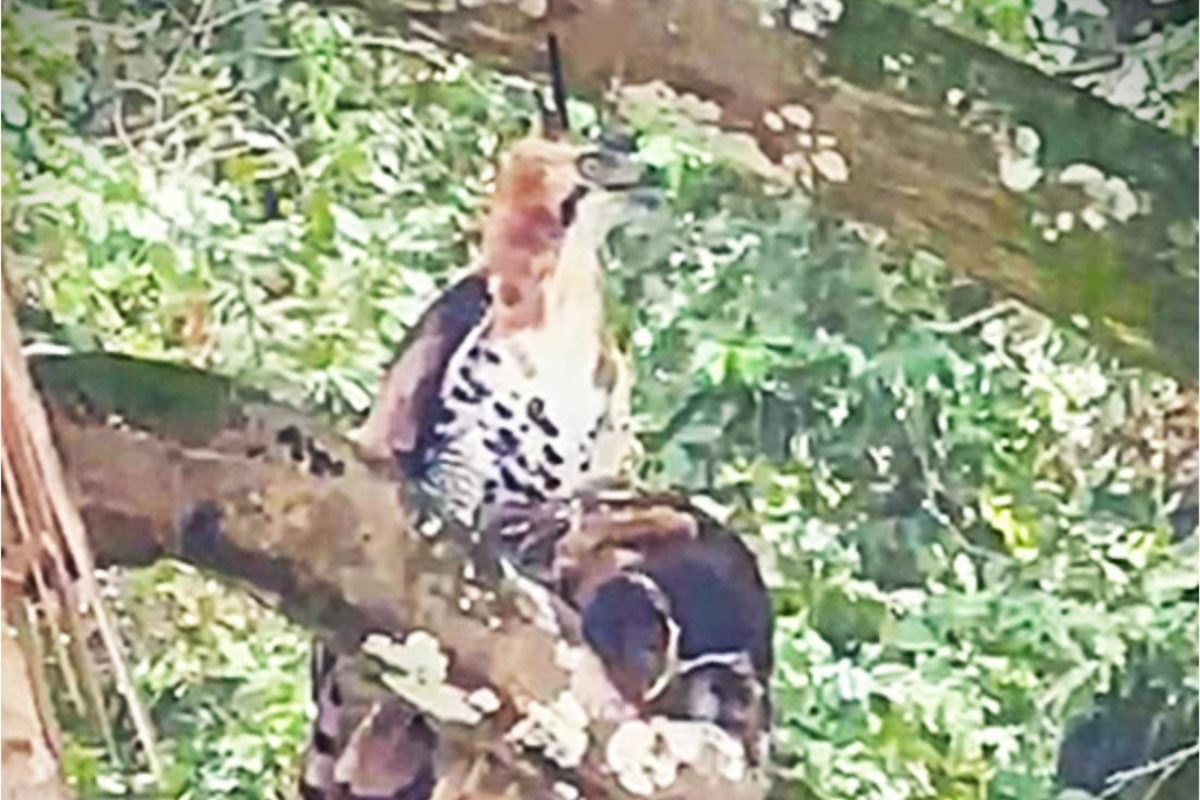
Ornate Hawk-Eagle Kills Crested Owl in Rare Costa Rica Event
Corcovado National Park Raptor Encounter
Researchers in Costa Rica documented an unprecedented predation event in Corcovado National Park’s lowland forests, where an ornate hawk-eagle attacked and killed a crested owl.
The Tech TL;DR:
- Researchers in Costa Rica recorded an ornate hawk-eagle preying on a crested owl for the first time.
- A common black hawk attempted kleptoparasitism by swooping in to steal the kill from the eagle.
- The primary ornate hawk-eagle successfully defended its prey before relocating it to a high forest branch.
The interaction between the ornate hawk-eagle (Spizaetus ornatus) and the crested owl (Lophostrix cristata) represents a documented first for science. Ornate hawk-eagles are powerful tropical American raptors with wingspans exceeding one metre. While they frequently target medium-sized birds and mammals like toucans, monkeys, squirrels, and cracids, direct observations of intraguild predation involving owls remain exceptional. This specific predation record highlights the vulnerability of even medium-sized nocturnal raptors to large forest eagles.
Common Black Hawk Intervention
The complexity of the encounter escalated when a third raptor species entered the scene. A stocky common black hawk (Buteogallus anthracinus), which had tracked the initial predation event from nearby, swooped in to execute kleptoparasitism—a feeding strategy where one animal deliberately seizes food procured by another.
The ornate hawk-eagle refused to relinquish its meal. The eagle aggressively fought off the intruding black hawk and retained the crested owl, eventually carrying the carcass to a high branch within the lowland forest canopy. Scientists involved in the field excursion published these findings in the Caribbean Journal of Science.

Baseline Knowledge of Predator-Prey Dynamics
The study authors emphasize that while a single observation cannot establish the exact statistical frequency of such lethal competitions, documenting these events expands baseline knowledge regarding tropical raptor assemblages. Intraguild predation occurs when competing species that share resource demands also prey directly upon one another.
Researchers credit the observation to José Manuel Mora and colleagues, whose documented field data adds a newly verified predator-prey interaction to avian ecology literature.