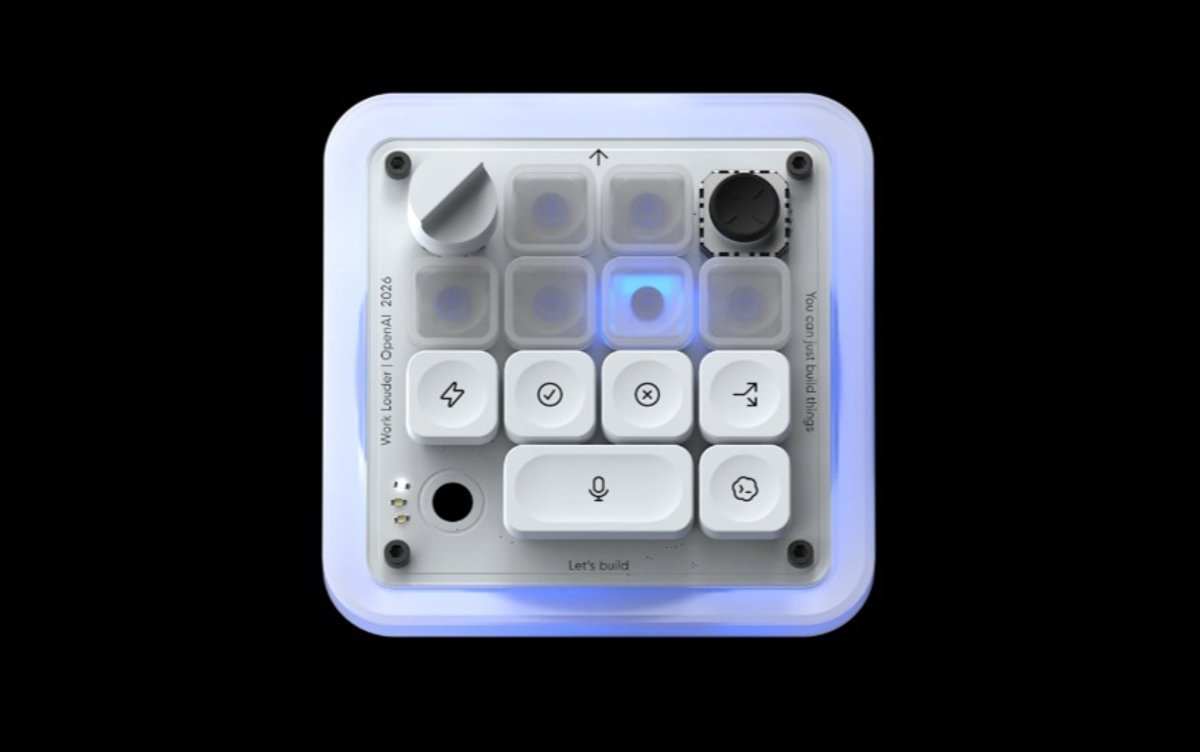
OpenAI Develops New Hardware Controller for AI Agents
OpenAI Agent Controller: Hardware-Level Latency Reduction for AI Workflows
OpenAI has begun prototyping a dedicated hardware peripheral designed to offload the management of AI agents to a tactile interface, featuring physical buttons and a joystick. This development aims to bridge the gap between high-latency software-based agent orchestration and immediate, physical command execution, effectively moving control from the GUI into a dedicated input device.
The Tech TL;DR:
- Hardware-Defined Orchestration: The peripheral allows for direct mapping of agent tasks to physical inputs, reducing context-switching latency in complex workflows.
- Input Precision: By utilizing a joystick and programmable buttons, users can navigate agent environments or adjust parameter sliders without relying on high-latency mouse-and-keyboard pointer precision.
- Enterprise Integration: The device is designed to interface directly with OpenAI’s agentic frameworks, streamlining tasks that require constant human-in-the-loop (HITL) oversight.
The shift toward “agentic” AI—systems capable of autonomous task execution—has created a new bottleneck: the human-computer interface. While LLMs excel at processing unstructured data, human oversight often remains sluggish due to the limitations of traditional desktop environments. OpenAI’s decision to move into hardware suggests a recognition that software-only orchestration, as documented in the OpenAI Platform Documentation, requires a more immediate tactile feedback loop for power users.
Architectural Implications for Agent Management
From an engineering perspective, the introduction of a dedicated controller suggests an attempt to bypass the OS-level input lag inherent in standard USB HID (Human Interface Device) implementations. By treating the controller as a specialized input for agent state-machines, OpenAI is likely optimizing for low-latency interrupts. This is critical for environments where an agent requires real-time calibration—such as adjusting a model’s temperature or focus parameters on the fly.
For enterprise IT departments, this hardware represents a new endpoint that requires management. Organizations currently utilizing Managed Service Providers (MSPs) to monitor their AI infrastructure will need to assess how these controllers interact with existing SOC 2 compliance frameworks. If the device stores local cache or configuration profiles, it effectively becomes another node in the network perimeter, necessitating strict endpoint security policies.
The Implementation Mandate: Interfacing with the Agent API
While the hardware is proprietary, the underlying logic relies on existing API hooks. Developers seeking to simulate this functionality before official hardware integration can map keyboard macros to existing OpenAI API endpoints using standard Python libraries to mimic “joystick” behavior for agent state transitions.
import requests

# Example: Mapping a 'Joystick' axis input to an agent's priority state
def update_agent_priority(axis_value):
    # Normalize input for API compatibility
    priority = "high" if axis_value > 0.8 else "normal"
    payload = {"agent_id": "agent_882", "priority": priority}
    response = requests.post("https://api.openai.com/v1/agents/update", json=payload)
    return response.status_code
Framework C: The “Tech Stack & Alternatives” Matrix
This hardware release positions OpenAI against traditional input device manufacturers and niche AI-hardware startups. The following matrix evaluates the current landscape of AI-focused human-machine interfaces.
| Feature | OpenAI Controller (Proposed) | Stream Deck (Macro-based) | Custom FPGA/Joystick |
|---|---|---|---|
| Latency | Ultra-low (Native Driver) | Medium (Software Hook) | Lowest (Custom Logic) |
| Flexibility | High (Agent-centric) | Low (Macro-dependent) | Extreme (Requires Coding) |
| Deployment | Plug-and-play | Software-intensive | Engineering-intensive |
Managing the Agentic Threat Surface
The introduction of physical controls for AI agents introduces a specific cybersecurity risk: unauthorized physical access. If an agent has the authority to execute code or access sensitive databases, a physical controller left unsecured on a desk could allow an unauthorized user to “nudge” an agent into performing unintended actions. Firms specializing in Cybersecurity Auditing recommend that all such hardware peripherals be managed with the same rigor as biometric security keys or YubiKeys.
As the industry moves toward deeper containerization of AI agents, hardware controls will likely become as standard as the mouse was to the GUI. For CTOs, the priority remains ensuring that these physical interfaces do not introduce vulnerabilities into the existing CI/CD pipeline or Kubernetes cluster configurations. As with any new hardware rollout, Software Development Agencies should be consulted to ensure that the integration layer between the physical joystick and the cloud-based agent remains encrypted and authenticated.
The trajectory of this technology points toward a future where AI interaction is no longer confined to the screen. As agents gain more autonomy, the physical controller may serve as the “kill switch” or the “throttle” for autonomous processes, turning complex computational workflows into tangible, human-scale operations.
Disclaimer: The technical analyses and security protocols detailed in this article are for informational purposes only. Always consult with certified IT and cybersecurity professionals before altering enterprise networks or handling sensitive data.