
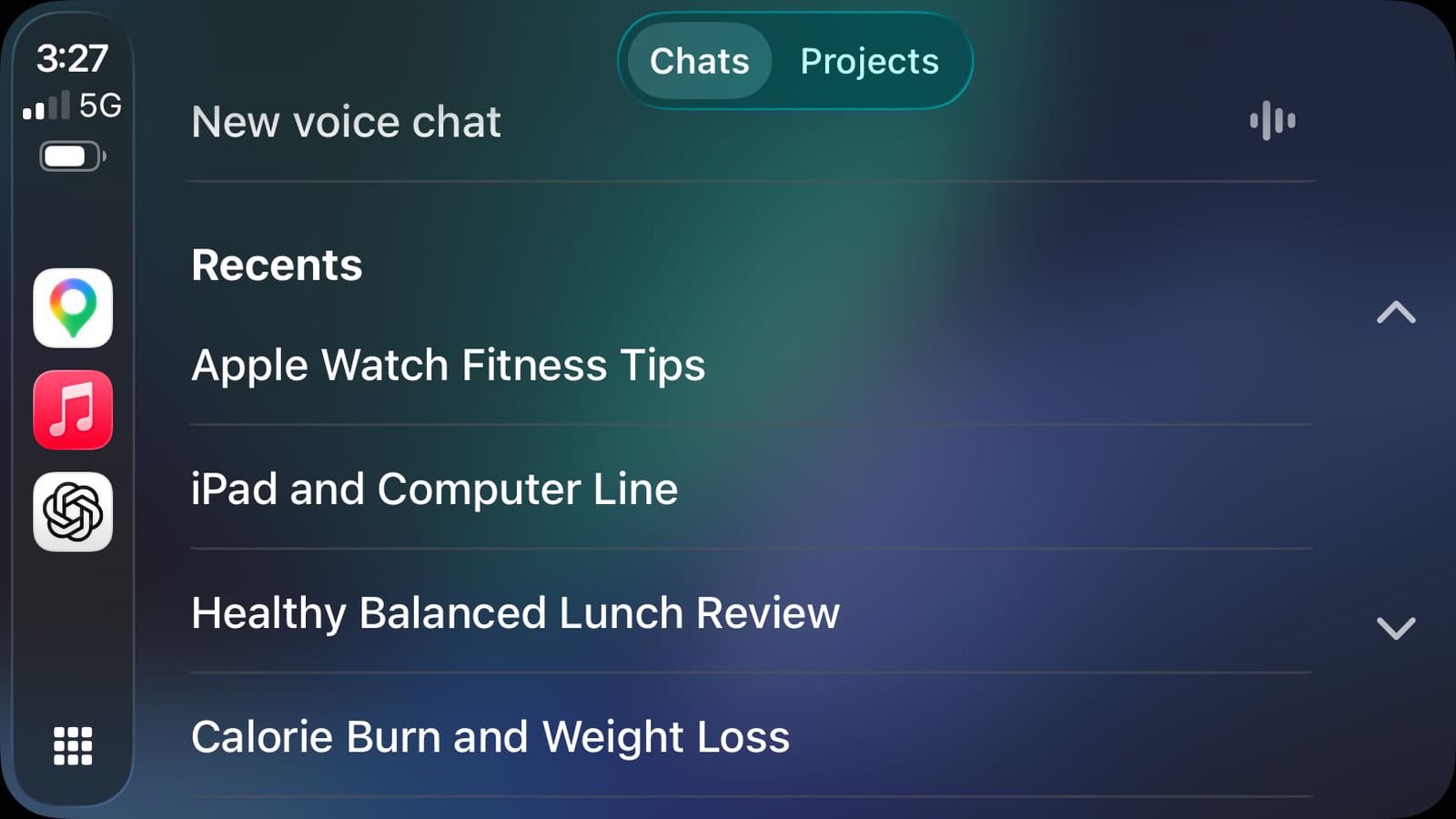
OpenAI Brings ChatGPT to CarPlay for Hands-Free Voice Conversations
OpenAI Deploys ChatGPT to CarPlay: A Security Architect’s Review of the Voice Pipeline
OpenAI pushed ChatGPT integration to CarPlay this week, enabling hands-free voice queries directly from the vehicle dashboard. While marketing teams celebrate the convenience, the architectural reality introduces a new attack surface for enterprise fleets and privacy-conscious consumers. This isn’t just a feature update; it’s a shift in how telemetry and voice data traverse the edge network.

The Tech TL;DR:
- Deployment Status: Live as of iOS 26.4, requiring specific Apple entitlements for voice-only interaction.
- Security Posture: Sandboxed environment prevents vehicle control but exposes voice telemetry to third-party processing.
- Operational Impact: Enterprise fleets must update Mobile Device Management (MDM) policies to restrict or audit AI voice usage.
The implementation relies on Apple’s voice control template, mandating voice as the primary interaction method with no text or imagery displayed during active sessions. This constraint reduces visual distraction but increases reliance on audio processing pipelines that operate outside the vehicle’s local compute unit. From a systems architecture perspective, every query generates a network request that bypasses the vehicle’s native firewall, routing through the iPhone’s cellular connection to OpenAI’s inference engines. For a CTO managing a logistics fleet, this represents an unmanaged data egress point.
The Latency and Privacy Bottleneck
Voice AI in a vehicular context introduces latency variables that deterministic software does not. The round-trip time for voice-to-text conversion, inference, and text-to-speech synthesis depends heavily on cellular signal strength and server load. In high-security zones or areas with spotty coverage, this dependency creates a reliability gap. More critically, the data privacy implications are significant. Voice prints are biometric data. Sending them to a third-party LLM provider requires strict adherence to compliance frameworks like SOC 2 and GDPR.
According to the Security Services Authority, cybersecurity audit services constitute a formal segment of the professional assurance market distinct from general IT consulting. Organizations integrating third-party AI into critical infrastructure, including vehicles, should treat voice data streams with the same rigor as financial transactions. The blast radius of a compromised voice session isn’t just data leakage; it’s potential social engineering vectoring against the driver.
“Integrating generative AI into vehicular systems without end-to-end encryption verification is akin to leaving the diagnostic port open. The convenience doesn’t outweigh the telemetry risk until we have localized inference.” — Senior Security Researcher, Automotive ISAC
Apple’s entitlement model attempts to mitigate this by sandboxing the application. The ChatGPT app cannot control vehicle functions or access iPhone system states beyond the voice input. However, prompt injection remains a viable threat vector. A malicious audio signal broadcast over short-range radio could theoretically trigger unintended queries if the microphone input isn’t properly filtered at the hardware level.
Enterprise Triage and Mitigation
For enterprise environments, the immediate response should be policy enforcement. IT departments cannot rely on user discretion. The deployment of vetted cybersecurity auditors and penetration testers is necessary to validate how voice data is logged and stored by the provider. Fleet managers should integrate this new capability into their existing Mobile Device Management profiles. Restricting app installation or disabling microphone access during driving hours are standard controls that demand updating for iOS 26.4.
Developers looking to implement similar voice interfaces should review the official entitlements to understand the constraints. The following cURL command demonstrates how to verify the entitlements profile for a CarPlay-enabled application during the build process:
codesign -display --entitlements :- /Path/To/YourApp.app | grep -i "com.apple.developer.carplay"This verification ensures that the binary includes the necessary permissions without exposing unintended capabilities. However, code signing is only the first layer. Continuous monitoring of network traffic is required to ensure no unauthorized data exfiltration occurs during voice sessions. Organizations lacking internal expertise should consider engaging specialized AI security consultants to review the data flow architecture.
Infrastructure Requirements and Standards
The underlying infrastructure supporting this feature relies on a complex chain of dependencies: iOS 26.4, the CarPlay daemon, and OpenAI’s API endpoints. Any break in this chain results in service degradation. For mission-critical operations, reliance on public AI APIs is risky. Service level agreements (SLAs) for public AI models do not match the uptime guarantees required for vehicular safety systems.
Per the Cybersecurity Risk Assessment and Management Services provider guide, qualified providers systematically evaluate these dependencies to ensure structured professional security. The guide emphasizes that risk assessment must cover third-party vendor stability, not just internal code quality. If OpenAI experiences an outage, the CarPlay interface should fail gracefully without locking the user out of essential vehicle functions.
Developers should also consider the computational load on the device. While inference happens in the cloud, voice preprocessing utilizes the iPhone’s Neural Engine. Monitoring battery drain and thermal performance is essential, especially in mounted scenarios where devices may overheat. For those building custom integrations, the Apple CarPlay Developer Guide outlines the strict UI limitations that must be respected to avoid App Store rejection.
The Path Forward for Fleet Security
As AI becomes embedded in the edge devices we rely on for transport, the perimeter expands. The integration of ChatGPT into CarPlay is a proof of concept for broader vehicle-to-cloud communication. It demonstrates that users expect conversational interfaces everywhere. However, expectation does not equal security. The industry needs to move toward localized large language models that process voice data on-device, eliminating the egress risk entirely.
Until then, the burden falls on IT leadership to govern usage. This means treating the vehicle as a network node. Regular audits of installed apps and data usage patterns are no longer optional. Companies should look toward managed IT services that specialize in IoT and vehicular connectivity to maintain visibility. The convenience of hands-free AI is compelling, but not at the cost of opaque data practices.
We are witnessing the early stages of the software-defined vehicle ecosystem. The tools are shipping, but the governance frameworks are lagging. Security teams must bridge this gap immediately, ensuring that the drive to innovate doesn’t compromise the integrity of the vehicle’s digital ecosystem. The road ahead is paved with data, and we need to ensure it’s encrypted all the way.
Disclaimer: The technical analyses and security protocols detailed in this article are for informational purposes only. Always consult with certified IT and cybersecurity professionals before altering enterprise networks or handling sensitive data.