Open Venous Cutdown Versus Seldinger Technique for Port-a-Cath Insertion: A Regional Australian Cohort Study
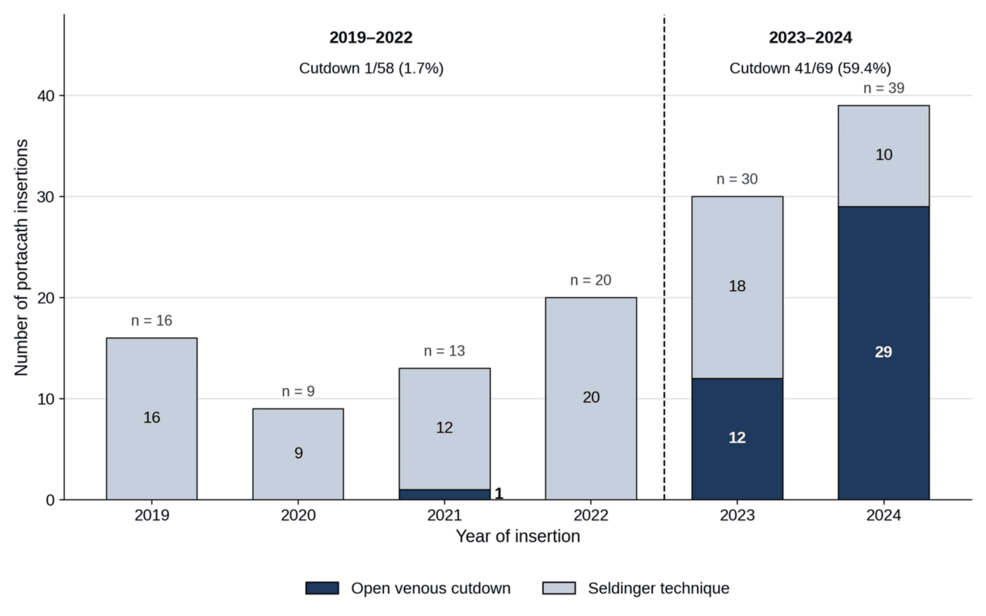
Between January 2019 and December 2024, a total of 127 totally implantable venous access port insertion episodes were performed at Goulburn Valley Health, with surgical teams utilizing open venous cutdown in 33.1% of cases and the Seldinger technique in 66.9%, according to data published in Cureus. The retrospective observational study evaluated procedural and postoperative outcomes within a regional Australian general surgery unit, tracking how technique selection shifted over a six-year period.
The Tech TL;DR:
- Goulburn Valley Health analyzed 127 total port-a-cath insertions performed between 2019 and 2024.
- Open venous cutdown usage surged from 1.7% in the 2019–2022 window to 59.4% during 2023–2024.
- All periprocedural complications—including four bleeding events, four arterial punctures, and one pneumothorax—occurred exclusively within the Seldinger percutaneous group.
Retrospective Analysis Tracks Six Years of Regional Port Insertions
The institutional review identified 42 open venous cutdown procedures and 85 Seldinger cannulation episodes among adult patients requiring long-term venous access for chemotherapy, parenteral nutrition, or repeated blood sampling. First-attempt success rates reached 88.1% for open cutdown and 82.4% for the Seldinger approach, yielding an unadjusted odds ratio of 1.58 with a 95% confidence interval spanning 0.50 to 6.00. Technique conversion rates stood at 9.5% for cutdown and 7.1% for Seldinger, while access-site conversion was required in 4.8% of cutdown attempts and 10.6% of Seldinger attempts. Ultimately, every procedure across both cohorts achieved final success.
Vein selection correlated directly with the chosen methodology. The initial access vein was the cephalic vein in 97.6% of open cutdown attempts, whereas the subclavian vein accounted for 90.6% of Seldinger insertions. Periprocedural complications—comprising four bleeding events, four inadvertent arterial punctures, and a single pneumothorax—manifested exclusively in the Seldinger cohort. Postoperative metrics showed unplanned removals within one year at 0% for open cutdown compared to 14.1% for Seldinger (p = 0.008). However, this statistical significance disappeared after applying Firth’s penalised logistic regression to adjust for calendar year or when restricting the dataset to procedures performed during 2023–2024.
Comparing Regional Findings With Multi-Center Brisbane Data
A separate three-year retrospective study published in PMC examined oncological port insertions across two peripheral Brisbane hospitals, detailing how general surgeons and radiologists approached vascular access. Conversely, radiologists in the same Brisbane study performed 248 ultrasound-guided internal jugular vein TIVAD insertions with a 99.5% first-attempt success rate (247 successful first attempts out of 248) and an overall complication rate of 15.3% comprising 22 infections, 14 port malfunctions, one haemorrhage, and one mediastinal injury.
At Goulburn Valley Health, the concentration of open cutdown procedures toward the later years of the study period—rising from 1.7% of volume between 2019 and 2022 to 59.4% across 2023 and 2024—precluded an independent assessment of the insertion technique’s isolated effect. Because insertion method dictated vein selection and aligned closely with specific calendar periods, researchers emphasized that larger, prospective, multicenter trials are required to isolate technique efficacy from temporal shifts in surgical practice. The institutional evaluation received approval from the Goulburn Valley Health Human Research Ethics Committee on September 9, 2025.
Context of Indwelling Vascular Access and Device Mechanics
Various methods of indwelling central venous access exist beyond totally implantable venous access devices (TIVADs) or port-a-caths, including external catheterization such as Hickman or Broviac catheters. Inside the body, a TIVAD consists of a small rubber dome and an attached flexible tube that leads to a vein above the heart, while a Dacron® cuff prevents the catheter from being pulled out, keeps bacteria out, and allows the skin to grow around it. When treatments are administered, there will be a “poke” when the port is accessed at the start of each treatment, utilizing a special needle inserted through the skin into the rubber dome.