Oman Martian Meteorite Returns Home Aboard Perseverance Rover
A Fragment of Mars, Discovered in Oman, Rides Aboard Perseverance as a Calibration Target
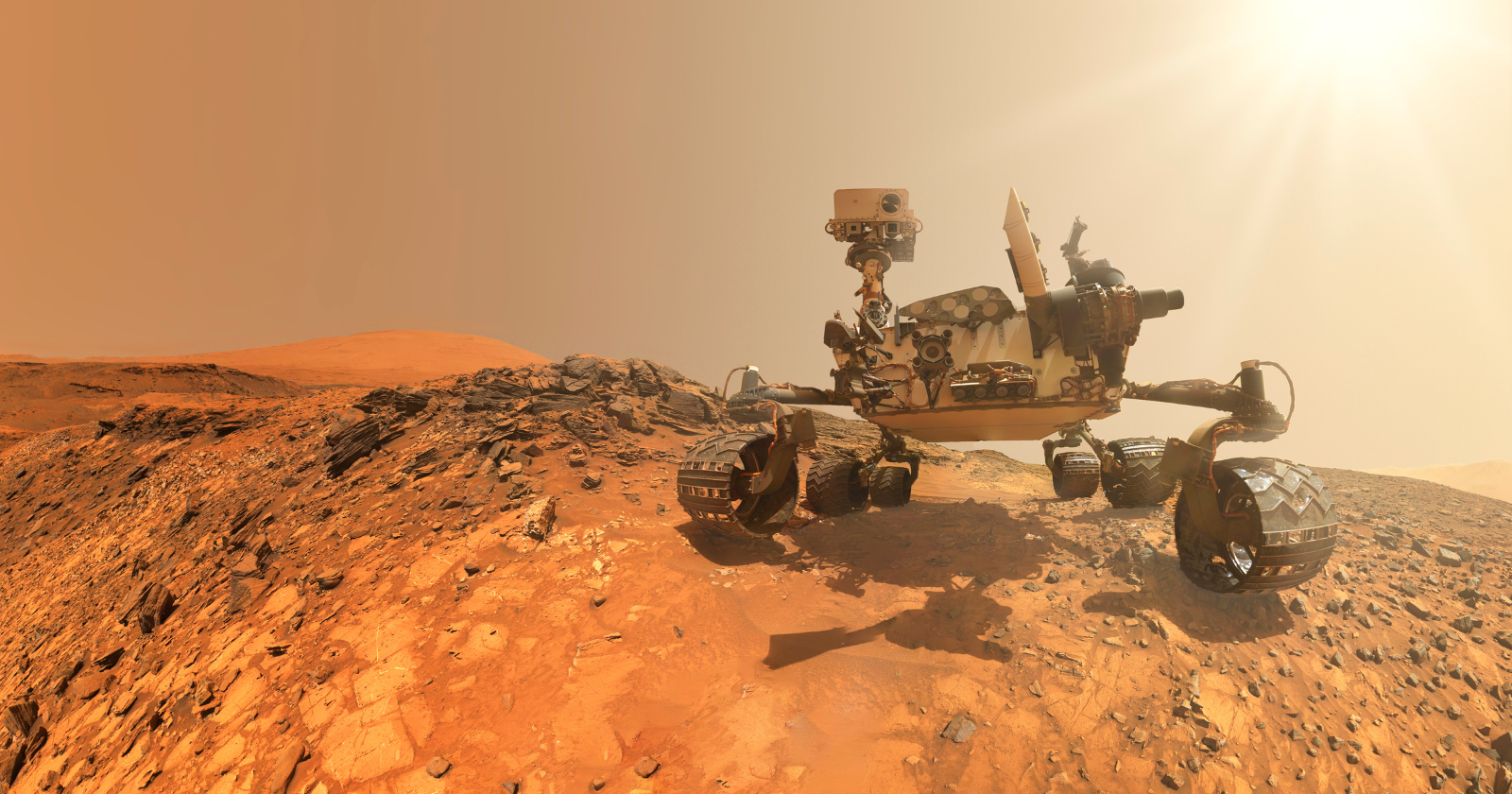
A dark volcanic rock recovered from the gravel plains of central Oman in 1999 has returned to the planet of its origin, mounted aboard the NASA rover Perseverance as an external calibration target. Catalogued originally as Sayh al Uhaymir 008, or SaU 008, and housed in the Natural History Museum in London the following year, the meteorite represents the first time a Martian fragment has been sent back to the Martian surface, according to museum documentation and mission records.
The Tech TL;DR:
- The Deployment: Mounted to the external calibration assembly of the SHERLOC instrument on NASA’s Perseverance rover, which landed in Jezero crater on February 18, 2021.
- The Function: Provides verified pre-launch mineralogical and organic ground truth for deep-ultraviolet Raman and fluorescence spectroscopy across mission telemetry cycles.
Material Durability and Pre-Launch Characterization
Spaceflight launch profiles and atmospheric entry demand extreme mechanical resilience. Many interesting meteorites fragment under vibration or thermal shock, but SaU 008 demonstrated the necessary structural integrity. Caroline Smith, then the Natural History Museum’s Principal Curator of Meteorites, noted that the stone was specifically chosen because it matches required chemical criteria while remaining exceptionally tough, describing the specimen as being “as tough as old boots,” according to historical loan announcements.
Mineralogically, SaU 008 is classified as a shergottite, a predominant subtype of Martian meteorites characterized by specific rock chemistry, noble-gas signatures, and mineral profiles. The slice bolted to Perseverance contains olivine, maskelynite, and iron-magnesium pyroxenes, alongside calcium-carbonate weathering features acquired during its residence in the Arabian desert. Rohit Bhartia, SHERLOC’s deputy principal investigator, explained that instrument validation requires defined textures and organic chemicals, noting that the target meteorite supplies both features for operational testing.
Instrument Calibration and Telemetry Validation via SHERLOC
Aboard the rover, SaU 008 is one of ten distinct targets situated on the SHERLOC (Scanning Habitable Environments with Raman & Luminescence for Organics & Chemicals) external calibration assembly. SHERLOC relies on deep-ultraviolet Raman and fluorescence spectroscopy alongside high-resolution imaging to map minerals and carbon compounds in Martian geology. By utilizing a natural Martian sample characterized on Earth prior to launch, the engineering team maintains a baseline reference to verify instrument response degradation or sample alteration over extended operational timelines.
Operational data confirm the stability of this calibration architecture. A 2025 analysis published in the Journal of Geophysical Research: Planets evaluated SHERLOC observations of SaU 008 across Perseverance’s first 1,000 sols, comparing them against pre-flight terrestrial benchmarks. The instrument consistently registered matching Raman and fluorescence signatures across identical spatial coordinates.
Trajectory and Impact Mechanics
The journey of SaU 008 spans two distinct phases: a chaotic ejection event and a controlled interplanetary transit. Planetary scientists estimate that an impact on Mars roughly 600,000 to 700,000 years ago generated sufficient kinetic energy to hurl debris completely out of the Martian gravity well. One fragment drifted through space before landing in the Omani desert, where it remained until its recovery by meteorite hunters.

Selected in 2018, the meteorite fragment arrived at Jezero crater aboard Perseverance on February 18, 2021. Rather than serving merely as a symbolic monument, the returned rock functions as an active analytical tool. Monitoring its surface over successive Martian years helps researchers parse chemical interactions between the exposed mineral surface and the prevailing Martian atmosphere, providing comparative datasets for ongoing planetary science operations.
Editorial Kicker: The Trajectory of Return-Sample Architecture
The deployment of SaU 008 highlights a shift in planetary exploration: utilizing characterized terrestrial samples as baseline anchors for off-world instrumentation. As automated analytical payloads become increasingly complex, relying on known reference materials prevents systemic drift in spectroscopic arrays.