Obesity-Related Cancers Account for 40 Percent of US Diagnoses, CDC Reports
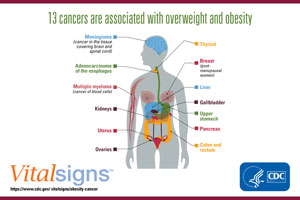
Overweight and obesity are formally linked to an increased risk of 13 distinct types of cancer, representing approximately 40 percent of all cancer diagnoses in the United States during 2014, according to a Vital Signs report released by the Centers for Disease Control and Prevention (CDC) and National Cancer Institute (NCI) researchers on October 3, 2017. While overall cancer incidence rates have declined since the 1990s, the rising prevalence of excess weight threatens to stall decades of public health progress against malignancies.
- Thirteen specific cancer types are recognized by the International Agency for Research on Cancer (IARC) as sharing a pathogenesis linked to overweight and obesity.
- Roughly 630,000 Americans received a diagnosis of an obesity-related malignancy in 2014, with two-thirds of those cases occurring in adults aged 50 to 74.
- Between 2005 and 2014, incidence rates for obesity-related cancers—excluding colorectal cancer—climbed by 7 percent, contrasting with declines in non-obesity-related tumor types.
Epidemiological Burden and High-Risk Demographics
Analyzing data sourced from the United States Cancer Statistics report, federal researchers mapped the heavy toll of excess adiposity on national oncology metrics. In 2013-2014, roughly two out of three adults in the U.S. met the clinical criteria for being overweight—defined as a body mass index (BMI) of 25 to 29.9 kg/m2—or having obesity, classified as a BMI of 30 kg/m2 and higher. BMI is calculated by dividing an individual’s weight in kilograms by the square of their height in meters.
The demographic distribution of these diagnoses shows notable disparities. According to the federal data, 55 percent of all cancers diagnosed in women and 24 percent of those diagnosed in men are associated with overweight and obesity. Furthermore, non-Hispanic blacks and non-Hispanic whites experienced higher incidence rates compared to other racial and ethnic groups, while black males and American Indian or Alaska Native males exhibited higher rates than white males.
“A majority of American adults weigh more than recommended – and being overweight or obese puts people at higher risk for a number of cancers – so these findings are a cause for concern,” said CDC Director Brenda Fitzgerald, M.D., highlighting the gravity of the statistics.
The Spectrum of Thirteen Associated Malignancies
Many patients remain unaware that excess weight acts as an independent risk factor for oncogenesis beyond cardiovascular disease and type 2 diabetes. The IARC has cataloged the 13 specific malignancies tied to this metabolic profile: meningioma, multiple myeloma, adenocarcinoma of the esophagus, and cancers of the thyroid, postmenopausal breast, gallbladder, stomach, liver, pancreas, kidney, ovaries, uterus, and colorectal tissue.

A divergence in incidence trends emerges when evaluating these disease sites over the 2005 to 2014 decade. While cancers linked to excess weight (excluding colorectal cancer) increased by 7 percent, non-obesity-related cancer rates dropped by 13 percent. Colorectal cancer rates moved in the opposite direction of other obesity-linked tumors, declining by 23 percent over the same timeframe. Epidemiologists attribute this specific reduction largely to widespread screening protocols, which allow clinicians to detect and remove precancerous polyps before malignant transformation occurs.
Clinical Triage and Prevention Protocols
Mitigating the long-term morbidity of these conditions requires proactive intervention within primary care settings. As medical standards shift to emphasize preventive medicine, healthcare providers are urged to integrate systematic screenings and counseling into routine patient visits.
“As an oncologist, when people ask me if there’s a cure for cancer, I say, ‘Yes, good health is the best prescription for preventing chronic diseases, including cancer,'” noted Lisa C. Richardson, M.D., M.P.H., director of the CDC’s Division of Cancer Prevention and Control. “What that means to healthcare providers like me is helping people to have the information they need to make healthy choices where they live, work, learn, and play.”
To curb these trends, public health guidelines instruct clinicians to perform standard biometric measurements—including weight, height, and BMI—during routine examinations. When indicated, providers should refer patients with obesity to structured, multi-component weight management programs.
*Disclaimer: The information provided in this article is for educational and scientific communication purposes only and does not constitute medical advice. Always consult with a qualified healthcare provider regarding any medical condition, diagnosis, or treatment plan.*