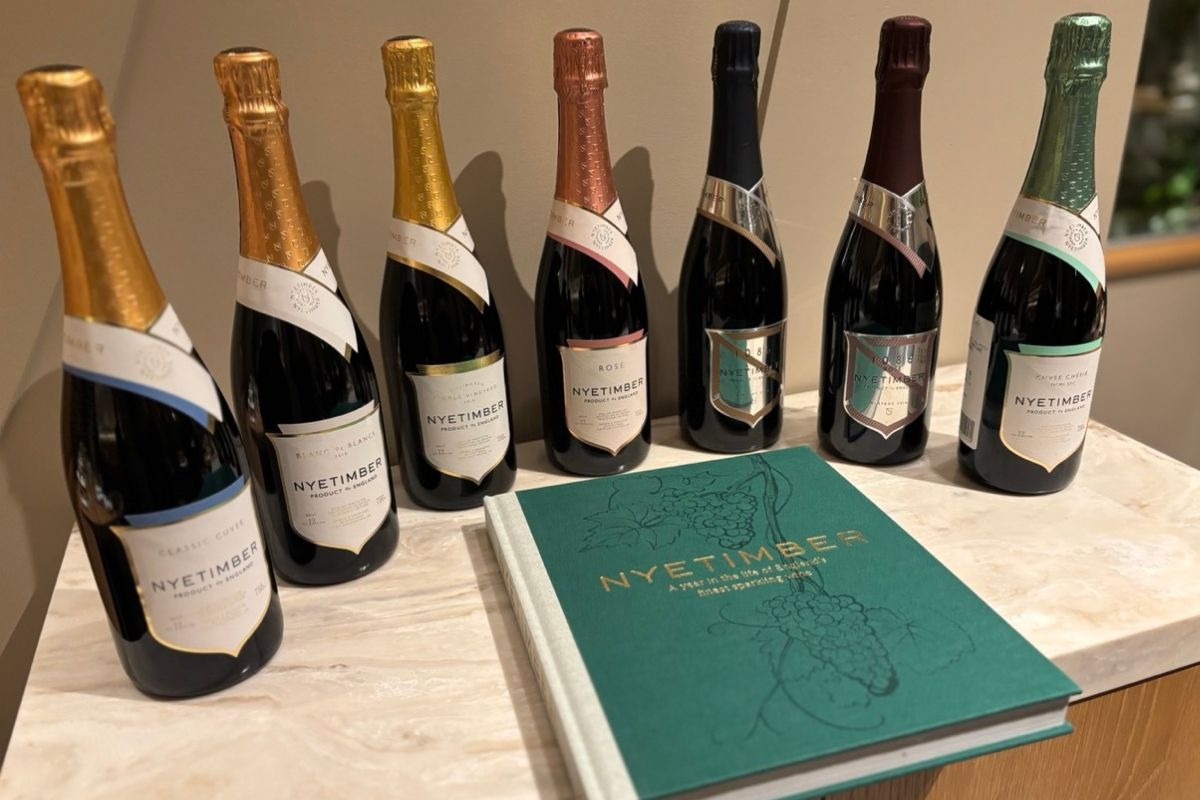
Nyetimber’s Classic Cuvée: Acidity, Time Define English Sparkling Wine
Nyetimber’s vineyards sit on land recorded in the 1086 Domesday Book.
The modern winery began in 1988 when Stuart and Sandy Moss, emigrating from the United States, planted Chardonnay, Pinot Noir and Pinot Meunier in West Sussex. Their first vintage, a Blanc de Blancs from 1992, was released in 1996 — England’s first traditional-method sparkling wine using the three Champagne varieties.
Dutch entrepreneur Eric Heerema acquired the estate in 2006 with a stated goal: “Not just the best in Britain, but among the world’s best.”
Winemakers Cherie Spriggs and Brad Greatrix, a Canadian husband-and-wife team, joined in 2007. They work exclusively from 11 estate vineyards across West Sussex, Kent and Hampshire, divided into roughly 150 individual parcels, each vinified separately. “The winery has 150 tanks,” Chan said.
“We taste each one separately to determine its character before deciding the blend.”
Quality control extends to rejecting entire vintages. In 2012, deemed too cold, Nyetimber harvested nothing and made no wine. “We go that far to protect quality,” Chan said.
While many prestige Champagne houses have moved toward extra brut levels around 6 grams per liter of residual sugar, Nyetimber maintains 9–10 grams across its range, keeping its wines in the brut category. The higher dosage counters pronounced acidity from grapes grown near the northern limit of viticulture. “When you actually taste it, you don’t perceive sweetness,” Chan said. “The acidity is so prominent that the sugar balances it.”
The entry-level Classic Cuvée Multi Vintage blends the cool 2021 vintage (74 percent) with five older vintages dating back to 2017, according to madameFIGARO.jp(フィガロジャポン).
Every cuvée undergoes a minimum of three years on lees before release. The flagship 1086 Prestige Cuvée 2013 spent six years on lees, bottles laid horizontally to maximize yeast contact. A rosé version from 2016 adds strawberry, raspberry and rose notes to the brioche-driven palate. The Tillington Single Vineyard, identified by Spriggs for its Pinot Noir’s distinctive rose-petal aroma, became one of the first site-specific cuvées in the category.
Wine journalist Tadayuki Yanagihara said that 19th-century Champagne recovered from shipwrecks analyzed at 200 grams per liter of residual sugar — far above today’s demi-sec maximum of 50 grams — yet tasted balanced because acidity was far higher.
Nyetimber’s demi-sec, the Cherie Multi Vintage, echoes that profile: noticeable sweetness supported by vibrant acidity. Unlike Franciacorta, which substitutes Pinot Bianco for Pinot Meunier, Nyetimber adheres to the three Champagne varieties and imposes stricter standards on itself than English law requires.