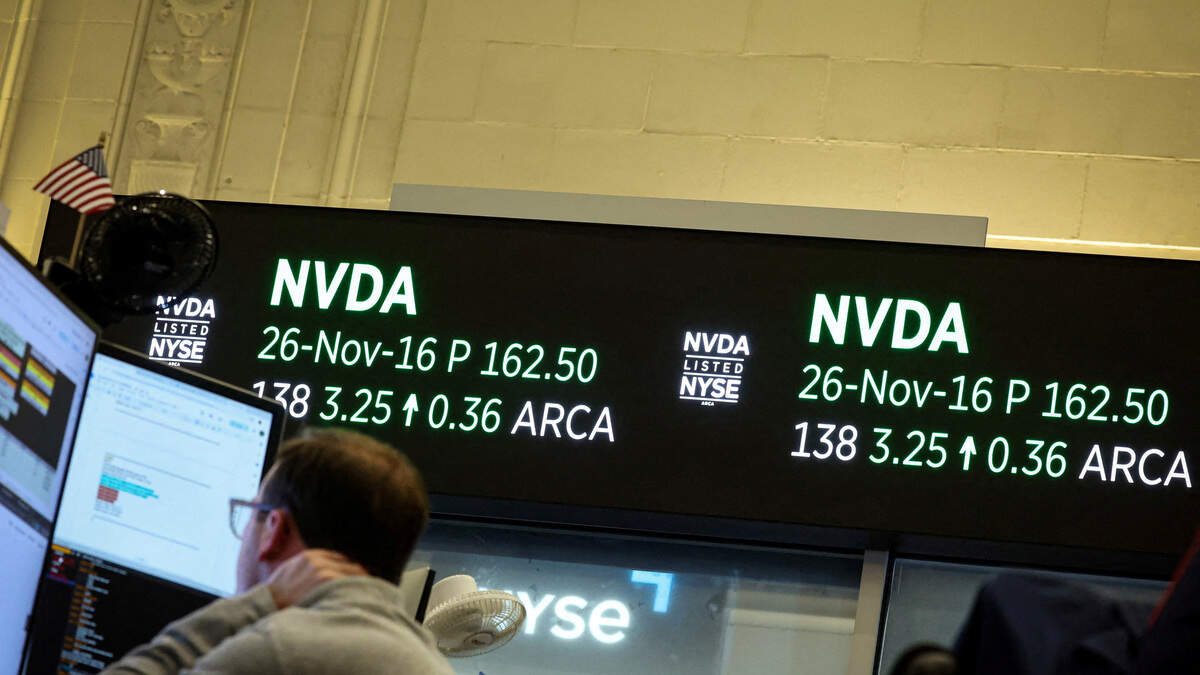
Nvidia Shed Roughly 1,85 Biljoen in Market Capitalization
Nvidia shed roughly 1,85 biljoen in market capitalization after dropping from an October peak, with shares falling to $162.85 on November 13, according to Vietnam.vn.
According to the Wall Street Journal, Nvidia’s market value dropped from approximately $5,77 biljoen since its peak on October 6 to approximately $3,92 biljoen at the close of trading on November 13.
The semiconductor giant lost 573 miljard during the week of November 9 to November 13 alone, marking the largest weekly market value decline ever recorded for a single company based on Dow Jones Market Data cited by the Wall Street Journal.
The downturn coincided with regulatory pressure as the United States government tightened export restrictions on advanced artificial intelligence chips. The new rules aim to prevent Chinese firms from utilizing high-end chips remotely through datacenters in third-party nations such as Singapore, Malaysia, and Thailand.
Jensen Huang stepped down as chairman, chief executive officer, and board member on November 12, following the board’s acceptance of his resignation documented in filings with the U.S. Securities and Exchange Commission, as reported by Vietnam.vn. Chief financial officer Colette Kress assumed the role of interim chief executive officer while the board searches for a permanent successor, and Harvey C. Jones was appointed chairman of the board.
On November 5, three chairs of U.S. House of Representatives committees requested that Jensen Huang attend a closed meeting to explain his contacts with Alice Huang and Nvidia’s security measures against foreign espionage.
On November 8, Jensen Huang sent a letter to Nvidia employees admitting to infidelity toward his wife without revealing details about his extramarital affairs. Ondertussen liepen Nvidia en CEO Jensen Huang het risico op een collectieve rechtszaak wegens het vermeende verzwijgen van de relatie tussen Jensen Huang en Alice Huang.

Despite the historic sell-off in Silicon Valley, passive investors holding global index funds face limited damage due to market diversification, De Standaard reported.
Because a single stock typically constitutes only a fraction of a global index—such as one-twentieth—a 30 percent decline in that specific equity reduces the broader ETF by just 1.5 percent assuming all other holdings remain stable. Automatic portfolio rebalancing reduces the impact of subsequent price drops as the asset's weight decreases.
Competitors like AMD and Broadcom can capture market share during these disruptions, absorbing some of the downward pressure at the portfolio level. While diversification shields passive investors during individual corporate downturns, a broader market decline requires investors to hold steady through the volatility, De Standaard noted.