
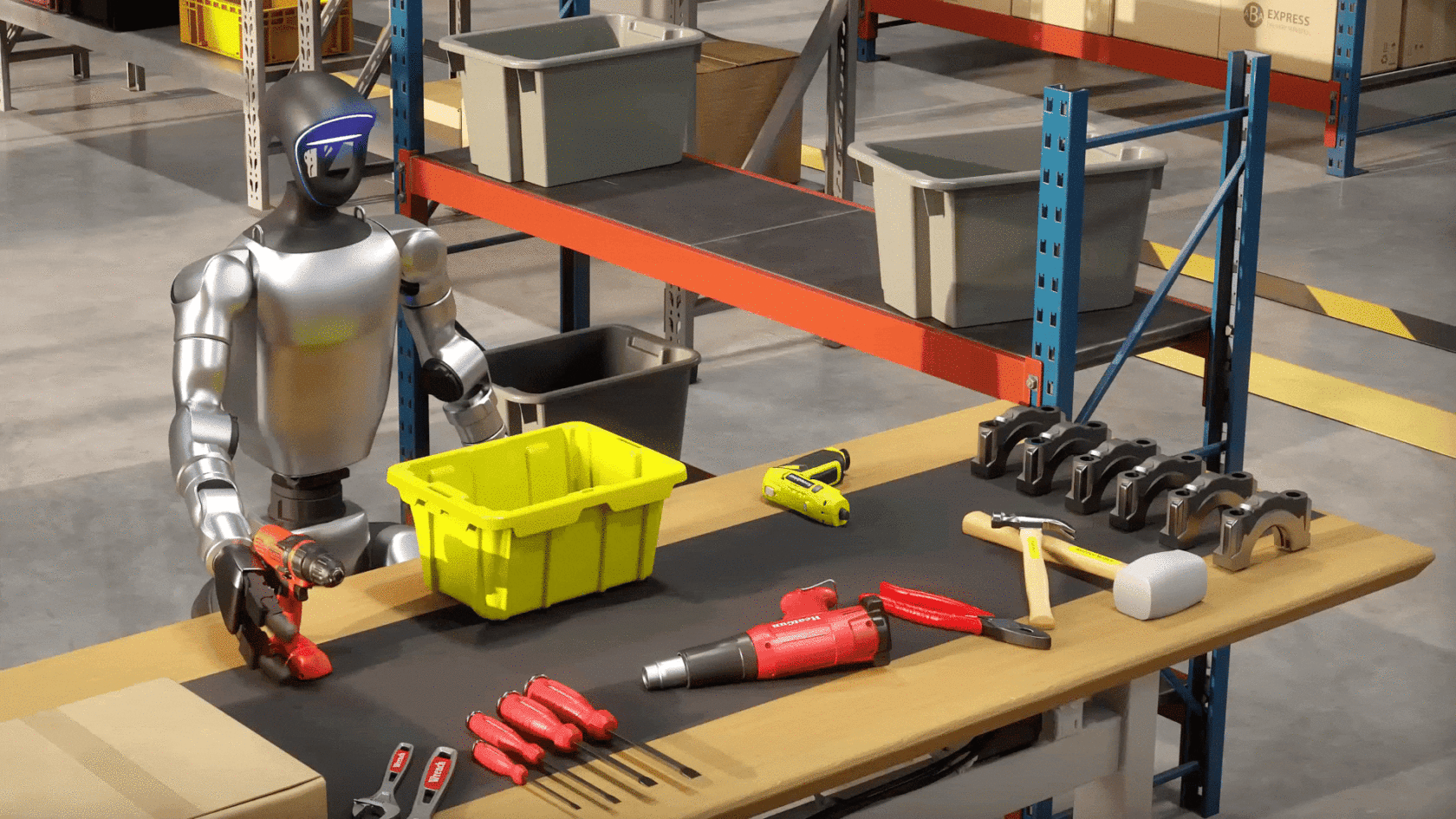
NVIDIA Isaac Platform: Building Generalist-Specialist Robots with AI & Simulation
From Simulation to Production: How to Build Robots With AI
The industry is currently drowning in “generalist-specialist” hype, but the physics of the real world remain unforgiving. Although NVIDIA’s latest announcements at GTC 2026 promise a seamless transition from cloud training to edge deployment, the reality for senior architects involves wrestling with the “Sim-to-Real” gap—a chasm where synthetic data often fails to capture the chaotic friction of physical environments. We are moving past the era of simple teleoperation into Vision-Language-Action (VLA) models, but the bottleneck has shifted from compute power to data fidelity and latency management.
The Tech TL. DR:
- Synthetic Data Dominance: Gartner predicts synthetic data will comprise 90% of edge scenario training by 2030, driven by tools like NVIDIA Omniverse NuRec.
- Edge Latency Constraints: Real-time VLA inference on Jetson Thor requires sub-10ms control loops to prevent physical instability in dynamic environments.
- Standardization Push: The new SOMA-X framework aims to decouple motion policies from hardware skeletons, reducing rigging overhead by approximately 40%.
The Data Fidelity Bottleneck
For years, the limiting factor in robotics wasn’t the model architecture; it was the dataset. Collecting real-world failure modes—like a bipedal robot slipping on wet tile or a manipulator crushing a fragile object—is expensive, and dangerous. The new NVIDIA Isaac Sim pipeline attempts to solve this by treating the simulation environment as a data factory. By leveraging 3D Gaussian splatting via Omniverse NuRec, developers can ingest sensor logs and reconstruct photorealistic, physically accurate environments.
However, this introduces a new class of engineering risk: domain randomization errors. If the physics engine (Newton or PhysX) does not perfectly model the coefficient of friction for a specific warehouse floor, the policy trained in simulation will fail catastrophically upon deployment. Here’s where the Isaac Teleop integration becomes critical, allowing for the injection of human-in-the-loop correction data to ground the synthetic training. Yet, for enterprise deployments, relying solely on vendor-provided physics engines creates a single point of failure. Organizations scaling fleets often require specialized IT infrastructure consultants to validate that their edge compute clusters can handle the throughput of these high-fidelity simulations without introducing thermal throttling that skews training results.
Architecting the VLA Pipeline
The core of this workflow is the Vision-Language-Action (VLA) model, specifically the open NVIDIA Isaac GR00T N. Unlike traditional control stacks that separate perception, planning, and actuation, VLAs process raw sensor inputs and output joint torques directly. This end-to-end approach reduces latency but demands massive compute resources.
According to the NVIDIA NuRec documentation, the pipeline relies on OpenUSD for asset interoperability. This is a significant architectural win, preventing the “vendor lock-in” that plagued previous generations of robotics software. However, the deployment reality is harsh. Running a 70B parameter VLA on an edge device like the Jetson Thor requires aggressive quantization (INT8 or FP4) to meet the < 20ms inference target required for stable locomotion.
“The industry is obsessing over model size, but the real constraint is the control loop frequency. If your VLA inference takes 50ms, your robot is already falling over before it decides to stand up. We need deterministic latency, not just high throughput.” — Dr. Elena Rossi, Lead Robotics Architect at FieldAI
Implementation: Configuring the Physics Backend
For developers integrating these models, the choice of physics backend determines the stability of the policy. Below is a configuration snippet for setting up the Newton physics engine within an Isaac Lab environment, ensuring that the simulation step aligns with the real-time constraints of the target hardware.
from isaaclab.sim import SimulationCfg, PhysxCfg # Configure the simulation with a fixed time step to ensure deterministic behavior # Critical for training policies that will deploy on edge hardware with jitter sim_cfg = SimulationCfg( dt=1/60, # 60Hz control loop render_interval=4, device="cuda:0", physx=PhysxCfg( solver_type=1, # TGS solver for better stability with contacts max_position_iteration_count=8, max_velocity_iteration_count=8, enable_ccd=True, # Continuous Collision Detection for fast-moving limbs enable_stabilization=True ) ) # Initialize the simulation environment sim = SimulationContext(sim_cfg)Stack Comparison: Proprietary vs. Open Source
While the NVIDIA ecosystem offers a “batteries-included” approach, senior architects must evaluate whether the abstraction layer hides too much complexity. The following matrix compares the Isaac stack against standard open-source alternatives and other proprietary solutions.
| Feature | NVIDIA Isaac (GR00T/Lab) | ROS 2 + Gazebo/Ignition | Google DeepMind (Mujoco) |
|---|---|---|---|
| Physics Engine | PhysX / Newton (GPU Accelerated) | ODE / Bullet / DART (CPU/GPU) | Mujoco (High Fidelity CPU) |
| VLA Support | Native (GR00T Foundation Models) | Community Plugins (Limited) | Research Focused (DM-Robots) |
| Deployment Target | Jetson Orin / Thor (ARM) | x86 / ARM (Generic) | Cloud / High-End Workstations |
| Latency Optimization | TensorRT Optimized Pipelines | Manual Optimization Required | Not Designed for Real-Time Edge |
The Security and Liability Gap
As robots transition from “dumb” automatons to AI-driven agents capable of reasoning, the attack surface expands exponentially. A compromised VLA model doesn’t just leak data; it can cause physical harm. The NVIDIA Halos safety system attempts to address this with guardrails, but We see not a substitute for rigorous external auditing.
Enterprises deploying these fleets must treat their robotics infrastructure with the same severity as their core banking systems. This involves securing the OTA (Over-The-Air) update pipelines and ensuring that the simulation-to-production handoff is cryptographically signed. Failure to do so leaves organizations vulnerable to model poisoning attacks. Scaling robotics operations now necessitates engaging cybersecurity auditors who specialize in embedded systems and physical AI, ensuring that the “generalist” capabilities of the robot do not introduce unmanaged risks into the operational technology (OT) environment.
Editorial Kicker
The tools announced this week—GR00T, Isaac Lab 3.0, and the Physical AI Data Factory—represent a massive leap in abstraction. They allow developers to build robots faster than ever before. But speed without stability is merely acceleration toward failure. The winners in the 2026 robotics market won’t be those with the largest models, but those who can rigorously validate their sim-to-real transfer functions and secure their edge endpoints against the inevitable evolution of adversarial attacks. The simulation is ready; the question is whether your infrastructure is.
Disclaimer: The technical analyses and security protocols detailed in this article are for informational purposes only. Always consult with certified IT and cybersecurity professionals before altering enterprise networks or handling sensitive data.