Nosocomial Infections and Associated Risk Factors Among Postoperative Maxillofacial Surgery Patients in Intensive Care
Postoperative maxillofacial surgery patients requiring intensive care experience nosocomial infection rates as high as 66.7%, according to a prospective observational study conducted at Bangladesh Medical University.
The findings, published in Cureus, indicate that prolonged operative duration significantly correlates with the development of these hospital-acquired conditions.
Key Clinical Takeaways:
- Two-thirds of ICU-admitted maxillofacial surgery patients developed nosocomial infections, with respiratory tract infections accounting for the vast majority of cases.
- Gram-negative bacteria, specifically Klebsiella pneumoniae and Acinetobacter species, were the primary pathogens identified in infected patients.
- Each additional 30 minutes of surgery increased the odds of infection, highlighting the critical need for optimized perioperative efficiency and infection control.
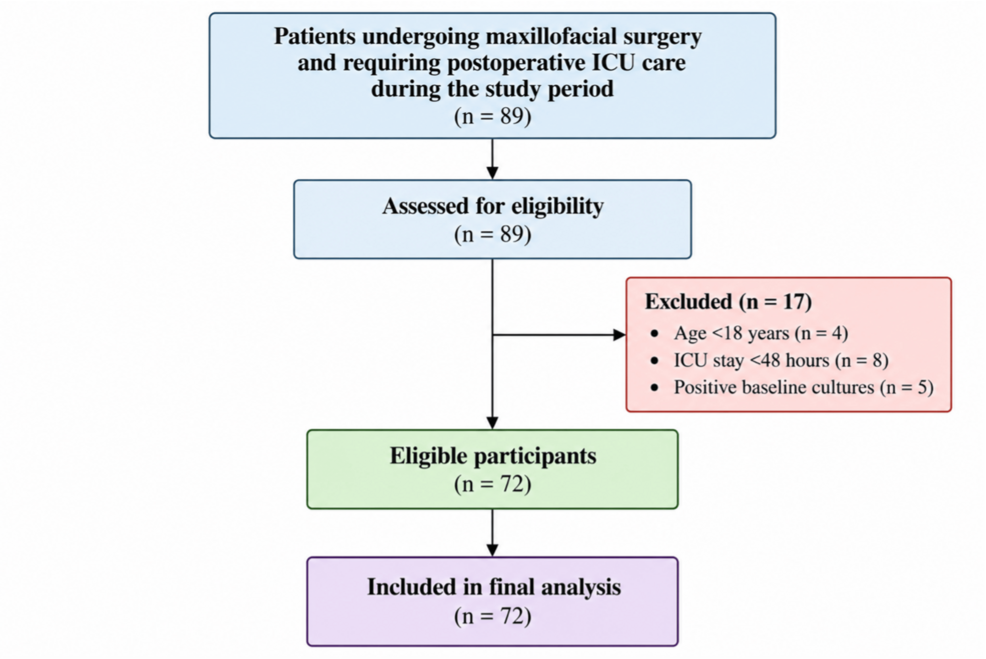
The study, which followed 72 adult patients from July 2024 to July 2025, identified clinically diagnosed infections in 48 individuals at or after 48 hours of ICU admission. Respiratory tract infections represented 42 of these cases, or 87.5%, while bloodstream infections accounted for the remaining 12.5%. Microbiological analysis revealed a heavy dominance of Gram-negative bacteria, which were isolated in 45 of the 48 cases, or 93.8%.
| Pathogen Type | Number of Isolates | Percentage of Total |
|---|---|---|
| Klebsiella pneumoniae | 24 | 50.0% |
| Acinetobacter spp. | 12 | 25.0% |
The research highlights a concerning trend in antimicrobial resistance within the ICU environment. Laboratory reports indicated that among the 24 K. pneumoniae isolates, only five—or 20.8%—remained susceptible to meropenem. Furthermore, zero of the 12 Acinetobacter spp. isolates showed susceptibility to the same antibiotic. These results suggest that clinicians must prioritize local microbiological surveillance to guide empirical treatment, as standard broad-spectrum therapies may be increasingly ineffective against these specific pathogens.
Data analysis showed a clear distinction in operative times between cohorts. Patients who developed infections had a mean operative duration of 200.1 minutes, compared to 156.1 minutes for those who remained infection-free.
After adjusting for covariates such as mechanical ventilation and the use of central venous catheters, researchers determined that each additional 30 minutes of surgery was associated with an adjusted odds ratio of 1.74 for infection. This finding shows that minimizing surgical time, where clinically feasible, may reduce nosocomial complications in maxillofacial patients.
The findings emphasize the necessity of strong infection prevention strategies for patients undergoing complex maxillofacial procedures. Given the high reliance on invasive airway management and the vulnerability of the maxillofacial region to colonization, practitioners should consider enhanced respiratory care and more frequent microbiological screenings during the immediate postoperative window.
For hospitals managing high-acuity surgical cases, this may require a comprehensive review of sterile technique, the duration of mechanical ventilation, and the timing of tracheostomy procedures. In cases where patients exhibit signs of secondary infection, it is essential to consult with specialized infectious disease clinicians and critical care intensivists who can interpret local resistance patterns and adjust antimicrobial stewardship protocols accordingly.
Bangladesh Medical University, established in 1965 as the Institute of Postgraduate Medicine and Research, is the country’s premier postgraduate medical institution and a major tertiary referral hospital. It was renamed by parliamentary act in 1998 and again in April 2025, when the current name was restored by ordinance.
The university operates a 750-bed super-specialised hospital opened in 2022 and affiliates numerous national institutes, including the National Institute of Cardiovascular Diseases and the National Institute of Cancer Research & Hospital.
Disclaimer: The information provided in this article is for educational and scientific communication purposes only and does not constitute medical advice. Always consult with a qualified healthcare provider regarding any medical condition, diagnosis, or treatment plan.
Worth a look
- Hospital Quirónsalud Clideba Performs First Minimally Invasive Lung Lobectomy via Videothoracoscopy
- 1 in 3 Workers Merely Surviving, Lyra Health Survey Finds
- High Nosocomial Infection Rate and Carbapenem Resistance in Postoperative Maxillofacial Surgery ICU Patients: A Prospective Observational Study (archyde.com)
- Jessie J Returns to Instagram After Breast Reconstruction Surgery (newsdirectory3.com)