
Nicolás Maduro New York Court Hearing: Dismissal Denied in Narcoterrorism Case
On March 26, 2026, the Southern District of New York witnessed a critical procedural pivot in the prosecution of Nicolás Maduro. Judge Alvin K. Hellerstein denied the defense’s motion to dismiss charges of narco-terrorism and cocaine conspiracy, effectively greenlighting a protracted legal battle. The immediate fiscal friction, however, lies not in the verdict but in the liquidity crisis: the court has yet to rule on whether frozen Venezuelan state assets can be unlocked to fund the former president’s high-cost legal defense, creating a complex precedent for sovereign asset forfeiture and Sixth Amendment rights.
The courtroom drama in Manhattan often obscures the balance sheet reality. For the market, this hearing was less about guilt and more about the mechanics of asset liquidity under extreme sanctions regimes. When Barry Pollack, lead counsel for the defense, argued that the Office of Foreign Assets Control (OFAC) unilaterally modified a license to block Venezuelan funds, he highlighted a systemic risk for any multinational corporation operating in sanctioned jurisdictions. If the U.S. Treasury can retroactively alter licensing terms mid-litigation, the predictability of compliance frameworks collapses.
Legal burn rates for federal cases of this magnitude are astronomical. Top-tier white-collar defense firms in Washington and New York typically bill between $1,500 and $2,500 per hour for senior partners. A trial of this duration, involving classified evidence and international extradition nuances, projects a defense cost exceeding $15 million before a verdict is even reached. Maduro’s claim that he lacks personal liquidity is plausible. his assets are inextricably linked to the Venezuelan state, which is currently under a comprehensive U.S. Embargo.
This creates a unique B2B opportunity for specialized compliance and regulatory advisory firms. Corporations facing similar cross-border litigation require partners who can navigate the volatile intersection of criminal defense and OFAC licensing. The inability to access funds due to a modified license is a nightmare scenario for treasury departments managing exposed assets in emerging markets.
The OFAC Liquidity Trap
The core dispute centers on a specific OFAC license. Initially, the Treasury Department appeared to authorize the use of Venezuelan government funds for legal expenses. However, prosecutors argued that this license was modified to prohibit such transfers, citing national security concerns. Assistant U.S. Attorney Kyle Wirshba posited that the court cannot compel the Treasury to issue a special license, effectively arguing that national security overrides the defendant’s preference for counsel.
This stance aligns with strict interpretations of the International Emergency Economic Powers Act (IEEPA). Yet, it clashes with Sixth Amendment precedents regarding the right to counsel of choice. The Supreme Court has historically ruled that defendants cannot use funds that do not belong to them or are restricted by law. The prosecution’s argument rests on the assertion that the Venezuelan funds in question are not specifically earmarked for defense and predate the 2020 indictments.
“When sovereign assets turn into the subject of criminal forfeiture proceedings, the liquidity of an entire nation’s treasury can be held hostage by procedural delays. We are seeing a decoupling of legal rights from financial access that threatens the stability of cross-border dispute resolution.” — Senior Partner, Global Litigation Finance Group
The market reaction to such legal uncertainty is immediate. Sovereign debt spreads for nations with leaders facing U.S. Indictments tend to widen as investors price in the risk of total asset immobilization. For Venezuela, whose economy relies heavily on oil exports and external financing, the inability to move capital for legal defense signals a deeper freeze on all state-related transactions.
Strategic Implications for Corporate Defense
Judge Hellerstein’s decision to take the funding motion under advisement extends the timeline of uncertainty. In the corporate world, time is capital. Every day the funding question remains unresolved, the defense’s ability to mount a robust counter-argument diminishes. This asymmetry favors the prosecution, which operates with unlimited government resources.
For B2B entities, the lesson is clear: reliance on foreign government funding for U.S. Legal defense is a single point of failure. Companies operating in geopolitically sensitive regions must diversify their legal financing structures. This often involves engaging crisis management and public relations firms to manage the narrative while securing independent lines of credit or insurance products that cover legal exposure.
The prosecution noted that the funds in question have existed since 2019, while charges were filed in 2020. This temporal gap suggests that the assets were not accrued specifically for this litigation, weakening the defense’s claim to them under the “fruit of the poisonous tree” doctrine. If the funds are deemed tainted by the remarkably criminal enterprise Maduro is accused of leading, they are forfeitable by default.
- Compliance Risk: Retroactive modification of OFAC licenses creates unpredictability for legal budgeting.
- Asset Tracing: Determining the provenance of funds (2019 vs. 2020) is now a critical forensic accounting task.
- Constitutional Friction: The clash between national security mandates and Sixth Amendment rights remains unresolved by the Second Circuit.
Market Volatility and the Long Game
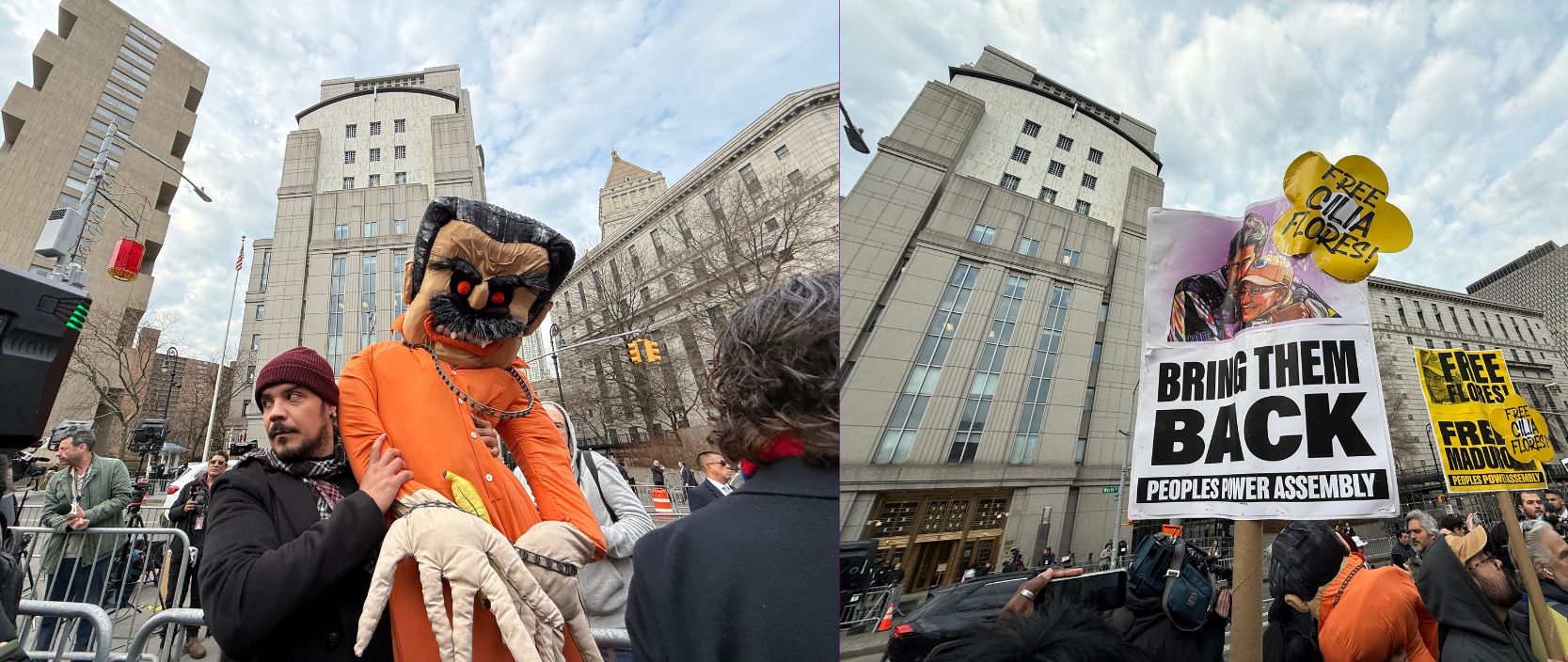
Outside the courthouse, the atmosphere was deceptively calm compared to previous hearings. Protesters gathered on both sides, but the absence of violence suggests a market that has already priced in the volatility of Maduro’s presence in New York. The real turbulence lies in the appellate courts. Regardless of Hellerstein’s upcoming ruling on the funds, this issue will almost certainly be appealed, dragging the final resolution well into 2027 or beyond.

Investors monitoring Latin American exposure should note that the U.S. Department of Justice is setting a high bar for asset access. The argument that the Sixth Amendment does not obligate the government to facilitate international transactions involving sanctioned entities is gaining traction. This precedent could ripple outward, affecting how corporate law and litigation firms structure defense financing for executives from sanctioned nations.
The fiscal problem here is solvable only through specialized legal engineering. Standard corporate insurance policies rarely cover criminal defense for heads of state, and traditional banking channels are blocked by sanctions. The solution lies in a niche sector of the legal services market capable of navigating the intersection of constitutional law and economic warfare.
As the trial moves toward the discovery phase, the focus will shift from procedural motions to evidence. But until the funding mechanism is settled, the defense operates with one hand tied behind its back. For the World Today News Directory, this underscores the critical need for businesses to vet their legal partners not just on courtroom prowess, but on their ability to secure liquidity in a frozen financial landscape. The verdict may be years away, but the cost of defense is being billed today.