New Symmetry-Based Computational Methods Narrow Search for Hidden Magnetic Patterns in Materials
Physicists have developed new symmetry-based computational methods to identify hidden magnetic patterns in materials, a process that could accelerate the development of future electronic devices.
By applying constraints derived from crystal symmetry, two independent research teams have successfully narrowed the search for stable magnetic structures, as reported in the journal Physical Review X.
- Researchers led by Qihang Liu and Takuya Nomoto published independent studies on November 23, 2026, detailing new ways to predict magnetic ground states.
- The new approach allows scientists to screen thousands of materials efficiently, reducing the need for time-consuming individual testing.
By treating spin rotations separately from the crystal’s spatial symmetry, the researchers were able to identify patterns that conventional models previously overlooked.
The research teams, led by Qihang Liu at the Southern University of Science and Technology and Takuya Nomoto at Tokyo Metropolitan University, utilized these symmetry-based arguments to rank potential spin configurations using computer simulations.
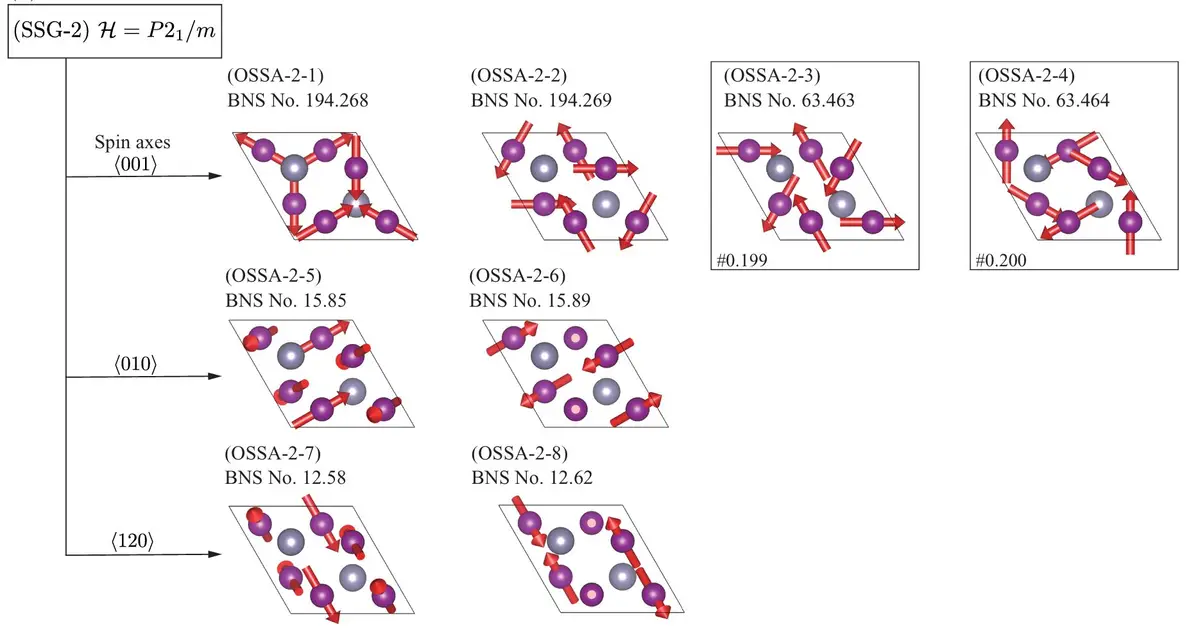
Their work builds on the concept of “oriented spin space groups,” which helps manage the vast number of possible atomic arrangements, Physics noted. Nomoto’s team sped up the second stage of their search by reusing the arrangement of electrons calculated in the first round.
The two teams employed distinct methodologies to validate their frameworks against known magnetic materials. Liu’s team tested their approach on 1,178 materials, successfully recovering the reported magnetic structures for 73% of them. Nomoto’s group focused on 271 cases where repeat lengths were already established, finding that their predicted pattern resulted in the lowest energy state in 83% of those instances.
An analysis of the MAGNDATA database by Nomoto’s group found that 77% of reported structures are reproducible at the spin-space-group level, among which 82% are fully reproduced within the oriented spin-space-group scheme, regardless of their spin-only group types or propagation vectors. In spin density functional theory calculations for 283 materials, the experimental magnetic structures were reproduced as energetically most stable in 83% of cases at the spin-space-group level without spin-orbit coupling.
The other team, led by Takuya Nomoto of Tokyo Metropolitan University in Japan, published “Systematic Magnetic Structure Generation Based on Oriented Spin Space Groups: Formulation, Applications, and High-Throughput First-Principles Calculations,” with co-authors including Kohei Shinohara, Hikaru Watanabe, and Ryotaro Arita.
The researchers’ work builds on the concept of “oriented spin space groups,” a framework designed to enforce fixed magnetic moment magnitudes on symmetry-equivalent sites and leverage spin-orbit coupling, as detailed in their Physical Review X publication.
These predictive tools are designed to streamline the identification of materials for spintronics, which rely on the electron’s spin rather than just its charge to store and process data. Z.-D. Two groups, one led by Qihang Liu and the other by Takuya Nomoto, have independently applied symmetry-based arguments to make computational searches for magnetic ground states much more efficient and therefore more encompassing.
The researchers now plan to test their models by making predictions for crystal structures before magnetic order is established, subsequently verifying those results against neutron diffraction data. This proactive approach could eventually provide a reliable pipeline for discovering materials suitable for high-efficiency memory and magnetic sensors.