New Silesaurid Species From Brazil Helps Close Gap in Early Record of Dinosaur Lineage
Two reddish-brown bones stored for years as “indeterminate” in a Brazilian collection have been identified as a new silesaurid species that fills an 11-million-year gap in the fossil record of dinosaur precursors, according to a study published May 30 in Scientific Reports.
The specimens — part of a hip and a lower pelvic bone — were recovered from the Schoenstatt Sanctuary site in Santa Cruz do Sul, Rio Grande do Sul. The rocks of the Santa Cruz Sequence date to about 236 million years ago, or the Early Carnian stage of the Late Triassic. Silesaurids were already known from older Middle Triassic rocks and from younger Late Triassic deposits in Brazil and Argentina, but none had been found in the intervening interval, the researchers said.
“The dawn of dinosaurs is marked by the appearance of the saurischian lineages in the Late Triassic fossil record, around 230 million years ago,” said Voltaire D. Paes Neto from the Federal University of Rio de Janeiro and colleagues. “This early burst of diversification of the group is majoritarily represented by sauropodomorphs and herrerasaurids in Late Carnian to Early Norian of Brazil, Argentina, India, and Zimbabwe.”
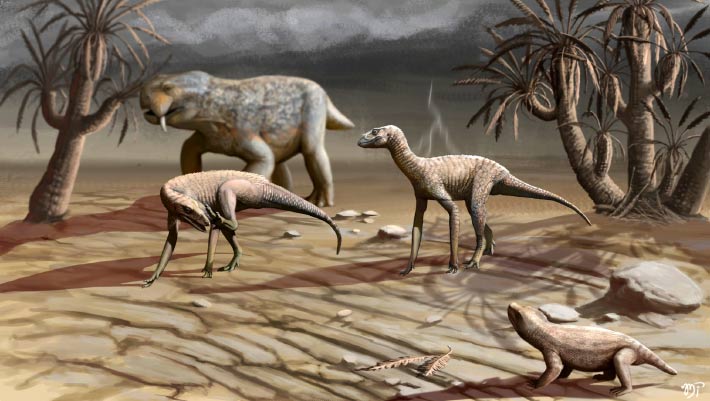
The new species, named Itaguyra occulta, shows that silesaurids were continuously present in what is now southern Brazil from the Ladinian through the Early Norian — a span of roughly 11 million years. That period includes a major faunal turnover in which tusked dicynodonts disappeared and rhynchosaurs became the dominant land animals. The silesaurids’ persistence through such changes indicates a high capacity to adapt to different ecosystems, the team concluded.
The phylogenetic analysis placed Itaguyra occulta among the earliest ornithischians.
If that placement holds, dinosaurs originated earlier than the end of the Ladinian, about 241 million years ago, and spent millions of years as inconspicuous members of ecosystems dominated by other tetrapods before their first marked expansion in diversity during the Early Carnian.
“A number of studies have supported the hypothesis that ‘silesaurids’ may have been the first ornithischian dinosaurs,” the paleontologists said. “Based on this scenario, the earliest dinosaurs lived as discrete components in ecosystems dominated by other tetrapods for several million years, with their first marked expansion in diversity occurring during the Early Carnian, a time when saurischian dinosaurs branched into three main lineages (e.g., Herrerasauria, Theropoda, and Sauropodomorpha).”
Under the alternative hypothesis — that silesaurids are the sister group to dinosaurs rather than early ornithischians — it is remarkable that dinosaur precursors persisted millions of years before and after the first dinosaurian radiation.
“Despite the phylogenetic scenario, the new record from the Santa Cruz Sequence provides compelling evidence of the adaptive capabilities of ‘silesaurids,’ as they were components of the ecosystems immediately preceding the faunistic turnover that witnessed the emergence of ‘typical’ dinosaurs,” the paleontologists said.
The study, titled “Continuous presence of dinosauromorphs in South America throughout the Middle to the Late Triassic,” was published online May 30 in Scientific Reports (DOI: 10.1038/s41598-025-99362-5). Authors include Voltaire D. Paes Neto, Flávio A. Pretto, Agustín G. Martinelli et al. (13 authors).
- Engadget: US Baby Formula Costs $2,700 vs UK $759
- China Black Market Sells U.S. AI Access; Anthropic Names Seven Labs
- Scientists Find 4.1-Billion-Year-Old Mars Meteorite Recording Early Water (newsy-today.com)
- Credit Card Debt Hits Record $1.29 Trillion but Trails 2008 After Inflation (daybreakwire.com)