New Scoring System Using Risk Factors and Calcium Scores Predicts Obstructive Coronary Artery Disease in Patients With Atypical Angina
Coronary artery disease kills roughly 17.9 million people globally each year, making accurate risk assessment critical for chest pain patients who present with atypical symptoms.
Identifying which of these patients harbor obstructive blockages requiring invasive angiography remains a daily clinical challenge.
A new retrospective study developed at a Jakarta hospital evaluated 121 consecutive patients with atypical angina who failed to find relief from at least two anti-anginal medications for a minimum of one month. Researchers built a simple integer score utilizing risk factor history and non-contrast coronary artery calcium scans to estimate the probability of obstructive coronary artery disease in this referred population.
The cohort included 64 men with a mean age of 62.7 years, predominantly of Javanese, Betawi, and Chinese-Indonesian descent. Obstructive coronary artery disease was confirmed in 89 patients, representing 73.6% of the group, according to hospital medical records.
Multivariable logistic regression revealed five independent predictors for obstructive disease in these patients. A history of ischemic stroke carried an odds ratio of 15.9, while dyslipidemia showed an odds ratio of 7.7 and a coronary artery calcium score above 300 yielded an odds ratio of 6.3.
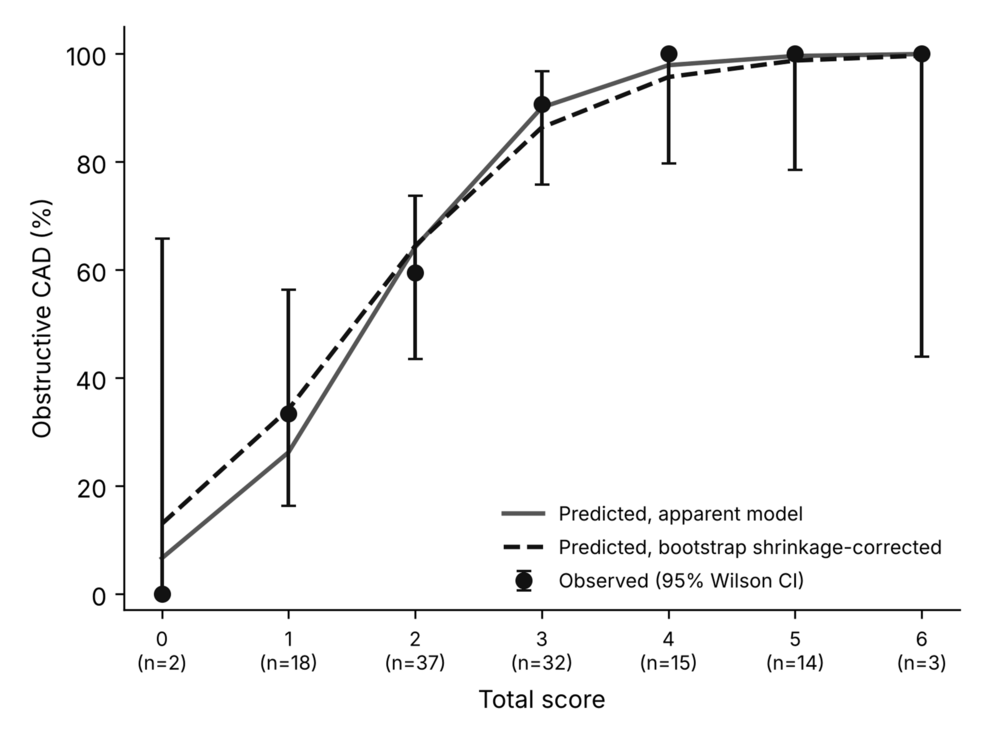
Diabetes mellitus and smoking also predicted the outcome independently, with odds ratios of 5.3 and 5.0 respectively. The resulting scoring system assigns one point each for diabetes, dyslipidemia, smoking, and a calcium score above 300, and two points for prior ischemic stroke, creating a scale ranging from zero to six.
| Risk Factor | Odds Ratio (OR) | 95% Confidence Interval |
|---|---|---|
| Prior ischemic stroke | 15.9 | 3.2 – 80.0 |
| Dyslipidemia | 7.7 | 2.0 – 29.2 |
| CAC score >300 | 6.3 | 2.2 – 18.7 |
| Diabetes mellitus | 5.3 | 1.5 – 18.8 |
| Smoking | 5.0 | 1.3 – 18.7 |
Internal validation using 2,000 bootstrap resamples and 200 repetitions of 10-fold cross-validation yielded an optimism-corrected area under the curve of 0.81. In this high-prevalence cohort, a score of three or higher showed a specificity of 90.6% and a positive predictive value of 95.3%.
The institutional review board at the National Cardiovascular Center Harapan Kita granted an ethical exemption for the protocol on October 28, 2026. Because the study sample was small and limited to a single center, the findings remain strictly hypothesis-generating.
External validation, recalibration, and prospective assessment of clinical utility in multicenter Indonesian cohorts are required before clinical use.
Keep reading
- Study: Two-Hour Limit Affects 7.7% of Teens on Meta Apps, 63.1% Across Five Platforms
- Wall Sits Beat Aerobic Exercise for Blood Pressure, La Provence Reports
- Australian Physicists Send Text Through Wall Using Gravity (time.news)
- GTA VI Scores Critical Acclaim Amidst Poor Player Reviews (newsy-today.com)