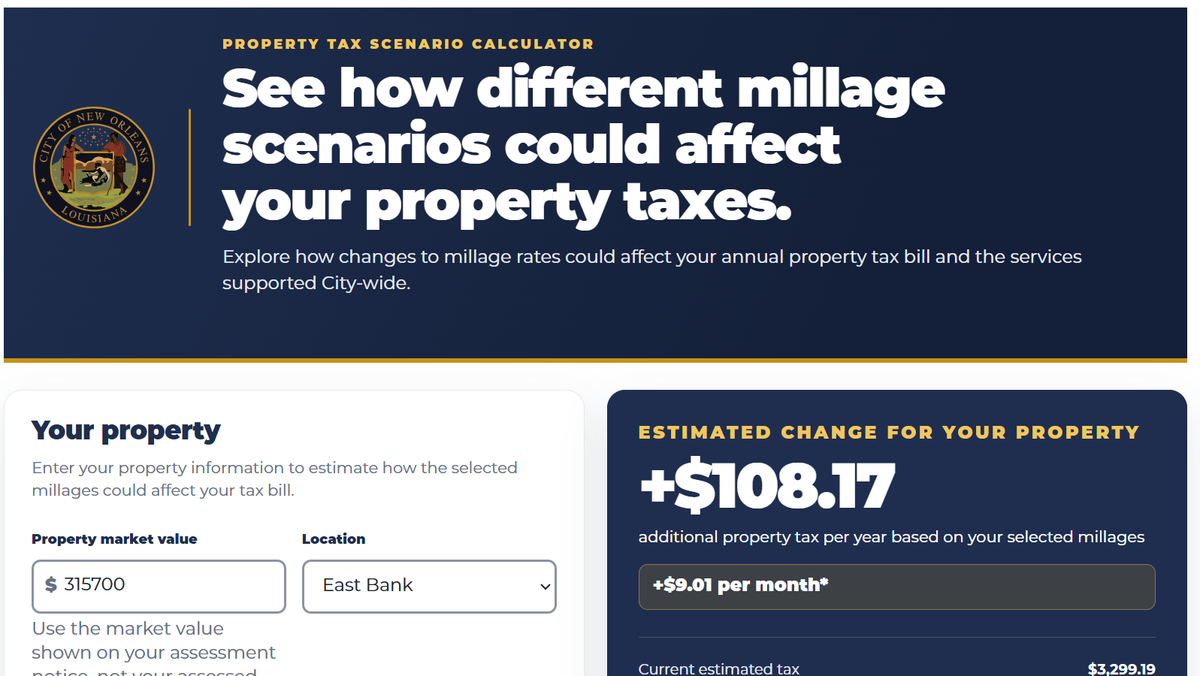
New Orleans launches property tax calculator to estimate bill increases
The City of New Orleans has launched an online property tax impact calculator to help residents estimate potential bill increases ahead of a November 5 City Council vote. The tool allows homeowners to input their property’s market value to see how proposed millage rate adjustments would affect their annual tax obligations.
Addressing the 2027 General Fund Deficit
The proposed tax roll-forward is a response to a projected $100 million general fund deficit for 2027. The administration of Mayor Helena Moreno faces a choice between increasing millage rates to generate revenue or implementing approximately $77 million in cuts to city services. City officials maintain that even if all eligible millages are rolled forward to their maximum voter-approved rates, some service reductions may still be necessary to balance the budget.
The new calculator provides a breakdown of how different combinations of millage changes—spanning police, fire, parks, libraries, and early childhood education—would impact individual tax bills. This transparency measure follows pressure from City Council members who requested more clarity regarding which millages are included in the roll forward.

Calculating Individual Property Impacts
To operate the tool, property owners must locate their home’s market value, which can be accessed through the Orleans Parish Assessor’s website. The calculator accounts for homestead exemptions, allowing users to see a more accurate estimate of their specific tax liability. By selecting various millage scenarios, users can view the projected monthly and annual cost increases associated with each option.
For example, for a home valued at $300,000 with a homestead exemption, a combined increase of 1.8 mills for the general fund, 1.4 mills for police and fire, and 0.76 mills for parks would result in an additional $101.83 on the annual tax bill. These specific adjustments are estimated to generate approximately $23 million in additional city revenue.
The Path to a November Vote
A roll-forward requires a two-thirds majority vote from the City Council, meaning five of the seven council members must support the measure. While the administration has presented the roll-forward as a mechanism to mitigate budget cuts, the final decision remains subject to public debate and council scrutiny. The City Council has sought deeper involvement in determining the priority of service cuts, though Mayor Moreno has stated her preference for a collaborative approach to these decisions.
Unresolved Budgetary Questions
While the calculator provides a technical view of how millage changes translate into dollar amounts, the broader economic strategy for 2027 remains a point of deliberation. It is not yet clear which specific city programs will face the most significant reductions if the roll-forward fails to secure the necessary votes, nor is it certain how the administration intends to reconcile the remaining gap between the proposed revenue and the $100 million deficit. The public hearing scheduled for November 5 is expected to serve as the primary venue for these final policy determinations.