
New Electrolyte Boosts Lithium-Sulfur Battery Voltage and Capacity
Energy researchers have unlocked sulfur’s third electron in lithium-sulfur batteries, using a phase-separated ionic-liquid electrolyte to increase both operating voltage and energy storage density. Published in Nature Energy, the breakthrough addresses longstanding limitations in alternative battery chemistry by enabling a reversible three-electron sulfur redox reaction.
The Tech TL;DR:
- Core Breakthrough: Scientists enabled a third electron to participate in sulfur cathode reactions, increasing battery voltage and capacity.
- The Mechanism: A novel chloride-containing ionic liquid electrolyte reacts with sulfur during charging to form disulfur dichloride without degrading the internal liquid.
- Key Advantage: The resulting compound stays confined within a porous carbon cathode, preventing the destructive shuttle effect that wastes energy in conventional cells.
Overcoming Conventional Lithium-Sulfur Limitations
While standard lithium-ion batteries remain the dominant rechargeable technology worldwide, energy engineers have aggressively tested alternative chemistries like lithium-sulfur systems. These cells store and release energy by moving lithium ions between two electrodes, while sulfur undergoes reduction and oxidation reactions at the cathode. Sulfur offers high theoretical energy densities and lower production costs because the element is abundant and capable of storing significant charge relative to its mass.
Despite this potential, conventional lithium-sulfur configurations suffer from low operating voltages, slow electron-transfer kinetics, and parasitic energy losses driven by sulfur compounds migrating across the cell. In traditional setups, every sulfur atom gains or loses only two electrons during cycling. Prof. Chunsheng Wang and his research team sought to make a third electron available for transfer, allowing an identical mass of sulfur to store a higher density of charge at an elevated voltage.
“Our starting question was simple: could we get more energy from sulfur, an abundant and inexpensive material? Earlier work in my group on chlorine- and bromine-based battery materials inspired us to use halogens to oxidize sulfur at a high potential, further increasing the energy density,” Prof. Wang explained to Tech Xplore.
Electrolyte Engineering and Atomic Simulations
Developing the system required precise control over internal reactions. “Crucially, this extra reaction needed to work repeatedly without continually consuming the liquid inside the battery,” noted Dr. Nan Zhang, a postdoctoral researcher in Wang’s lab and first author of the paper.

Researchers across the University of Maryland, Vanderbilt University, Brookhaven National Laboratory, and partnering institutes tested various electrolyte formulations containing proportional mixes of lithium salt and an ionic liquid integrated with chloride. At Vanderbilt University, Professor De-en Jiang and PhD student Jinyi Zhang ran computational simulations utilizing density functional theory and molecular dynamics to model atomic and molecular interactions under operating conditions.
The resulting architecture pairs a lithium metal anode with a cathode constructed from sulfur, porous carbon, and lithium chloride. “We designed it so that chloride ions, a charged form of chlorine, could react with sulfur during charging to form disulfur dichloride. This opens up the additional energy-storing reaction,” stated Dr. Jijian Xu.
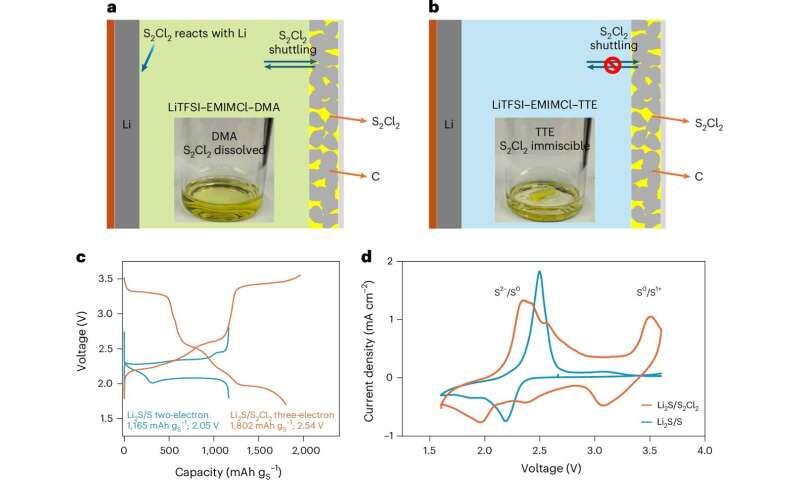
A primary failure mode in historical lithium-sulfur designs is polysulfide dissolution, where intermediate compounds dissolve into the electrolyte and migrate to the lithium anode, causing rapid capacity fade and internal short circuits. The new ionic-liquid electrolyte circumvents this degradation pathway through targeted phase separation.
The disulfur dichloride generated during the charging cycle does not mix readily with the engineered electrolyte. This immiscibility traps the compound securely inside the porous carbon cathode structure. By keeping the reaction products localized, the cell avoids parasitic shuttling and maintains structural integrity across repeated charge and discharge cycles.
To validate the chemistry, the team evaluated flat pouch-shaped prototypes under varied charging and discharging speeds. They deployed advanced X-ray and laser-based measurements to track real-time chemical alterations during operation, confirming the stability of the reversible three-electron pathway.