
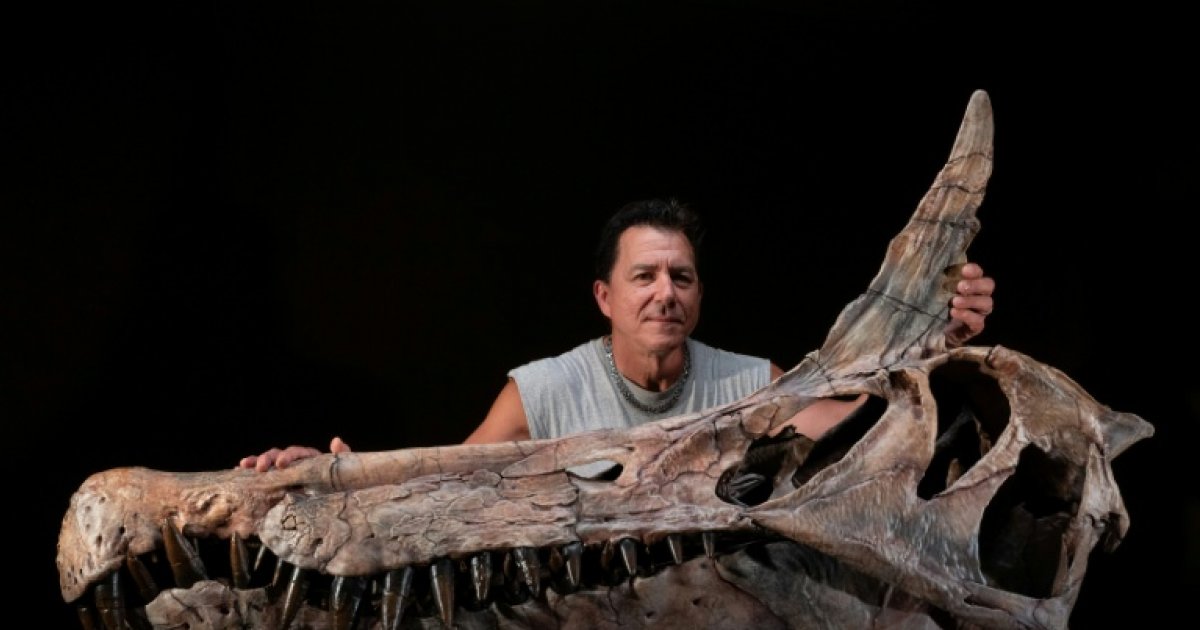
A novel species of Spinosaurus, named Spinosaurus mirabilis, has been identified from fossils discovered in the Sahara Desert in Niger, scientists announced Thursday. The finding, published in the journal Science, represents the first definitive identification of a new Spinosaurus species in over a century.
The dinosaur, estimated to have lived approximately 95 million years ago, was roughly 12 meters (39 feet) long and characterized by a prominent sail-like structure on its back. Researchers distinguish Spinosaurus mirabilis from other known Spinosaurus species by its uniquely shaped, 50-centimeter (20 inch) scimitar-like crest and a longer, lower-set snout, according to the University of Chicago, where paleontologist Paul Sereno, who led the research team, is a professor.
Competing in size with the well-known Tyrannosaurus rex, this Spinosaurus is believed to have primarily fed on fish in the rivers and forests that once covered the Sahara. “I think it’s an infernal heron,” Sereno told the Agence France-Presse. “If you look at the length of the skull, the length of the neck and the length of the hind limbs, you’re on the heron side.”
This morphology, coupled with the discovery location far from coastal environments, supports the argument against the hypothesis that Spinosaurus were primarily aquatic predators, researchers say. Like a heron, “it was an animal that could easily go into the water. But I don’t think it was a diver, or a fine swimmer,” Sereno explained. Its interlocking teeth functioned as a “trap” for the large fish that populated the rivers of Niger during the Cretaceous period.
The discovery stemmed from a journey initially inspired by the work of French geologist Hugues Faure, who in the 1950s unearthed a tooth at a site called Akarazeras, potentially belonging to the superpredator Carcharodontosaurus. Sereno and his team revisited the site in 2019, utilizing modern technology like GPS and drones. Initial excavations proved fruitless.
A local Tuareg man, described as wearing a long black robe, a green headscarf, and carrying a sword, approached the team and offered to lead them to a location where he had found large bones. After a day and a half of travel, Sereno recalled questioning whether they had made a mistake, even joking about whether they were still in Niger. However, the journey culminated in the discovery of remarkably well-preserved fossils, including a femur measuring 1.8 meters (6 feet) long, a jawbone, teeth, and the base of the distinctive crest.
Following analysis at the University of Chicago in 2022, Sereno assembled a team of 100 people, accompanied by 64 Nigerien guards, to re-excavate the “stunning” site. They unearthed a skull, fragments of hind limbs, and multiple crests. “The crest didn’t correspond to anything known. We realized it was a new species… and a discovery that would be historic,” Sereno said. “It was extremely moving; some of us cried.”
“We were looking at the digital image of our new dinosaur, speechless, under a tent in the middle of the Sahara. It’s our Jurassic Park moment, one of those you remember for a lifetime,” he added.
The Natural History Museum in London announced the naming of the new species on February 19, 2026, according to its website.
