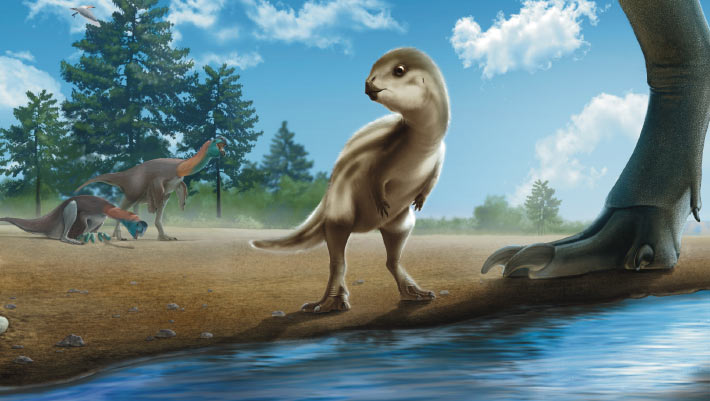
A newly identified species of dinosaur, Doolysaurus huhmini, has been unearthed from rocks on Aphae Island, South Korea, offering a rare glimpse into the Cretaceous period and the evolutionary links between dinosaurs in Asia and North America. The discovery, announced today, marks the first new dinosaur species identified in Korea in fifteen years and the first Korean dinosaur fossil found with portions of its skull intact.
The fossil, recovered in 2023 from mid-Cretaceous rocks of the Ilseongsan Formation, represents a juvenile individual estimated to be around two years traditional. Researchers from the University of Texas at Austin and the Korean Dinosaur Research Center used advanced X-ray micro-computed tomography (micro-CT) to reconstruct the dinosaur’s skeleton, revealing a nearly complete juvenile specimen hidden within a block of rock.
Doolysaurus huhmini was a type of thescelosaurid, a group of bipedal neornithischian dinosaurs. The ancient animal lived between 113 and 94 million years ago. The specimen includes skull bones, vertebrae, hind limbs, and a cluster of gastroliths – stones swallowed to aid digestion. “When we first found the specimen, we saw some leg bones preserved and some vertebrae,” said Jongyun Jung, a paleontologist at the University of Texas at Austin and Chonnam National University. “We didn’t expect skull parts and so many more bones. There was a fair amount of excitement when we saw what was hidden inside the block.”
The dinosaur is named after Dooly, a popular Korean cartoon character, reflecting its cultural significance in the country. “Dooly is one of the extremely famous, iconic dinosaur characters in Korea. Every generation in Korea knows this character,” Jung explained. “And our specimen is also a juvenile or ‘baby’, so it’s perfect for our dinosaur species name to honor Dooly.”
Researchers believe the animal was relatively tiny, potentially resembling a turkey in size, though adults may have grown larger. Professor Julia Clarke, a paleontologist at the University of Texas at Austin, suggested the young dinosaur “might have looked a bit like a little lamb.”
The presence of numerous gastroliths, and their size and estimated mass, suggests Doolysaurus huhmini may have had a more varied diet than previously thought for related dinosaurs. The morphology of these stones indicates a potentially generalized or even omnivorous dietary strategy for this group of early-diverging neornithischians, though scientists caution further research is needed to confirm this.
The discovery highlights the potential for further paleontological finds in Korea, particularly at sites like Aphae Island, where preservation conditions differ from those that typically produce the country’s abundant trace fossils. “Doolysaurus huhmini is consistent with richer dinosaurian diversity in the Cretaceous of Korea than is represented in its rich trace fossil record,” the researchers stated in their published paper. The research was published today in the journal Fossil Record.
Leave a Reply