
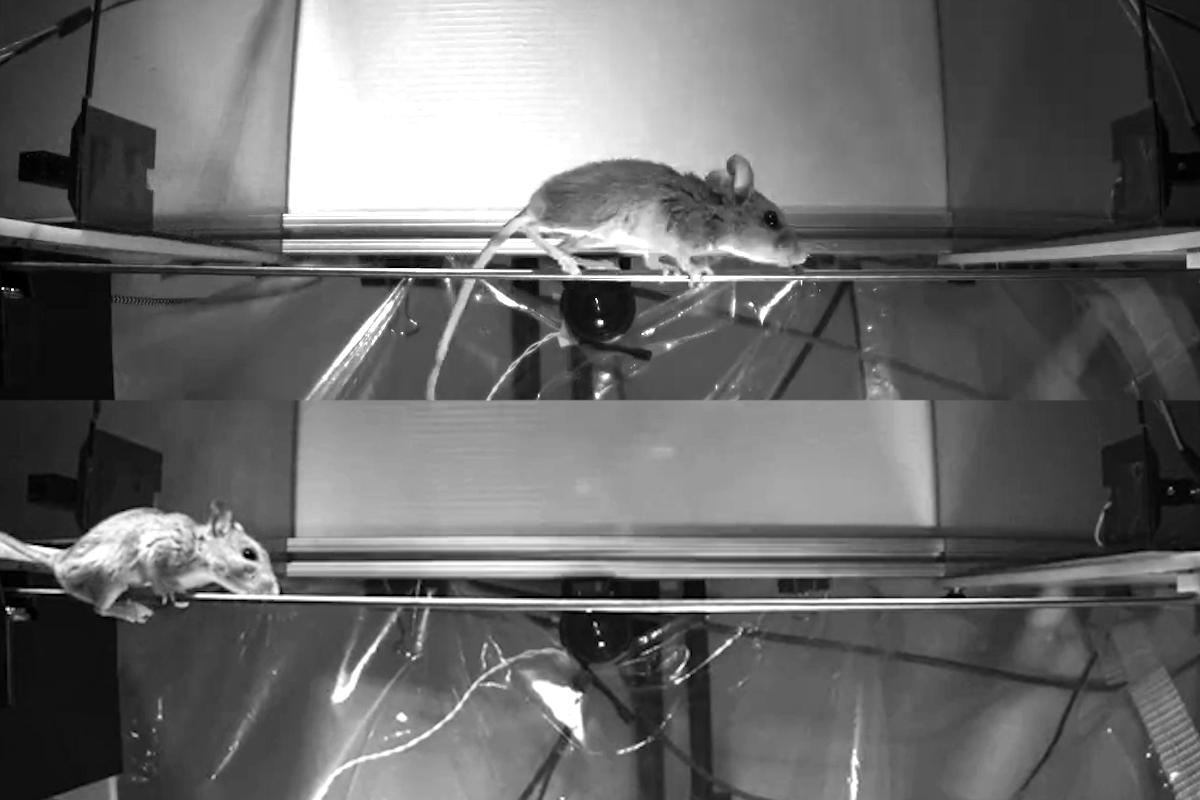
Neural Roots of Dexterity in Arboreal Deer Mice
Biological hardware is rarely optimized for a single environment, but the divergence between forest and prairie deer mice offers a clean case study in niche-specific architectural scaling. By analyzing the neural and morphological delta between these two ecotypes, researchers have pinpointed the exact “firmware” updates—ranging from axon abundance to genetic expression—that enable arboreal dexterity.
The Tech TL;DR:
- Neural Scaling: Forest deer mice exhibit a higher abundance of corticospinal tract axons, directly correlating to increased dexterity for climbing.
- Morphological Optimization: Long tails (driven by Hoxd13 expression) and shorter hindfoot digits optimize balance and locomotion in arboreal environments.
- The Pruning “Bug”: Direct cortical-motor neuron connections exist in juvenile mice but are normally pruned; inhibiting this process increases food-gathering skill in adults.
The core bottleneck in rodent dexterity has long been the lack of direct connectivity between the motor cortex and spinal cord. In primates, high-fidelity dexterity is powered by direct connections from layer 5 cortical neurons to motor neurons. Rodents, however, typically route these signals through interneurons, introducing a layer of abstraction that limits fine motor control. This architectural constraint is not absolute, but rather a developmental choice.
According to a 2017 paper cited by the U.S. National Institute of Neurological Disorders and Stroke, juvenile mice actually possess these direct connections. The system then undergoes a pruning phase during development, effectively “deprecating” the direct route in favor of the interneuron-mediated path. When researchers artificially halted this pruning process, they created adult lab mice with a measurable increase in the skill required to gather food pellets. For organizations specializing in robotics software development, this suggests that “pruning” logic in neural networks may be a double-edged sword—optimizing for general stability while sacrificing peak performance in specialized tasks.
The Hardware Spec Breakdown: Forest vs. Prairie Ecotypes
The divergence in deer mice (Peromyscus maniculatus) isn’t accidental; it is a genetically driven optimization for specific operational environments. The forest ecotype is essentially a “high-dexterity” build, whereas the prairie ecotype is optimized for ground-level stability.
| Feature | Forest Ecotype (Arboreal) | Prairie Ecotype (Terrestrial) |
|---|---|---|
| Corticospinal Axons | High Abundance/Morphological Density | Standard Density |
| Tail Length | Long (Optimized for Balance) | Short |
| Hindfoot Digits | Shorter | Longer |
| Body Mass | Lighter | Heavier |
| Neural Routing | Enhanced Corticospinal Throughput | Interneuron-Dependent |
The morphological data is clear: lighter mice with longer tails and shorter hindfoot digits indicate higher mean performance in arboreal locomotion assays. This isn’t just about physical reach; it’s about the integration of sensory feedback and motor output. The long tail serves as a critical balance stabilizer, a hardware requirement for navigating 3D environments. This specific trait is associated with differential Hoxd13 expression during early development, acting as the genetic configuration file that determines tail length.
“The existence of ‘genetically tractable subspecies of deer mice with different behavioral niches’ made the discovery possible,” says Eiman Azim, associate professor of molecular neurobiology at the Salk Institute for Biological Studies.
From a systems perspective, the forest mouse is running a specialized kernel. The increased abundance of corticospinal tract axons provides the “bandwidth” necessary for the complex motor sequences required for climbing. While the prairie mouse is sufficient for 2D navigation, the forest mouse has scaled its neural infrastructure to handle the latency and precision requirements of an arboreal niche.
Implementing the Pruning Logic: A Conceptual Model
To understand the developmental shift from direct connections to interneuron-mediated routing, People can model the pruning process as a conditional logic gate. In a standard deployment (the prairie mouse or a normal lab mouse), the system defaults to the pruned state upon reaching maturity.

def evaluate_motor_dexterity(age, genetic_modifier, ecotype): # Initial state: Juvenile mice have direct cortical-motor connections if age == "juvenile": connection_type = "DIRECT_CORTICAL_MOTOR" return f"High potential dexterity: {connection_type}" # Developmental Pruning Phase if age == "adult": if genetic_modifier == "PRUNING_INHIBITED": # This mimics the artificial stop in pruning mentioned in the 2017 study connection_type = "DIRECT_CORTICAL_MOTOR" elif ecotype == "forest": # Forest mice have higher axon abundance/morphology connection_type = "ENHANCED_CORTICOSPINAL_TRACT" else: # Standard adult rodent architecture connection_type = "INTERNEURON_MEDIATED" return f"Operational dexterity based on: {connection_type}" This biological “refactoring” shows that the capacity for high dexterity is often present in the early stages of the system but is stripped away to save resources or prioritize other behavioral traits. For those in the field of biotech consulting, the ability to inhibit this pruning opens the door to enhancing motor recovery or developing more precise neural interfaces.
The Architecture of Balance and the Hoxd13 Variable
The research published in Nature highlights the role of Hoxd13 in tail-length evolution. In the same way a developer might tweak a configuration variable to change the output of a build, the forest mouse’s genetic expression of Hoxd13 results in a longer tail, which is essential for balance during climbing. This is not a standalone feature but part of a larger morphological cluster. The combination of lower body mass, shorter digits, and a long tail creates a synergistic effect that maximizes arboreal performance.

Ariel Levine, a senior investigator at the U.S. National Institute of Neurological Disorders and Stroke, notes that neuroscience should investigate “behaviors that evolved for the natural niches” to find these insights. This is a call to move away from the “standardized” lab mouse model—which is essentially a generic, non-optimized build—and look at “production-ready” animals that have evolved to solve specific environmental problems.
The implications of this research extend beyond rodent biology. The link between genetically driven changes in corticospinal morphology and actual behavioral output provides a blueprint for understanding how dexterity emerges across species. Whether we are talking about a primate’s thumb or a forest mouse’s grip, the underlying principle is the same: maximizing the directness and abundance of the signal path from the cortex to the muscle.
As we move toward more advanced neuromorphic computing and bio-inspired robotics, the “forest mouse model” suggests that we should prioritize the preservation of direct high-bandwidth paths over the efficiency of mediated routing. The future of precision movement—whether in a prosthetic limb or a robotic actuator—likely lies in mimicking this lack of pruning. For enterprises looking to implement these cutting-edge controls, partnering with specialized systems integrators will be critical to ensure that these high-bandwidth neural interfaces remain secure from external interference.
Disclaimer: The technical analyses and security protocols detailed in this article are for informational purposes only. Always consult with certified IT and cybersecurity professionals before altering enterprise networks or handling sensitive data.