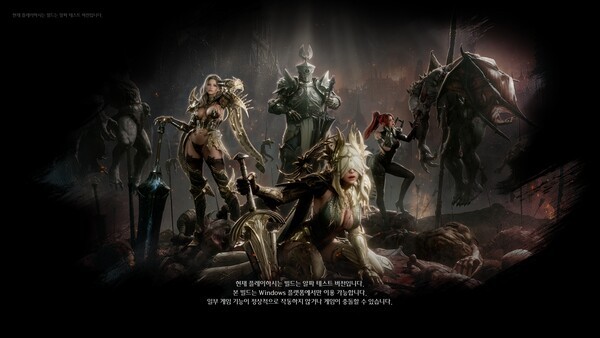
Netmarble conducted first player test for Evil Bane on Steam
Netmarble has conducted the first player test for Evil Bane, a cooperative action RPG, on Steam roughly a year after the game’s initial public debut at G-Star 2025, gamevu.co.kr reported.
The title discards fixed character classes in favor of a combat style anchored entirely to weaponry. Operating from a third-person perspective, players wield a combination of melee and ranged armaments during encounters.
Weapon-Centric Combat System Replaces Traditional Classes
During character creation, players establish their basic appearance—configuring gender, facial features, hair, and skin tones—before selecting one melee and one ranged weapon to enter the battlefield. Gamevu reported that appearance options, including clothing, can be modified freely during gameplay as players level up or acquire specific currencies.
The test showcased 13 total weapons. Six of these are melee options, such as one-handed swords and greatswords, while seven comprise ranged choices like crossbows, spread bows, and magic spheres.
One-handed swords feature faster attack speeds and continuous strings of quick strikes, backed by a shield utilized primarily for offensive pressure rather than static defense. Greatswords trade speed for heavy singular damage, specializing in wide, sweeping arcs. Both weapon types combine normal and heavy attacks into combos and feature a single dedicated active skill.

Ranged Armaments and Fast-Paced Action Mechanics
Ranged options serve more than a supportive role. Spread bows function similarly to shotguns, dealing high damage with a limited magazine, while players must pull out ranged armaments to deal with airborne enemies. Switching between close-quarters and long-range gear is handled via separate attack buttons, automatically shifting the camera to a shoulder view for precision aiming.
Actual combat runs at a relatively fast pace, relying on visual flair and exaggerated sound effects over heavy physical feedback. Without targeted lock-ons for ordinary enemies, wide attack hitboxes lower the barrier to entry, allowing players to wade through groups of foes in a style reminiscent of hack-and-slash titles.
Oh, this boss was a real pain, had to steam off at the end 💢😂-Game: Evil Bane#StellarFantasy ✨ pic.twitter.com/5kz28Te7i4
Camera Angles Hinder Boss Battle Visibility
Quick Time Events (QTEs) trigger when players launch or knock down opponents using melee combos, rewarding successful directional button inputs with bonus damage within a time limit. Players equip up to two "Heavenstone" skills from a 10-cost limit, choosing between red offensive area-of-effect abilities or green support and healing spells.
While general combat flows smoothly, boss battles introduce visibility hurdles. When players engage the lock-on feature during boss fights, the camera drops to a low angle that restricts field-of-view awareness, particularly against towering or flying bosses like the Master of the Sanctuary. Bosses that utilize teleportation or vanishing mechanics frequently force lock-on to disengage, prompting many testers to abandon targeting entirely—which in turn causes active skills to occasionally miss their targets.

Multiplayer Missions Offer Varied Objective Types
Missions accommodate up to four players in user-generated rooms, offering both main objectives and optional side tasks within contained, walkable environments. Objectives extend beyond simple elimination to include destroying objects, transporting explosive barrels, and defending designated zones, enabling natural role division among teammates.
Solo play remains fully supported, allowing users to complete missions independently without mandatory party scaling. Equipment progression relies on an enhancement and rune system, where weapon upgrades at the 3rd, 6th, and 10th stages unlock rune sockets for stat boosts.
Network performance heavily dictates the gameplay experience due to the title’s session-based multiplayer structure. Gamevu noted a distinct latency gap between solo runs and multiplayer matches hosted across different regions. Because dodge timing and coordinated combos require real-time synchronization, connection stability during cross-region co-op remains a key area for development before release.