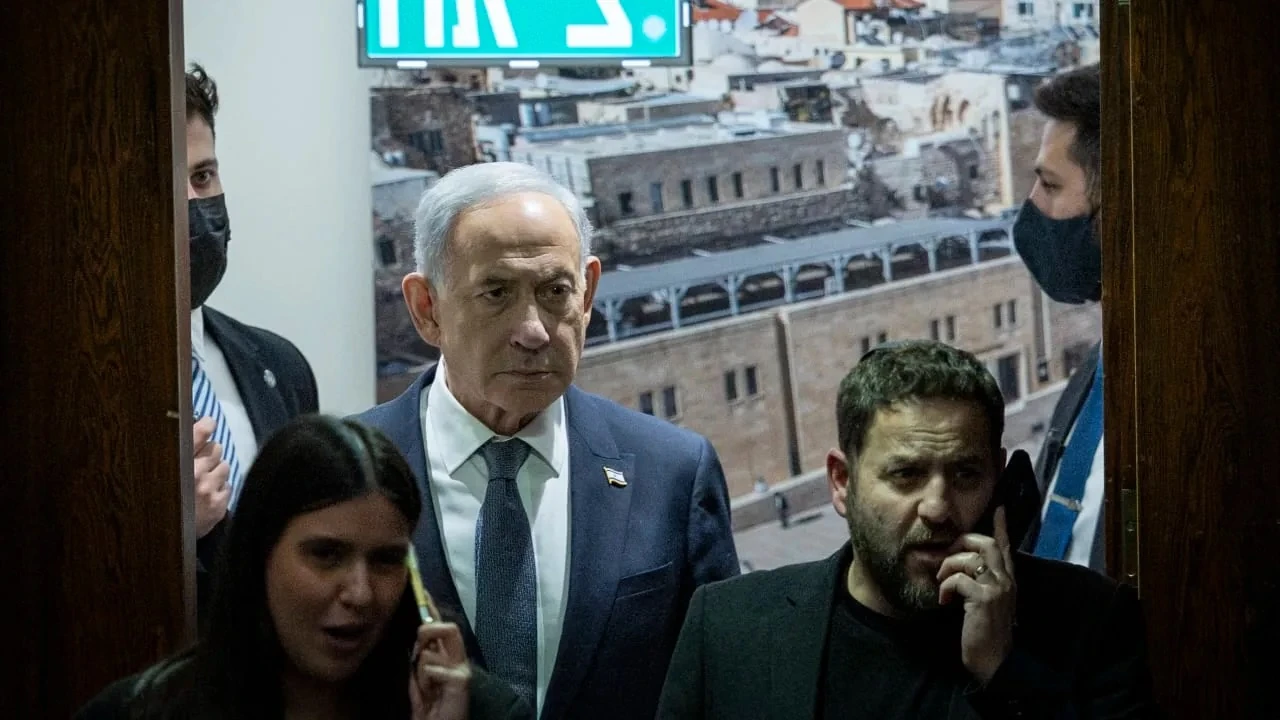
Netanyahu Proposes Rotating Premiership With Eisenkot for Unity Government
Israeli caretaker Prime Minister Benjamin Netanyahu proposed a rotating premiership on Saturday, offering to let opposition leader Gadi Eisenkot serve as prime minister first in a bid to form a unity government. The offer comes as Eisenkot faces a December 6 deadline to assemble a coalition following inconclusive October elections, NDTV reported.
Netanyahu shifts coalition strategy
“my responsibility as a leader requires me to set everything aside… and agree that Gadi Eisenkot will serve first as prime minister, while I will serve as alternate prime minister at the beginning of the term,” Israeli caretaker Prime Minister Benjamin Netanyahu said. In a social media post, he expressed his willingness to serve as alternate prime minister at the start of a term, provided that Eisenkot and his Yashar party agree to begin “genuine, sincere, and accelerated negotiations,” CNN reported.
The proposal marks a departure from earlier conditions set by Likud, which had previously insisted that Netanyahu remain the sole prime minister, thecradle.co reported. Netanyahu alleged that a government formed without his party could be influenced by Arab-majority lists to pursue policies such as citizenship for Palestinians or autonomy in the Galilee and Negev regions, according to the Middle East Monitor.
Opposition reaction to rotation offer
Eisenkot’s allies and other opposition figures have largely rejected the proposal. Former Prime Minister Yair Lapid described the offer as “another transparent con by a serial fraudster who has cheated every partner and broken every agreement,” NDTV reported. Yair Golan, head of the Democrats, added, “Enough with the tricks and shticks. Netanyahu has lost,” thecradle.co reported. The following table summarizes the parliamentary standing as the December 6 deadline approaches:”
| Political Bloc | Seats Held |
|---|---|
| Eisenkot’s Opposition Bloc | 48 |
| Netanyahu’s Coalition | 53 |
| Arab-Led Parties | 19 |
Obstacles to government formation
Eisenkot has already secured coalition deals with the right-wing Yisrael Beiteinu party and the left-leaning Democrats, but these alliances only account for 36 lawmakers, NDTV reported. A majority in the 120-seat Knesset requires 61 seats. While Eisenkot has been holding talks with the ultra-Orthodox United Torah Judaism party, those negotiations remain complicated by economic concerns; research from the Bank of Israel found that public expenditure for an average haredi household approaches NIS 13,000 monthly, The Jerusalem Post reported.
Eisenkot has vowed to announce his government formation by December 6 without requesting a 14-day extension, NDTV reported. If he fails to secure a majority by that date, President Isaac Herzog could assign the task to another Knesset member, such as Netanyahu, for a 28-day period, Al Jazeera reported.
If no government is formed, Israel could face a new round of elections, as occurred following political deadlocks in 2019 and 2020, according to Al Jazeera. Eisenkot did not immediately respond to the rotation proposal.

More on Benjamin Netanyahu
Israel's caretaker prime minister Benjamin Netanyahu on Saturday reiterated his calls for a national unity government with his opponent Gadi Eisenkot, who in turn dismissed the appeal as a ruse.https://t.co/Yktxfa21jm pic.twitter.com/YtJsuEdxX8
Worth a look
- Zelenskyy Confirms Uncoordinated Ukrainian Drone Strike on Russian Warship in Libya
- A Guide to Your First Pointe Shoe Fitting: Preparation and What to Expect
- Netanyahu Proposes Power-Sharing Premiership with Eisenkot (newsy-today.com)
- Netanyahu Offers Rotating Premiership, Eisenkot to Serve First (time.news)