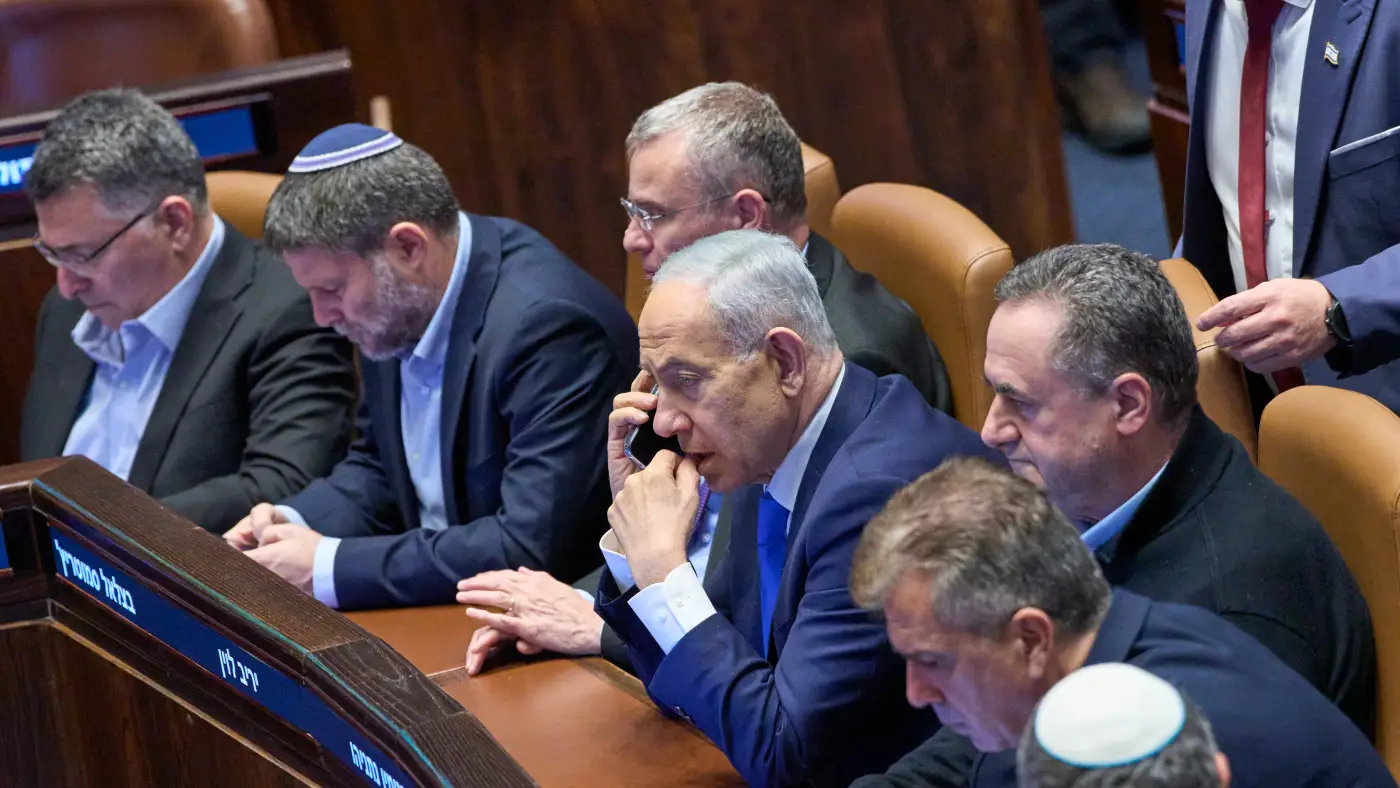
Netanyahu and Eisenkot Meet to Discuss Unity Government After Inconclusive Elections
Israeli Prime Minister Benjamin Netanyahu and opposition leader Gadi Eisenkot met Sunday to discuss a unity government, three weeks after President Isaac Herzog tasked Eisenkot with forming a coalition following inconclusive Oct. 27 elections.
- Netanyahu offered Saturday to let Eisenkot serve as prime minister first in a rotation arrangement.
- Eisenkot faces a Dec. 6 deadline to form a government or request a two-week extension.
- Netanyahu’s bloc holds 53 seats; Eisenkot’s bloc holds 48; Arab-led parties hold 19 seats in the 120-member Knesset.
- Both leaders began Sunday’s meeting with a security briefing before political talks.
Rotation offer shifts dynamics
Netanyahu announced Saturday night he would accept serving as alternate prime minister under a power-sharing deal that would install Eisenkot, a former military chief of staff, as premier first, The Hill reported. The concession came as Eisenkot’s Dec. 6 deadline approached and after weeks of what Eisenkot described as “refusal and evasion” from Likud negotiators, according to Reuters.
Opposition figures split on proposal
Yair Lapid, who led the 2021 coalition that ended Netanyahu’s 12-year rule, called the offer “a scam.” Yousef Jabareen, leader of the Joint List of Arab-led parties, urged rejecting it.
Tamar Hermann, who directs the Viterbi Center for Public Opinion and Policy Research at the Israel Democracy Institute, said a unity government would be seen by change voters as “another name for kicking the Arabs out.” Naftali Bennett, another former prime minister from the 2021 coalition, welcomed the rotation offer and said a unity government should center parties representing Israelis who perform military or national service.
Parliamentary math blocks easy majorities
Neither bloc secured the 61-seat majority required to govern. Netanyahu’s right-wing and ultra-Orthodox allies won 53 seats, down from a peak of 68 in the previous parliament, The Hill reported. Eisenkot’s bloc won 48 seats.
Arab-led parties captured a combined 19 seats, historic gains that made them potential but politically fraught partners for the opposition. Netanyahu has campaigned relentlessly against relying on Arab parties, warning Saturday that “without firing a single bullet, hostile elements will take control of the country from within.”
Core disputes remain unresolved
Parties backing Eisenkot disagree over whether to include Arab-led or ultra-Orthodox factions in a coalition. The country remains gripped by more than three years of war in Gaza, against Hezbollah in Lebanon, and a direct conflict with Iran that saw joint Israeli-U.S. strikes on Feb. 28.
Arab leaders reject unity government as betrayal
Yousef Jabareen, who leads the Joint List of three Arab-led parties, urged rejection of Netanyahu’s rotation offer on Sunday. Jabareen’s coalition holds 19 seats in the Knesset, a historic gain that made his parties potential but politically fraught partners for Eisenkot’s bloc.
Netanyahu frames offer to block Arab influence
In a statement Saturday, he warned that “without firing a single bullet, hostile elements will take control of the country from within,” describing a potential Arab-backed government as a “government of catastrophe.”
Eisenkot had served as a minister without portfolio in Israel’s unity government from 2023 to 2024 and as the 21st chief of staff of the Israel Defense Forces from 2015 to 2019, giving him recent executive and security experience that distinguished him from other opposition figures like Yair Lapid.
Dec. 6 deadline looms
If Eisenkot fails to form a government by Dec. 6, he may ask Herzog for a two-week extension. Should that fail, Netanyahu could get the next opportunity. New elections might be called if neither succeeds.