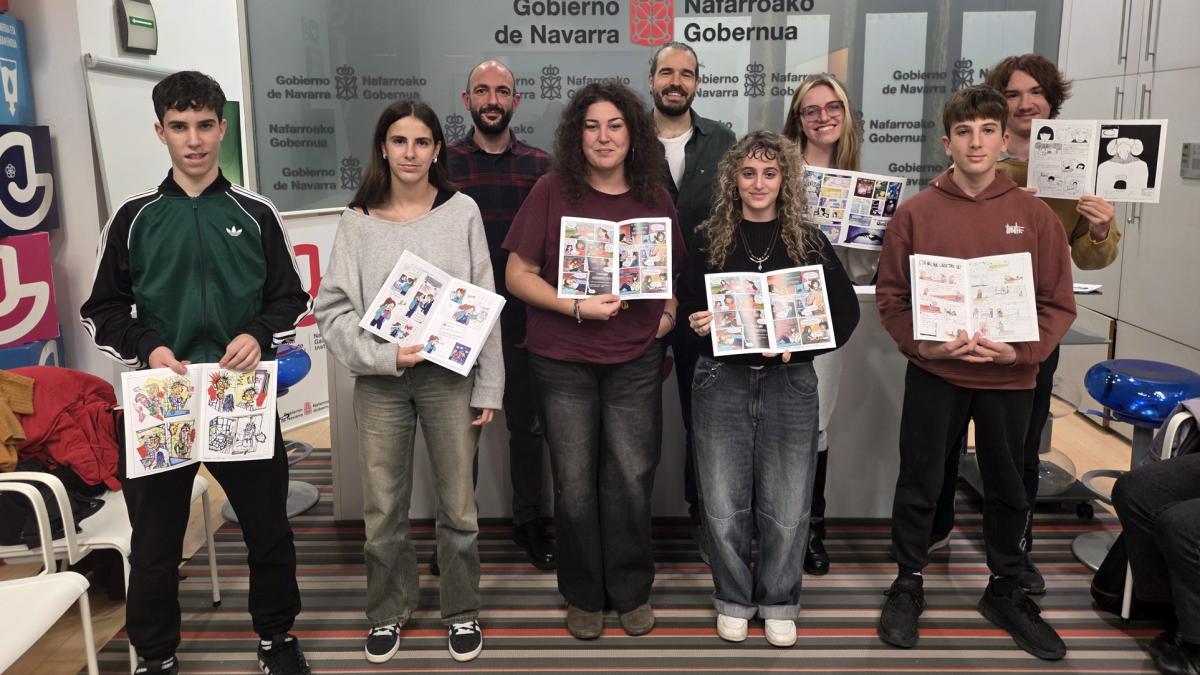
Navarro Youth Institute Announces Klask Comic Winners on Equality, Violence Prevention
Teenagers in Navarra are turning issues like cyber control, stereotypes, and consent into illustrated stories through the Klask youth comic contest.
The Navarro Youth Institute announced the winning works of the competition, which uses creativity to promote equality, respect, and the prevention of violence against women.
Seven authors aged 14 to 22 created the selected works, which are presented in a brief double-page format. The contest allows participants to build narratives from their own experiences and interests using visual and narrative codes familiar to their generation. The resulting stories address gender prejudices, disinformation, social media control relationships, and the importance of consent.
The winning comics have been compiled into a fanzine available in both physical and digital formats. Alongside the strips, the publication includes questions and reflection proposals prepared by the Navarra Institute for Equality to examine the addressed themes more deeply.
Beyond the publication, the awarded works will form an itinerant exhibition for interested cultural spaces and youth houses. The exhibition will also return to the 2027 Comic Fair through a collaboration with the Tiza Association.
Klask is the only comic contest in Navarra that offers a two-phase participation process, separating script creation from illustration. Eligible participants must be born or living in Navarra, hold the Youth Card, and fall between the ages of 14 and 22.
In the phased category separating script and illustration, Maitane González received the best script award for the work “Y esto, ¿dónde se pregunta?”. In the graphic phase, recognized proposals included those by Irati Hernández for “Y esto, ¿dónde se pregunta?” and Aratz Huarte for “Eta hau, non galdetzen da?”.
As the autonomous body charged with leading public youth policies in the region, the Navarro Youth Institute was specifically established in 2007 with dedicated competences in the field and subsequently re-established in 2019 through a dedicated regional decree. Operating as part of the regional administrative structure that has guided youth policy since 1991, the unit functions to direct public youth initiatives and coordinate strategic planning frameworks within the Navarre community.
In the complete category featuring both writing and illustration by the same creator, awarded works included Indira Espelosin with “Estereotipos”, Keydan John Harold with “Segundas caras”, June Laforet with “Con Sentido”, and Aitor Balda with “Ziberkontrola”, according to Diario de Navarra.