NATO Recon Aircraft, Drones and Tankers from Five Nations Surge Over Black Sea
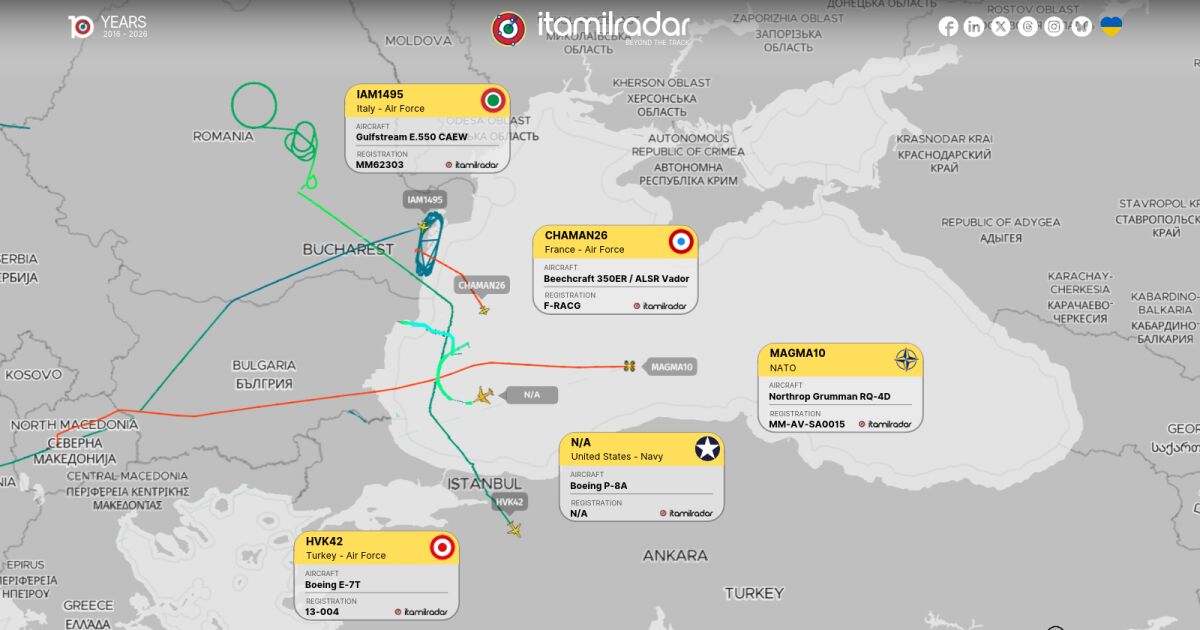
NATO reconnaissance aircraft, drones and tankers from five countries — Italy, France, the United Kingdom, the United States and Turkey — patrolled the Black Sea region on Thursday, November 19, in one of the heaviest single-day concentrations of allied air activity the area has seen in recent weeks, according to the military aviation tracking site ItaMilRadar.
The operations covered surveillance, early warning, intelligence gathering and air-to-air refueling along NATO’s eastern flank, bTV Новините reported.
Tracking data showed the Italian air force operated a Gulfstream E.550 CAEW, a jet equipped for long-range radar surveillance, early warning and management of air operations, on a flight over the western Black Sea, according to Nova. France contributed a Beechcraft 350ER ALSR Vador reconnaissance aircraft, which had also been spotted in the region in recent days, bTV Новините reported.
What made the day stand out was not any single aircraft but the combination of them — the simultaneous presence of strategic reconnaissance platforms, airborne command planes, a maritime patrol aircraft and three tankers. Bgonair described it as one of the most saturated days of military aviation activity in the Black Sea region in recent weeks.

Five nations, five separate missions
NATO’s own RQ-4D Phoenix, a Northrop Grumman-built unmanned reconnaissance aircraft, also flew over the sea. The drone flies at high altitude and can gather intelligence across vast areas without exposing a pilot crew to risk.
The United States Navy sent a Boeing P-8A Poseidon, an aircraft designed for maritime surveillance and anti-submarine warfare. Turkey’s air force participated with a Boeing E-7T, fitted with early warning and airspace control systems.
Nova.bg, citing FlightRadar24, added a detail the other reports did not carry: an aircraft of the United States Navy took off from Varna on the Bulgarian coast and subsequently disappeared from radar tracking.
Three tankers kept the patrols aloft
Refueling activity was particularly heavy. Trackers identified three tankers: a British Airbus KC3 Voyager, a NATO Airbus A330 MRTT and a French Airbus A330 MRTT.
https://t.co/moHYNEVBux
Their routes ran over Romania and the western Black Sea. Tankers allow fighter jets, reconnaissance aircraft and early warning platforms to extend their time in the air and maintain a continuous presence over the region rather than return to base between missions.
Transponders Off, Public Data Understates Activity
Additional fighter activity was registered across the wider area, but those aircraft could not be independently identified through publicly available flight tracking systems. ItaMilRadar said the real scale of the air operations was probably larger than public data alone can show.
That gap between what trackers can see and what actually flew is inherent to military aviation over the Black Sea. Transponders on combat aircraft are often switched off or set to encrypted modes, so the publicly visible picture understates the total activity.
Why the western Black Sea matters now
None of the four outlets reported any specific trigger for Thursday’s surge, and none quoted officials explaining the timing.
What the tracking data shows
| Country / operator | Aircraft | Role |
|---|---|---|
| Italy | Gulfstream E.550 CAEW | Radar surveillance, early warning, air operations management |
| France | Beechcraft 350ER ALSR Vador | Intelligence gathering and surveillance |
| NATO | RQ-4D Phoenix | High-altitude unmanned reconnaissance |
| United States (Navy) | P-8A Poseidon | Maritime surveillance, anti-submarine warfare |
| Turkey | Boeing E-7T | Early warning and airspace control |
| United Kingdom | Airbus KC3 Voyager | Air-to-air refueling |
| NATO / France | Airbus A330 MRTT (two aircraft) | Air-to-air refueling |
The open question over the Black Sea
What the alliance was watching for, and whether the surge responds to a specific development on the battlefield or at sea, remains unstated in the public record. The day’s flight paths are documented; the reasons behind them are not.
The RQ-4D Phoenix traces its lineage to Northrop Grumman, the American aerospace and defense company formed in 1994 through the merger of Northrop Corporation and Grumman Aerospace, in a deal valued at $2.1 billion.
Grumman, founded in December 1929 on Long Island, built most United States Navy aircraft during World War II and later the Apollo Lunar Module, while Northrop, established in California in 1939, pioneered the flying wing designs that paved the way for the B-2 Spirit stealth bomber.
The company’s unmanned aircraft are central to alliance surveillance: alongside the RQ-4D Phoenix developed for the NATO Alliance Ground Surveillance Force, it produces the MQ-4C Triton.
As ItaMilRadar’s data makes plain, the aircraft that could be identified were the ones that wanted to be seen — the actual scale of NATO’s Black Sea air operations that day was, by the tracker’s own assessment, larger than the public record shows.