National Taiwan University Uncovers Chlorine Anion Redox in Li2FeCl4
Solid-state battery research took a new turn when researchers uncovered chlorine anion redox activity operating in lithium iron chloride cathodes.
The Tech TL;DR:
- Researchers identified chlorine anion redox in Li₂FeCl₄ solid-state battery cathodes, moving beyond traditional metal-centered charging.
- Testing revealed two distinct oxidation voltages, with chlorine contributing to charge compensation near 4.2 V.
- The findings point toward cleaner ways to build high-energy solid-state batteries without relying exclusively on transition metals.
Conventional rechargeable batteries rely strictly on transition metals to store and release electrical charge during use. Scientists are trying to draw additional charge from anions instead, looking closely at oxygen and sulfur to improve energy density.
Whether chlorine could perform a similar function in chloride-based battery cathodes remained unclear until recent experiments by a team led by Professor Ru-Shi Liu in the Department of Chemistry at National Taiwan University. The research group collaborated with scientists at the National Synchrotron Radiation Research Center in Taiwan and the Nagoya Institute of Technology in Japan to study lithium iron chloride, or Li₂FeCl₄.
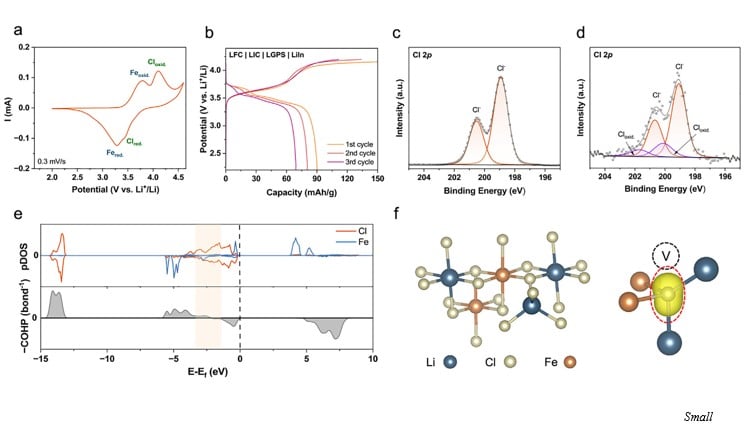
The team constructed an all-solid-state cell using Li₂FeCl₄ as the cathode, a Li₃InCl₆ solid electrolyte, a Li₁₀GeP₂S₁₂ interlayer, and a lithium-indium alloy anode. Electrochemical testing of this cell revealed two distinct oxidation features occurring near 3.8 and 4.2 V versus Li⁺/Li.

Measurements showed that the lower-voltage process near 3.8 V stemmed primarily from Fe²⁺/Fe³⁺ oxidation. The higher-voltage feature near 4.2 V came directly from chlorine.
To confirm the origin of this second voltage spike, the research team used X-ray photoelectron spectroscopy and X-ray absorption spectroscopy alongside density functional theory calculations. These combined methods confirmed changes in the electronic state of chlorine during the charging cycle.
Calculations of the partial density of states and crystal orbital Hamilton population identified occupied, chlorine-derived nonbonding orbitals. These specific electronic states are capable of stepping in to handle charge compensation when electrons are pulled from the material.
The tests also highlighted a distinct interaction between iron and chlorine atoms inside the cathode. During the initial charging phase, iron oxidizes and its surrounding Fe–Cl octahedra become distorted. At higher voltages, as chlorine-related oxidation takes over, the iron centers display partial reduction rather than continued oxidation.
Integrating anion redox into solid-state systems faces hurdles regarding inefficient lithium-ion transport kinetics across the cathode-electrolyte interface and structural instabilities within the host framework. The newly documented reductive coupling behavior in lithium iron chloride offers insight into how these halide materials can redistribute electronic charge while recovering local structural symmetry.