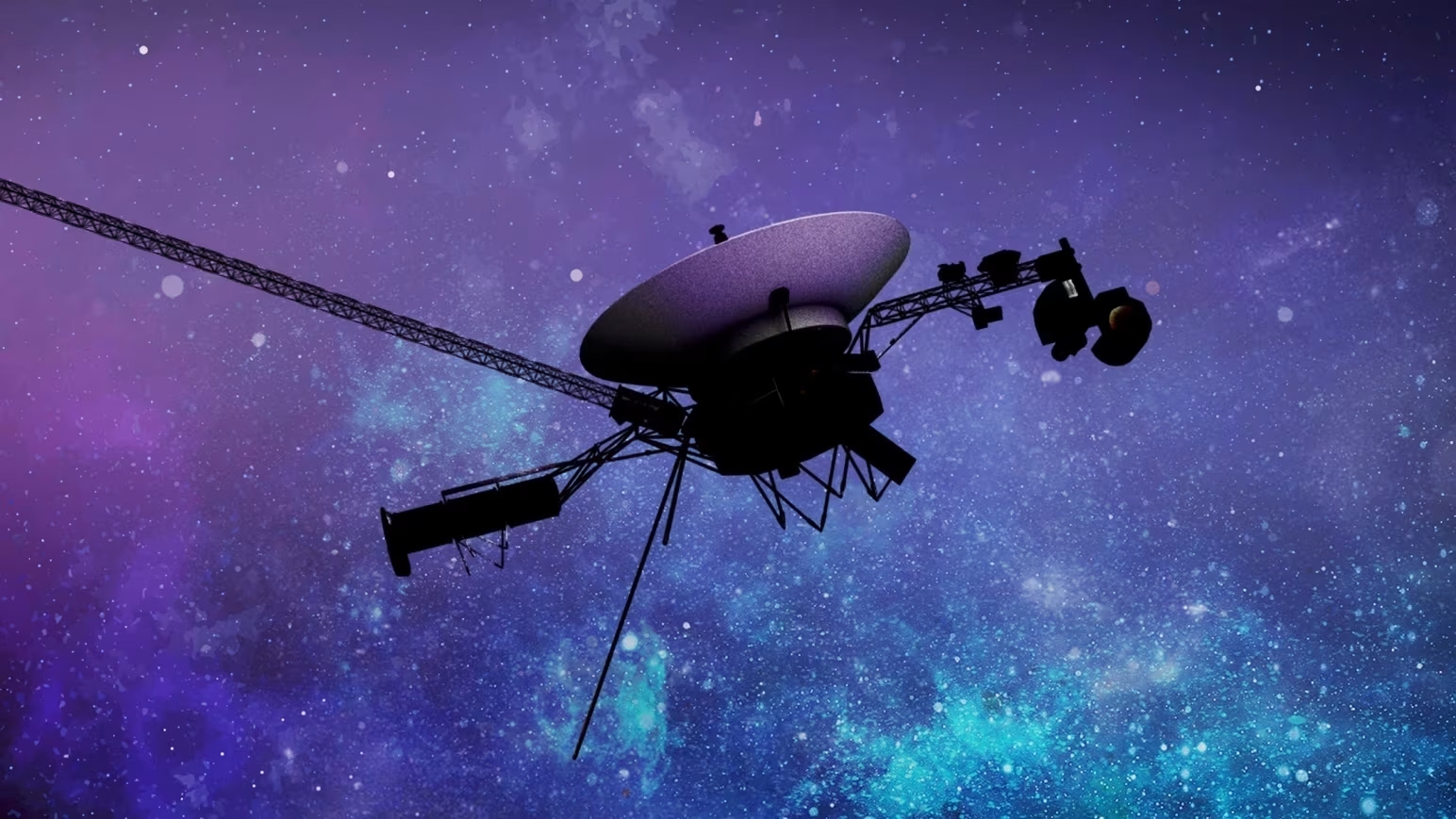
NASA’s Voyager 1 Reaches Historic One Light-Day Distance From Earth
The NASA Voyager 1 probe has reached the historic milestone of one light-day of distance from Earth, marking the farthest point any human-made object has ever traveled.
According to NASA, the spacecraft crossed the threshold at 2:16 a.m. Pacific Time on November 18, 2026. This distance, representing the space light travels in 24 hours, is approximately 25.9 billion kilometers.
The Deep Space Network received confirmation of the feat 24 hours later, accounting for the time the radio signal required to traverse the vast expanse between the probe and Earth. Multiplying the speed of light by the 86,400 seconds in a day confirms this 25.9 billion-kilometer figure.
Communication Challenges at 26 Billion Kilometers
While the milestone highlights the spacecraft’s unprecedented journey, the probe is currently experiencing a communications anomaly. Voyager 1 stopped transmitting scientific and engineering data on November 14, returning only an empty "carrier signal," CNN Brasil reported. Engineers at the Jet Propulsion Laboratory in California are analyzing the issue, which resembles a similar failure the probe encountered in November 2023, according to oRegiões.
The failure involves the flight data subsystem, one of the three onboard computers. Because of the vast distance, a simple exchange of information between scientists and the craft can take at least 48 hours. Joe Westlake, director of the Heliophysics Division at NASA, noted the extraordinary relevance of this technological feat.
The presence of the carrier signal indicates that the navigation computer is correctly pointing the antenna toward Earth, according to NASA. “I see this as an engineering milestone, which marks the incredible longevity of Voyager 1 — and also as an engineering achievement to be able to communicate with Voyager 1 at this distance,” Alan Cummings, a physicist and program scientist who has worked on the mission since 1973, told VEJA.
Tracking Distant Signals and Future Trajectories
The mission’s reach extends far beyond the current milestone, as NASA confirms the probe is traveling toward the star AC +79 3888, also known as Gliese 445. Located in the constellation Ursa Minor, this stellar body lies more than 17 light-years from Earth. According to mission counters, it currently sits at approximately 21.7 billion kilometers from Earth, a distance equivalent to about 20 light-hours.

Beyond our solar neighborhood, the nearest stars forming the Alpha Centauri system reside roughly 4.24 light-years away. Rogério Rosenfeld, a professor at the Institute for Theoretical Physics at Unesp, emphasizes the sheer scale of these depths, noting that “The Universe is very big!”
As an author who explores cosmic phenomena, Rosenfeld explains that much of the data regarding the interstellar medium cannot be captured by ground-based telescopes, making the aging probe’s local measurements uniquely valuable for understanding the cosmos.
Reflecting on Nearly Five Decades of Exploration
The endurance of these spacecraft remains a subject of intense scientific interest, as the original mission design intended for the probes to last only five years. This legacy of exploration mirrors the spirit of the classic Star Trek series, where the probe’s journey to “boldly go where no one has gone before” echoed the promise made by Captain Kirk.
Shining bright across the solar system! On Nov. 18, the Voyager 1 spacecraft will pass an extraordinary milestone, a distance reached by no other human-made object: one light-day away from Earth. And we're celebrating with a special message for the spacecraft! pic.twitter.com/CHgYMKrbhL
Public engagement with the mission has also evolved, with NASA utilizing the “Shine Bright for Voyager Light-Day” event to connect with audiences. Such gestures celebrate the craft’s history, honoring the Golden Record’s inclusion of the Latin phrase “Ad astra per aspera,” which translates to “through hardships, to the stars.”
Mission Milestones and Longevity
Launched in 1977 to capitalize on a rare planetary alignment, the Voyager 1 and Voyager 2 missions have fundamentally altered human understanding of the solar system.
The probe and its twin, Voyager 2, launched in late August 1977, were originally designed to last only five years and explore Jupiter and Saturn, according to CNN Brasil. Voyager 1 entered interstellar space in 2012, becoming the first human-made object to leave the heliosphere, the magnetic bubble generated by the Sun.

The spacecraft carries the Golden Record, which contains 115 images, greetings in 55 languages, sounds of nature and life on Earth, and 90 minutes of music from different cultures and eras. One of the curiosities noted during the mission is the Morse code message on the Golden Record: “Ad astra per aspera”, or “through hardships, to the stars”.
| Milestone | Date |
|---|---|
| Launch from Cape Canaveral | September 5, 1977 |
| Jupiter Flyby | March 5, 1979 |
| Saturn Flyby | November 12, 1980 |
| Exit from Heliosphere | August 25, 2012 |
| One Light-Day from Earth | November 18, 2026 |
On November 19, 2026, a communication station located in Robledo de Chavela, Spain, received radio signals sent by the spacecraft from interstellar space. NASA had celebrated the moment even before official confirmation, publishing the message “Happy Voyager Light-Day!” on social media the day before.
The event, titled “Shine Bright for Voyager Light-Day,” invites those with a mobile phone or tablet to connect to a special NASA website to display the VGR light signal, which is the Morse code call sign for “wave”.
If you'd like to know where Voyager 1 is right now in the sky: pic.twitter.com/wdnksvkLCp
Maintaining operational status for nearly 50 years requires constant adjustments. Engineers have progressively shut down non-essential instruments to preserve the probe’s decaying plutonium-powered radioisotope thermoelectric generators, which lose approximately four watts of power annually. NASA expects to keep the remaining scientific instruments active until at least the mission’s 50th anniversary next summer.
“The Universe is very big!”, said physicist Rogério Rosenfeld, a professor at the Institute for Theoretical Physics (IFT) at Unesp since 1995. For comparison, the nearest stars to the Sun, forming the Alpha Centauri system, are approximately 4.24 light-years from Earth. The Voyager probe and its journey to “boldly go where no one has gone before” echoed the promise made by Captain Kirk in the opening of the classic series.