
pandora Telescope: A New Eye on Exoplanet Atmospheres
On Jan. 11,2026,I watched with anticipation at the tightly controlled Vandenberg Space Force Base in California as a SpaceX Falcon 9 rocket carried NASA’s new exoplanet telescope,Pandora,into orbit. This launch marks a pivotal moment in our quest to understand worlds beyond our solar system and, perhaps, to find signs of life.
Exoplanets – planets orbiting other stars – are notoriously challenging to observe.From our vantage point on Earth, they appear as incredibly faint dots of light dwarfed by the brilliance of their host stars. The Pandora telescope is designed to overcome this challenge, working in tandem with NASA’s James Webb Space Telescope to unravel the mysteries of thes distant worlds.
as an astronomy professor at the University of Arizona specializing in exoplanets and astrobiology, and as a co-investigator leading the exoplanet science working group for Pandora, I can attest to the transformative potential of this mission. We built Pandora to address a critical limitation in our current ability to study small exoplanets and search for biosignatures – indicators of life.
The Challenge of Stellar Activity and Observing Exoplanets
Astronomers employ a clever technique to study exoplanet atmospheres: observing the starlight that filters thru them as the planets pass in front of their host stars – a process known as a transit. This is akin to analyzing the quality of wine by observing how light passes through it. By dissecting the starlight, we can identify the presence of water vapor, hydrogen, clouds, and potentially even evidence of life .
Initial transit observations,significantly improved by 2002 , opened a new window into the study of exoplanets. Though, starting around 2007, astronomers began to notice a confounding factor: starspots. These cooler, active regions on stars can disrupt the precision of transit measurements.
Our research, conducted with then-Ph.D. student Benjamin V. Rackham and astrophysicist Mark Giampapa in 2018 and 2019, demonstrated how starspots and other magnetically active regions can mislead exoplanet measurements. We termed this issue the “transit light source effect.” Most stars are spotted, active, and constantly changing , and these changes introduce noise into the data. Furthermore,the presence of water vapor in a star’s atmosphere,often concentrated in starspots,can mimic the signal of water vapor in an exoplanet’s atmosphere,leading to false positives.
We predicted, even before the 2021 launch of the James Webb Space Telescope, that stellar activity would limit its full potential. We realized we were attempting to analyze subtle planetary signals through a flickering, unstable light source.
The Birth of Pandora: A Rapid-Response Solution
The Pandora mission began with an intriguing email from NASA’s Goddard Space Flight Center in 2018. Scientists Elisa Quintana and Tom Barclay proposed a bold plan: to build a dedicated space telescope quickly, specifically to address the issue of stellar contamination and enhance the capabilities of Webb. This was an aspiring undertaking, as space telescopes are typically developed over many years.
blue Canyon Technologies
Pandora represents a departure from traditional NASA mission growth. We adopted a faster, lower-cost approach, prioritizing simplicity and accepting a degree of calculated risk. This allowed us to build and launch Pandora in a remarkably short timeframe.
What Sets Pandora Apart?
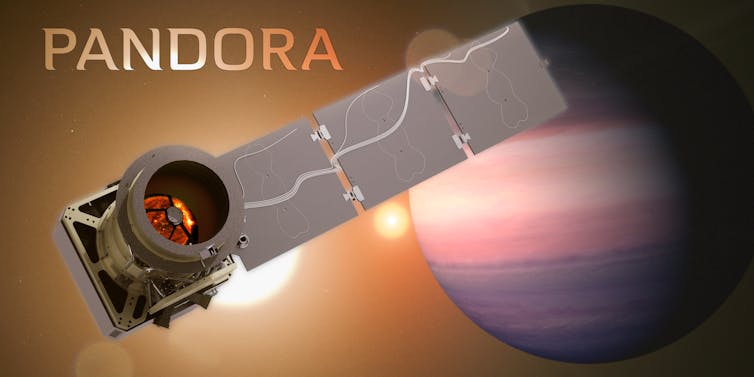
While Pandora is smaller than Webb and collects less light, it possesses a unique capability: sustained, dedicated observation of stars. Unlike Webb, which typically makes brief observations of exoplanets, Pandora will patiently monitor stars to understand the dynamic nature of their atmospheres.
By staring at a star for 24 hours using both visible and infrared cameras , pandora will meticulously record subtle changes in brightness and color caused by starspots, active regions, and other stellar phenomena. Pandora will revisit its target stars 10 times over a year, accumulating over 200 hours of observation for each star.This continuous monitoring will allow us to characterize stellar variability with unprecedented detail.
NASA’s Goddard Space Flight Center/Conceptual Image Lab, CC BY
This data will allow us to determine how stellar changes impact transit observations, ultimately enabling more accurate measurements of exoplanet atmospheres. By combining Pandora’s stellar observations with Webb’s detailed atmospheric analyses, we will gain an unprecedented understanding of the composition and characteristics of exoplanets.
Following a successful launch, Pandora is currently orbiting Earth approximately every 90 minutes.Blue Canyon Technologies, Pandora’s primary builder, is diligently conducting thorough testing of the spacecraft’s systems and functions.
Within a week of launch, control of Pandora will be transferred to the University of Arizona’s Multi-Mission operation Center in Tucson, Arizona. This marks the beginning of our science mission, as we begin to capture starlight filtered through the atmospheres of other worlds – and observe them with a new, steady eye.
