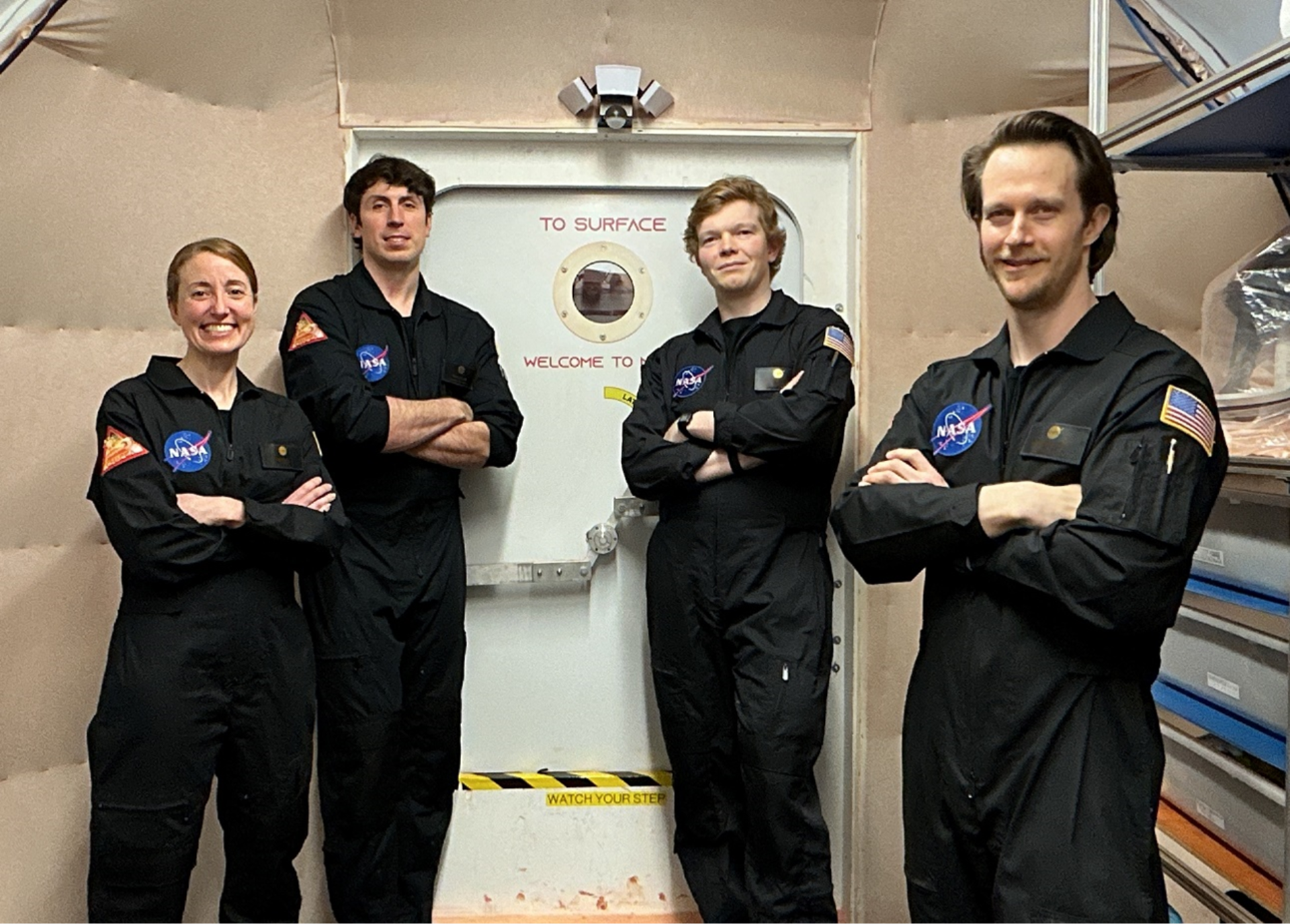
NASA’s One-Year Mars Simulation Hits 200-Day Milestone Inside Isolation Habitat
May 7, 2026 Rachel Kim – Technology EditorTechnology
NASA’s CHAPEA-2 Mars Analog: A Real-World Stress Test for Deep-Space IT Resilience
NASA’s CHAPEA-2 mission—200 days into its 378-day simulation of a Mars surface stay—isn’t just a psychological endurance test. It’s a live benchmarking exercise for the latency-sensitive, autonomous systems that will define crewed interplanetary missions. The current two-week “loss-of-signal” period, mimicking Mars-Earth communication blackouts, forces the crew to operate in a high-autonomy mode where every API call, diagnostic script, and hardware failure must be resolved without ground support. This isn’t vaporware; it’s a real-world deployment scenario for the next generation of edge computing and cyber-physical systems. And the bottlenecks are already revealing themselves.
The Tech TL;DR:
Autonomous IT in extreme latency: CHAPEA-2’s “blackout” phase exposes how offline-capable Kubernetes clusters and preemptive failure modes perform under 20-minute round-trip communication delays (simulating Mars-Earth lag).
Cybersecurity in isolation: The habitat’s airlock and life-support systems run on hardened embedded Linux with no external patches—mirroring the constraints of deep-space hardware. Zero-trust architectures are being stress-tested in ways no Earth-based data center ever will.
Human-AI collaboration gaps: The crew’s reliance on pre-trained LLM diagnostics (for medical and structural issues) highlights the hallucination risks of AI in high-stakes, low-bandwidth environments. No cloud fallback means no retries.
The Workflow Problem: Why Mars Simulations Break Earth’s IT Assumptions
CHAPEA-2 isn’t just testing human psychology—it’s a live benchmark for distributed systems architecture. The habitat’s 1,700 sq ft of 3D-printed habitat infrastructure (per NASA’s [CHAPEA program page](https://www.nasa.gov/humans-in-space/chapea/)) runs on a hybrid stack of COTS hardware and custom firmware, designed to mimic the processing constraints of a Martian base. Here’s where the cracks appear:
Latency as a feature: Earth-based IT assumes sub-100ms API responses. Mars adds 3–22 minutes of round-trip delay (depending on planetary alignment). CHAPEA-2’s crew must execute pre-approved scripts for critical failures—no real-time debugging.
No patch Tuesday: The habitat’s life-support systems run on offline-updatable firmware, a model more akin to military-grade embedded systems than cloud-native DevOps. A CVE in a dependency here isn’t patched; it’s worked around.
AI as a co-pilot, not a pilot: NASA’s use of LLM-assisted diagnostics (e.g., for medical or structural anomalies) exposes a critical flaw: hallucinated confidence scores in a system with no ground truth. On Earth, you’d query Stack Overflow. On Mars? You’re stuck with the model’s last output.
Under the Hood: The CHAPEA-2 Tech Stack and Its Mars-Ready Alternatives
NASA’s official CHAPEA-2 announcement confirms the mission uses a custom-modified habitat control system built on ROS 2 (Robot Operating System 2) for autonomy, paired with high-reliability embedded Linux distributions (likely Yocto or Debian LTS). Below is a spec comparison of the habitat’s core systems against Earth-based equivalents:
The Implementation Mandate: How to Test Your Systems for Mars-Level Resilience
If your organization operates in high-latency, low-bandwidth, or offline-capable environments (e.g., oil rigs, submarine networks, or remote military bases), CHAPEA-2’s approach offers a real-world stress test. Here’s how to replicate the key constraints:
# Simulate Mars-Earth latency (20-min round-trip) using tc (Linux) sudo tc qdisc add dev eth0 root netem delay 600 300 # Test offline Kubernetes with pre-approved scripts (example: failure recovery) kubectl apply -f /path/to/pre-approved-failure-handlers.yaml --validate=false # Benchmark LLM hallucination rates in a constrained environment python3 -m pip install transformers from transformers import pipeline classifier = pipeline("text-classification", model="distilbert-base-uncased-finetuned-sst-2-english", device=0) # Run with a closed knowledge base (no internet access)
Expert Voices: What the CHAPEA-2 Crew’s Struggles Reveal
“The biggest misconception is that ‘offline-capable’ means ‘dumb.’ CHAPEA-2 proves you can run predictive maintenance and autonomous diagnostics without a cloud connection—but only if you’ve pre-computed every possible failure mode. The real bottleneck isn’t processing power; it’s decision latency in a system where ‘asking for help’ takes 20 minutes.”
“We’ve seen ROS 2 used in nuclear plants and underwater drones, but CHAPEA-2 is the first time it’s being stress-tested for human-critical autonomy. The lesson? Deterministic timing isn’t just about hardware—it’s about pre-validated software stacks. If your Kubernetes cluster can’t guarantee a 99.999% uptime SLA without a network, you’re not Mars-ready.”
Directory Bridge: Who’s Building the Stack for the Next CHAPEA?
If your organization needs to harden systems for extreme autonomy, these providers are already working on the same challenges:
The Editorial Kicker: Mars Isn’t the Edge—It’s the New Mainframe
CHAPEA-2 isn’t just a stepping stone to Mars. It’s a live architecture review for any system where latency kills and human lives depend on autonomous decisions. The lessons here—pre-validated stacks, deterministic timing, and offline-capable AI—are already being adopted in:
Submarine cables (where repairs take weeks).
Autonomous shipping (where satellite links drop).
Military forward operating bases (where comms are jammed).
The question isn’t if your industry will face these constraints—it’s when. And the CHAPEA crew’s 200-day milestone is your wake-up call: Your systems aren’t ready.
Disclaimer: The technical analyses and security protocols detailed in this article are for informational purposes only. Always consult with certified IT and cybersecurity professionals before altering enterprise networks or handling sensitive data.