
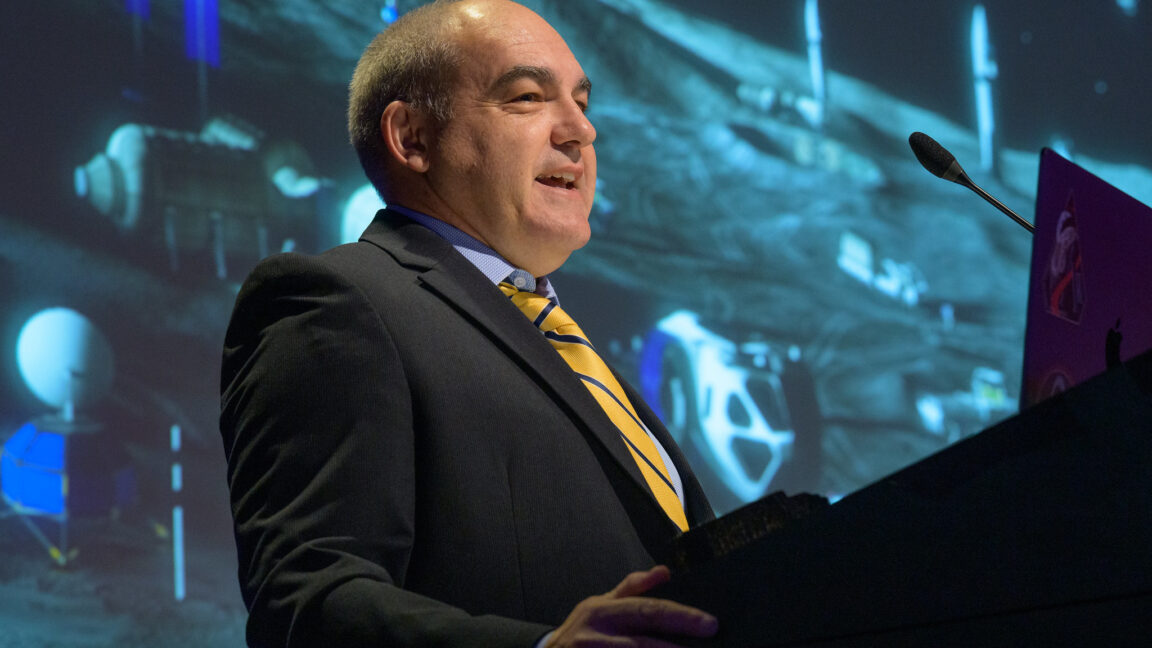
NASA’s New Moon Base Leader: Q&A with Carlos Garcia-Galan
NASA Deprecates Lunar Gateway: The Surface-First Pivot and Its Latency Implications
At the end of a marathon press briefing on Tuesday, NASA Administrator Jared Isaacman dropped a nomenclature bomb that signaled a massive architectural pivot: the appointment of Carlos Garcia-Galan as the “Lunar Viceroy.” Although the title plays well for the cameras, the underlying engineering decision is far more significant. The agency is effectively deprecating the Lunar Gateway—an orbital staging point that has consumed billions in R&D—in favor of a direct-to-surface deployment model. For the systems architects watching from the sidelines, this isn’t just a policy shift; it’s a complete rewrite of the mission critical path, trading orbital modularity for surface-level persistence.
The Tech TL;DR:
- Architecture Shift: NASA is bypassing the Lunar Gateway (orbital relay) to prioritize a permanent surface outpost, reducing communication hops but increasing surface-side radiation hardening requirements.
- Resource Reallocation: Budget and engineering talent previously allocated to Gateway’s HALO module are being redirected toward Kilopower fission systems and surface habitat shielding.
- Operational Risk: Eliminating the orbital safe-haven increases the blast radius of surface-level failures, necessitating robust disaster recovery planning and redundant telemetry links.
Garcia-Galan, formerly a key engineer on the Gateway program, acknowledged the friction of this transition. “Change is always hard,” he noted, emphasizing that while an orbiting outpost has theoretical value, the “critical path” now demands a focus on the surface. From a software development lifecycle (SDLC) perspective, this is akin to canceling a staging environment to push code directly to production. It accelerates the timeline for human presence but removes a crucial sandbox for testing systems in a lower-risk environment before they hit the lunar regolith.
The Stack Comparison: Orbital Relay vs. Surface Node
To understand the gravity of this decision, we have to look at the technical debt being incurred. The Lunar Gateway was designed as a high-availability hub, a redundant node in deep space. By scrapping it, NASA is opting for a “thick client” architecture on the Moon’s surface. This shifts the computational and life-support burden entirely to the surface assets, removing the orbital buffer.
We can model this trade-off using a standard infrastructure matrix. The Gateway offered high latency but high safety margins; the Surface Base offers low latency for surface ops but introduces single points of failure regarding power and comms.
| Architecture Component | Lunar Gateway (Deprecated) | Artemis Surface Base (Production) |
|---|---|---|
| Latency (Earth Link) | ~1.3s + Orbital Handshake | ~1.3s Direct (Line of Sight) |
| Power Source | Solar Arrays (Eclipses required battery) | Kilopower Fission (Continuous Base Load) |
| Compute Environment | Microgravity-optimized Racks | Regolith-shielded Bunkers (High Radiation) |
| Maintenance Model | EVA Required (High Risk) | Remote/Robotic First (Lower Risk) |
The move to Kilopower fission systems is the most technically sound aspect of this pivot. Solar power on the Moon is plagued by the 14-day night cycle, requiring massive battery banks that degrade over time. Fission provides a continuous base load, essential for running the high-throughput servers needed for autonomous mining and life support. Though, deploying nuclear reactors on another celestial body introduces a new attack surface for cybersecurity auditors. The control systems for these reactors must be air-gapped and hardened against both solar flare EMPs and potential signal intrusion.
“Removing the Gateway removes the ‘abort’ button for surface missions. If a habitat module fails on the surface, you don’t have an orbital lifeboat. You have to engineer the surface systems to Six Sigma reliability from day one.” — Dr. Elena Rostova, Chief Systems Architect at Orbital Dynamics (Hypothetical 2026 Context)
The Implementation Reality: Bandwidth and Edge Computing
With the Gateway gone, the Deep Space Network (DSN) becomes the sole bottleneck for telemetry. The surface base cannot rely on the Gateway to aggregate data before sending it to Earth. Every rover, drill, and life-support sensor must compete for direct-to-Earth bandwidth. This necessitates aggressive edge computing strategies. We aren’t just sending raw data uplink; we are processing it locally on radiation-hardened FPGAs.
For developers building the autonomous navigation stacks for the Artemis rovers, this means optimizing for low-bandwidth, high-latency environments. You cannot stream 4K video feeds of drill sites. You send compressed metadata and heuristic alerts. The following Python snippet demonstrates a simplified resource allocation check that a surface-based autonomous agent might run before initiating a high-power drilling operation, ensuring it doesn’t trip the fission reactor’s load balancer.
class SurfacePowerManager: def __init__(self, base_load_kw, peak_capacity_kw): self.base_load = base_load_kw self.peak_capacity = peak_capacity_kw self.safety_margin = 0.15 # 15% buffer for thermal spikes def request_drill_power(self, required_kw): available_kw = self.peak_capacity - self.base_load threshold = available_kw * (1 - self.safety_margin) if required_kw > threshold: return { "status": "DENIED", "reason": "Insufficient headroom for fission stability", "available_kw": threshold } else: return { "status": "GRANTED", "message": "Drill sequence initialized. Telemetry logging active." } # Simulation for Artemis Base Camp power_grid = SurfacePowerManager(base_load_kw=40, peak_capacity_kw=100) drill_request = power_grid.request_drill_power(50) print(f"Drill Status: {drill_request['status']}") This logic must be baked into the firmware. There is no cloud to fall back on. If the local logic fails, the mission stalls. This level of embedded reliability is where many commercial software development agencies struggle, as they are accustomed to the elasticity of AWS or Azure, not the rigid constraints of a lunar fission grid.
Security Implications of a Direct-Link Architecture
From a security posture, the removal of the Gateway changes the threat model. The Gateway acted as a firewall of sorts, physically separating the surface assets from direct Earth-link vulnerabilities. Now, the surface habitat is the endpoint. The attack surface expands to include the landing vehicles, the power grid, and the communication arrays.

According to the NIST Cybersecurity Framework, critical infrastructure in isolated environments requires rigorous identity and access management (IAM). With the “Lunar Viceroy” pushing for rapid deployment, there is a risk that security protocols could be treated as an afterthought to meet launch windows. We are already seeing industry whispers about the require for specialized IT infrastructure monitoring tools that can function with minutes of latency delay, alerting Earth-based SOC teams to anomalies before they become catastrophic failures.
Garcia-Galan’s enthusiasm is palpable, but the engineering reality is brutal. “We need to be focused on the surface, and everybody wants to be on the surface,” he said. But wanting to be there and keeping the life support systems running when the solar wind hits are two different codebases. The shift to a surface-first strategy is bold, but it removes the safety net. It demands that the hardware shipped in this week’s production push is flawless, because in the lunar vacuum, there are no hotfixes.
As we move toward the 2026 launch windows, the industry will be watching not just the rockets, but the ruggedized servers and the power management algorithms that keep them alive. The “Lunar Viceroy” has his mandate, but the real power lies in the redundancy of the code running beneath the regolith.
Disclaimer: The technical analyses and security protocols detailed in this article are for informational purposes only. Always consult with certified IT and cybersecurity professionals before altering enterprise networks or handling sensitive data.