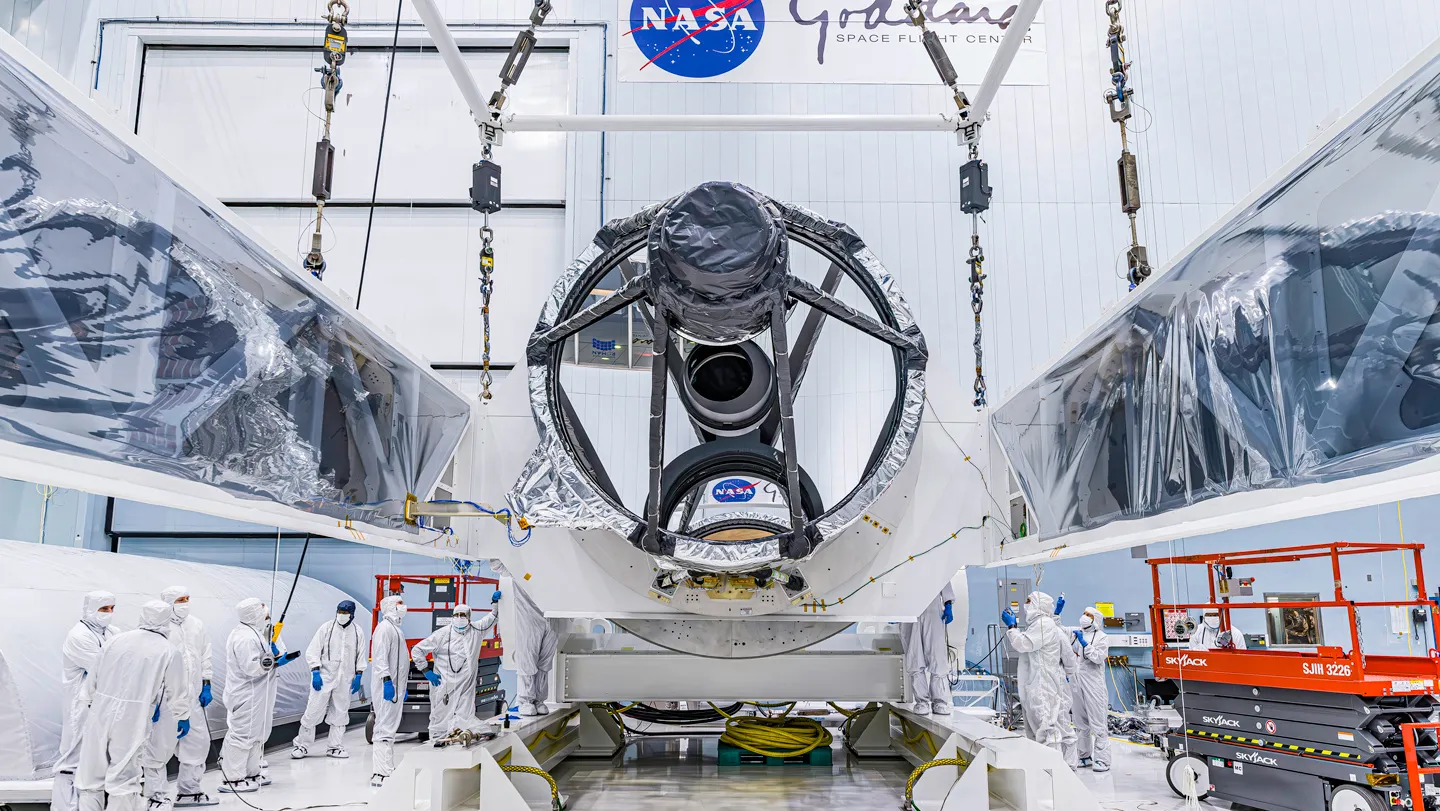
NASA’s Nancy Grace Roman Telescope to Explore Dark Energy and Exoplanets
The Nancy Grace Roman Space Telescope is scheduled to launch on August 30, 2026, atop a SpaceX Falcon Heavy rocket from the Kennedy Space Center in Florida, according to NASA. Designed to operate nearly one million miles from Earth, the 42-foot-long flagship observatory will tackle fundamental questions regarding dark energy, dark matter, and the search for exoplanets.
- Launch Timeline: Liftoff is scheduled for August 30, 2026, from the Kennedy Space Center using a SpaceX Falcon Heavy rocket, with science operations projected to begin in January 2027 per NASA and University of Arizona accounts.
- Instrument Capabilities: Outfitted with a 300-megapixel Wide Field Instrument and a powerful coronagraph, the observatory will capture images with Hubble-like sharpness across an area 100 times larger than the Hubble Space Telescope’s field of view.
- Core Objectives: The mission aims to chart billions of galaxies, investigate cosmic acceleration driven by dark energy, and discover thousands of new exoplanets beyond our solar system.
Mission Architecture and Technical Specifications
Managed by NASA’s Goddard Space Flight Center in Greenbelt, Maryland, the Nancy Grace Roman Space Telescope represents a major expansion in astrophysics capabilities. The observatory spans 42 feet long and more than 14 feet wide, housing a primary mirror measuring 7.9 feet across—the same physical diameter as the Hubble Space Telescope mirror, according to NASA data published by USA Today. However, its engineering configuration centers heavily on breadth of observation. Every single image beamed back by the Roman telescope will contain the equivalent of 100 pictures captured by Hubble.

This wide-field capability relies on two primary instruments. The Wide Field Instrument operates as a multi-band near-infrared camera designed to survey vast swaths of the cosmos and scan for exoplanets. Alongside it, a high-performance coronagraph will suppress the intense glare of distant stars. This coronagraph allows the observatory to photograph celestial bodies nearly a billion times fainter than their host stars, including distant worlds and surrounding debris disks.
Probing Cosmology and the Invisible Universe
A central purpose of the mission involves mapping the distribution of dark matter and dark energy, two unseen components that make up nearly the entire universe. To maximize the scientific return of these observations, academic institutions have secured specialized funding roles. For instance, the University of Arizona received a $2 million allocation for its Arizona Cosmology Lab, where Professor of Astronomy and Physics Elisabeth Krause leads a wide-field science team investigating kinematic lensing, as detailed by SciTechDaily.

Complementary Observations with Hubble and Webb
The Roman Space Telescope will not operate in isolation. It is engineered to complement existing assets such as the Hubble Space Telescope and the James Webb Space Telescope. While Webb specializes in deep, narrow-field inspections of specific cosmic regions, Roman provides panoramic coverage. Because both Roman and Webb observe infrared light, astronomers can cross-reference their data sets to build a more comprehensive model of cosmic evolution.
The mission honors Nancy Grace Roman, an American astronomer born in Nashville, Tennessee, who served as NASA’s first chief of astronomy until her retirement in 1979. Known widely as the “mother of Hubble” for her foundational planning of the earlier observatory, Roman died in 2018 at the age of 93. True to her legacy of open scientific access, NASA plans to make all data generated by the Roman Space Telescope freely available to researchers worldwide, establishing a collaborative framework for future astrophysical analysis.
*Disclaimer: The information provided in this article is for educational and scientific communication purposes only and does not constitute medical advice. Always consult with a qualified healthcare provider regarding any medical condition, diagnosis, or treatment plan.*