NASA’s Juno Reveals How Jupiter’s Complex Bow Shock Deflects Solar Wind
The discovery reveals important differences in how Jupiter and Earth respond to these incoming particles.
The Tech TL;DR:
- Juno spacecraft data from December 2024 revealed that Jupiter’s bow shock uses multiple frequencies of plasma waves rather than Earth’s simpler single-frequency approach.
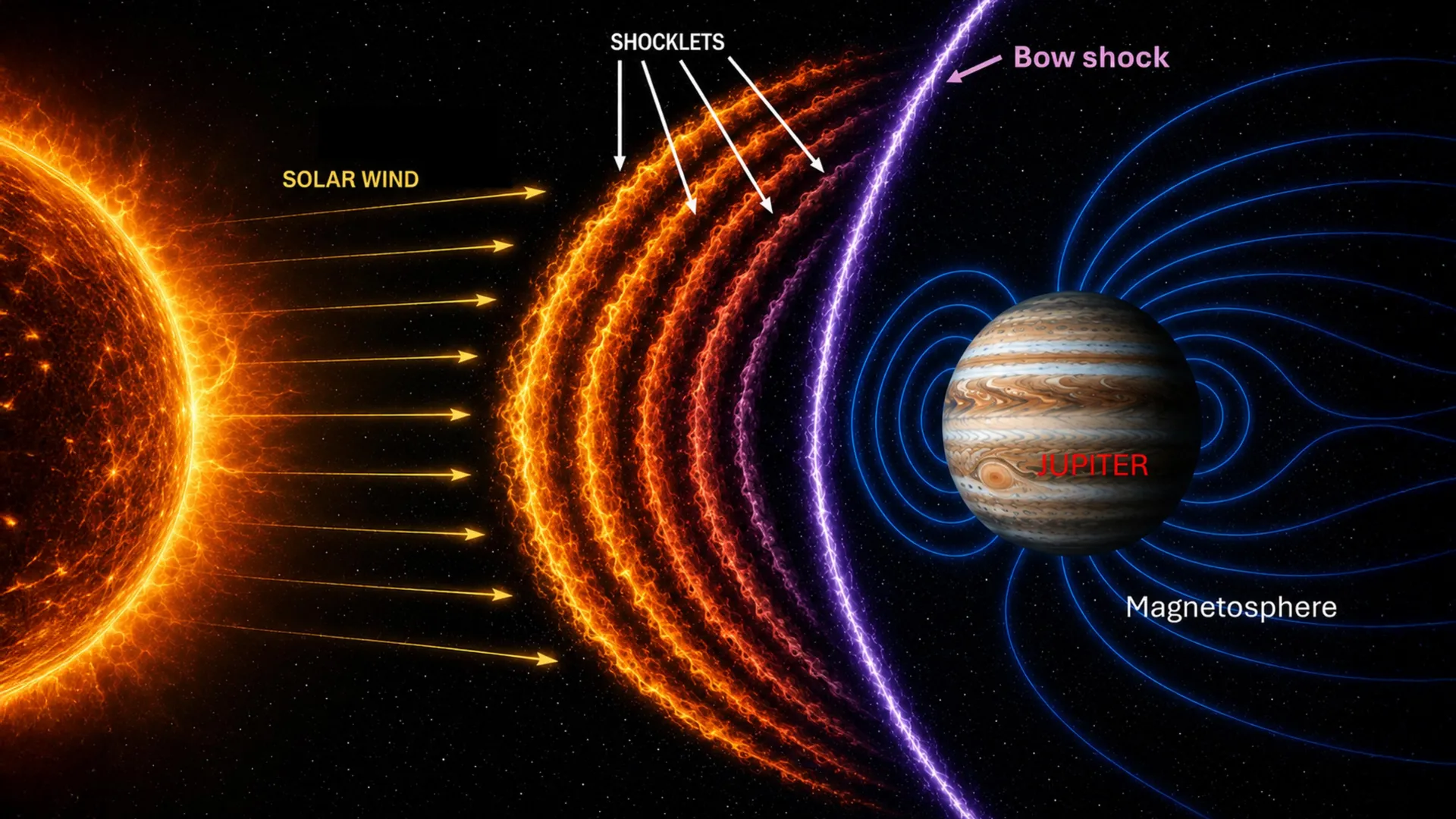
- The planet features smaller structures called shocklets before the main bow shock, providing an extra layer of defense against solar wind.
- These findings offer a natural laboratory to study extreme cosmic shock waves, such as those from supernova remnants.
How Jupiter Protects Itself From the Solar Wind
The Sun continuously releases a stream of electrically charged particles called the solar wind.
At Earth, this boundary plays an important protective role. It slows and heats the incoming particles, helping redirect much of the solar wind around the planet.

Scientists Discover a More Complex Defense System
The process can be compared to music.
Earth’s bow shock, by comparison, primarily uses plasma waves concentrated around a single frequency. That simpler arrangement is generally sufficient for the conditions encountered near our planet.
Jupiter Has an Extra Line of Defense
The researchers identified another striking difference in how the two planets interact with the solar wind. Before incoming particles reach Jupiter’s main bow shock, they can encounter smaller shock structures called shocklets. These additional regions help slow the solar wind before it arrives at the primary shock boundary.
Kurth has participated in NASA’s Juno mission since the spacecraft launched in 2011.
What Jupiter Can Teach Us About Exploding Stars
Although these observations focus on Jupiter, their significance could extend far beyond our solar system. Shock waves occur throughout the universe, particularly in environments where enormous amounts of energy are released.
These cosmic shock waves are vastly more powerful than those encountered near Jupiter. However, the physical processes that control how energy moves through plasma share important similarities.
NASA’s Juno Makes Unprecedented Measurements
The breakthrough was made possible by observations Juno collected in December 2024.
Juno’s observations have now provided a much clearer picture of how these waves behave at Jupiter.
NASA provided funding for the research.
